"Prohibition and the Physiological Effects of Alcohol"
Dublin Core
Title
"Prohibition and the Physiological Effects of Alcohol"
Subject
A scientific account of the effects of alcohol during the time of Prohibition.
Description
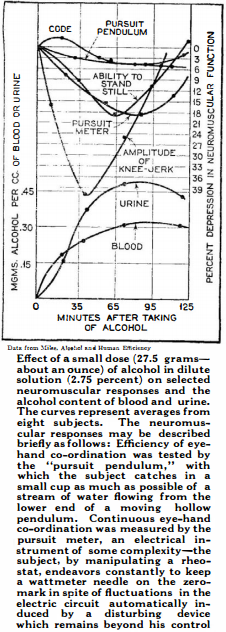
This piece demonstrates an acknowledgement of the negative effects of alcohol, undoubtedly. But surprisingly, it concludes that alcohol clearly has an important place in society, and takes the middle road, believing that it shouldn't be completely illegal, but most assuredly should be regulated amongst consumers. It bears a striking resemblance to what one would see about legalizing marijuana today. It contains experiments tested on things such as motor skills, and considers the psychological effects of alcohol too. Perhaps the most interesting part of the article was its portrayal of the greater social context of (abnormal) psychology: "In so far as the criminal is a psychopath, with an inherited tendency to mental and nervous instability, he is, according to Starling, an especially susceptible victim of alcoholic poisoning." (303)
Creator
H. H. Mitchell
Source
Nature Magazine archive of The Scientific American
Publisher
The Scientific American
Date
October 1930
Contributor
Elinor Hayes
Rights
rights unknown
Language
English
Type
Magazine article
Files
Collection
Citation
H. H. Mitchell, “"Prohibition and the Physiological Effects of Alcohol",” HistoryStudent—Omeka Sites, accessed November 16, 2026, https://schrag.reclaim.hosting/omeka/items/show/108.