Burt's Bees "Your Beauty, Set Free" [Advertisement]
Dublin Core
Title
Burt's Bees "Your Beauty, Set Free" [Advertisement]
Subject
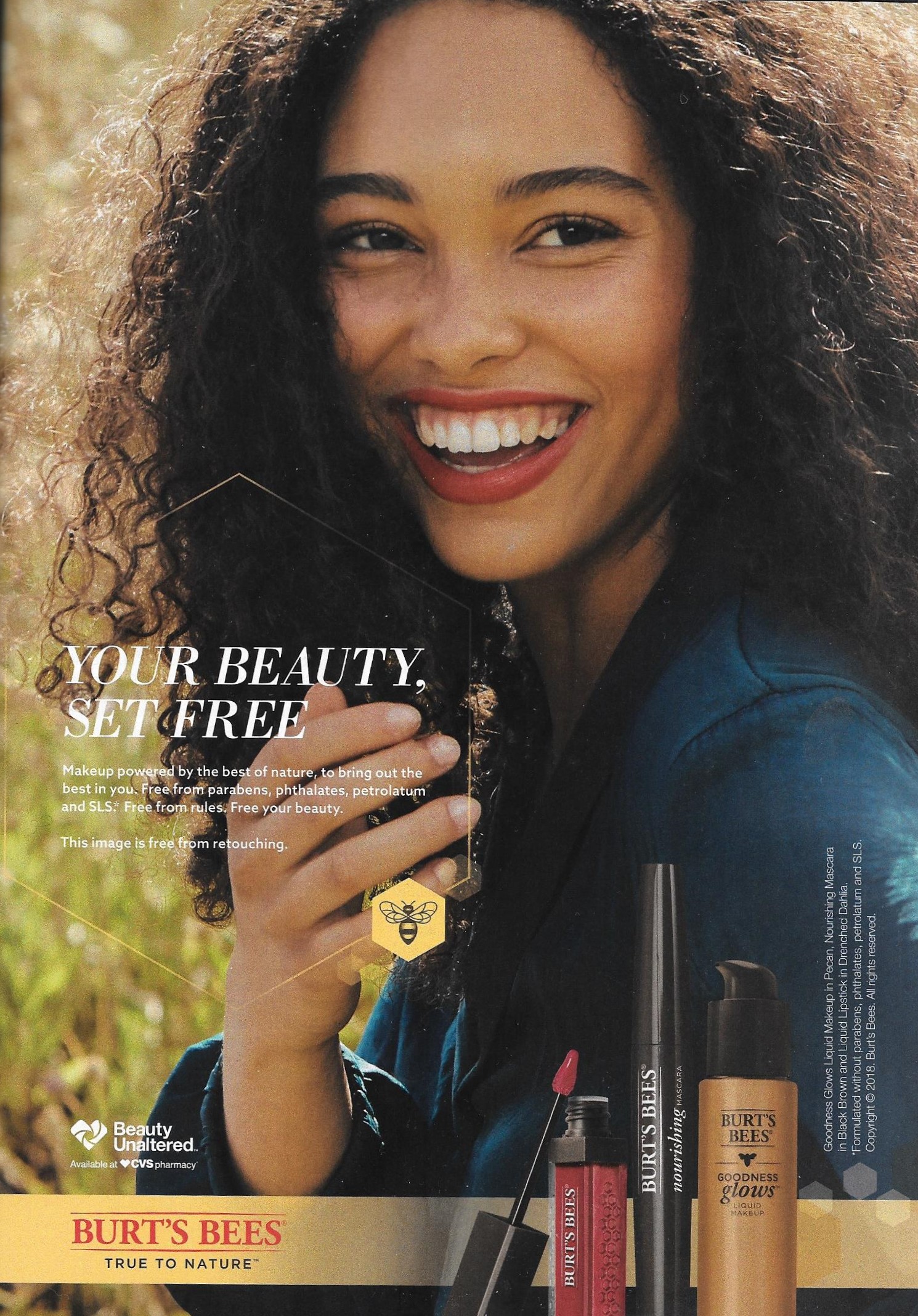
Burt’s Bees Advertisement in Vogue magazine promotes “Natural” and “Clean” beauty.
Description
The Clean Makeup trend is a response to the emergence of cosmetics that utilize additives such as parabens, titanium dioxide, lead, mercury, phthalates, and other potentially harmful ingredients which were to reduce production cost and enhance longevity. Despite knowledge that these chemicals can harm the body, the FDA is not authorized to approve cosmetic ingredients and some are allowed in certain quantities. The clean makeup trend is an example of what the conscious consumers want shaping the technology of cosmetics. Burt’s Bees is capitalizing on this trend by using this advertisement in a magazine targeted towards fashionable and beauty-conscious women.
Additionally, the Burt’s Bees advertisement sheds light on the oxymoron that is no-makeup makeup, or using makeup to enhance features while having it look like no makeup was used. On one hand, this trend can build body positivity through making the models seem more relatable and as having beauty be achievable. On the other hand, it still promotes the use of cosmetics to appear more attractive and the ultimate goal of the company is to sell product, not to challenge the definition of beauty as what the Body-Positivity Movement focuses on. Another note on this trend is that the models, despite having freckles or wrinkles which are not edited out, are still conventionally attractive by the European beauty standard. Other advertisements in this issue of Vogue also promote achieving “natural beauty” through the use of their cosmetics. For example, there is a three-page spread by L’Oreal disguised as a Vogue article advocating against the use of editing software and for the use of no-makeup makeup as the preferred alternative to visible makeup (colorful eyeshadow or liquid liner). The next step in technology is to figure out how to make these clean and natural products that are effective and are able to last a long time on the face.
Additionally, the Burt’s Bees advertisement sheds light on the oxymoron that is no-makeup makeup, or using makeup to enhance features while having it look like no makeup was used. On one hand, this trend can build body positivity through making the models seem more relatable and as having beauty be achievable. On the other hand, it still promotes the use of cosmetics to appear more attractive and the ultimate goal of the company is to sell product, not to challenge the definition of beauty as what the Body-Positivity Movement focuses on. Another note on this trend is that the models, despite having freckles or wrinkles which are not edited out, are still conventionally attractive by the European beauty standard. Other advertisements in this issue of Vogue also promote achieving “natural beauty” through the use of their cosmetics. For example, there is a three-page spread by L’Oreal disguised as a Vogue article advocating against the use of editing software and for the use of no-makeup makeup as the preferred alternative to visible makeup (colorful eyeshadow or liquid liner). The next step in technology is to figure out how to make these clean and natural products that are effective and are able to last a long time on the face.
Creator
Burt's Bees
Source
Vogue February 2019 Issue
Publisher
Vogue
Date
February 2019
Contributor
Megan Le
Type
Advertisement
Still Image Item Type Metadata
Original Format
Magazine Paper
Files
Collection
Citation
Burt's Bees , “Burt's Bees "Your Beauty, Set Free" [Advertisement],” HistoryStudent—Omeka Sites, accessed November 16, 2026, https://schrag.reclaim.hosting/omeka/items/show/287.