Lolita
Dublin Core
Title
Lolita
Subject
Movie of a middle-aged college professor becomes infatuated with a fourteen-year-old nymphet.
Description
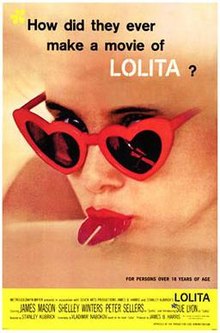
Lolita (1962) tells the story of Humbert Humbert, a middle-aged academic, who develops a sexual obsession with a young girl, Dolores Haze (called Lolita by Humbert). This movie was based on a 1955 novel of the same name. Marketing of the movie exploited its own controversy over hebephilia through the use of the tagline, “How did they ever make a movie of Lolita?” above a suggestive photo of actress Sue Lyon as Lolita. In this image used for promotional purposes, Lolita’s body is edited out leaving her face and arms bare thus suggesting nudity. She appears with red heart-shaped sunglasses, red lipstick, and holding a red lollipop up to her lips. These pops of red stand out, drawing the viewer to become intrigued about her. The movie, told through Humbert’s perspective, paints her as the encapsulation of the maturity of womanhood mixed with the innocence of childhood. However, her appearance of maturity is a performative act achieved by wearing makeup, clothes, and demeanor. These performative acts of womanhood combined with her precociousness leads her to men who apply toxic masculinity to objectify her.
This movie gives an insight into attitudes about sexuality, age, and agency during this time period. Lolita perpetuates the connection between sexuality and makeup as well as ideas of toxic masculinity. It shows an alarming trend in film of older men preying over underage girls using the excuse of “the child’s maturity” to justify their behavior. This is also portrayed in Pretty Baby (1978) where a young girl works as a prostitute, wears heavy makeup, and is used as an object of men’s pleasure. However, maturity and womanhood can be performative play. Makeup, in the case of Lolita, is shown as both a carefree, explorative act, misinterpreted through the lens of toxic masculinity as consent and maturity. The use of cosmetics, seen before as an indicator of a sexual availability, when worn by a prepubescent child, confuses men sexually as they subscribe their preconceived idea of makeup and maturity to the child. This confusion and controversy it brings urges society to learn that makeup is not solely for the male audience, but rather a personal expression of femininity. However, the viewers aren’t given the viewpoint of the girls.
This movie gives an insight into attitudes about sexuality, age, and agency during this time period. Lolita perpetuates the connection between sexuality and makeup as well as ideas of toxic masculinity. It shows an alarming trend in film of older men preying over underage girls using the excuse of “the child’s maturity” to justify their behavior. This is also portrayed in Pretty Baby (1978) where a young girl works as a prostitute, wears heavy makeup, and is used as an object of men’s pleasure. However, maturity and womanhood can be performative play. Makeup, in the case of Lolita, is shown as both a carefree, explorative act, misinterpreted through the lens of toxic masculinity as consent and maturity. The use of cosmetics, seen before as an indicator of a sexual availability, when worn by a prepubescent child, confuses men sexually as they subscribe their preconceived idea of makeup and maturity to the child. This confusion and controversy it brings urges society to learn that makeup is not solely for the male audience, but rather a personal expression of femininity. However, the viewers aren’t given the viewpoint of the girls.
Creator
Stanley Kubrick (Director)
Source
Publisher
A.A. Productions Ltd
Date
21 June 1962
Contributor
Megan Le
Rights
A.A. Productions Ltd
Format
Video
Type
Movie
Files
Collection
Citation
Stanley Kubrick (Director) , “Lolita,” HistoryStudent—Omeka Sites, accessed November 16, 2026, https://schrag.reclaim.hosting/omeka/items/show/421.