Tattooing in the Marshall Islands
Dublin Core
Title
Tattooing in the Marshall Islands
Subject
Tattoos in Pacific Island Cultures, pre-contact
Description
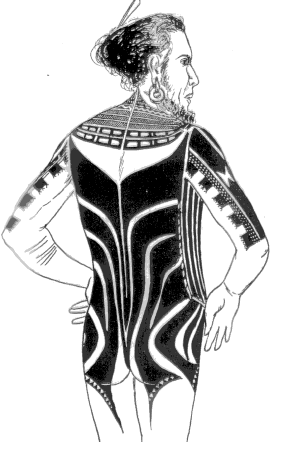
This article and collection of volumes attempts to discuss the finding and cultural reasons behind tattooing in the Marshall Islands. By the time in which Captain Cook made it to the Marshall Islands, tattooing had for the most part been considered taboo among regular European society due to the rules of Christianity. Tattoos were seen among the sailing crowd but they were an exemption to societal norms at time. Additionally, when Cook and his men first stumbled upon the tattoos in the Marshall Island, they had never seen such full body tattoos before or the cultural meaning behind them. In fact today’s term “Tattoo”, comes from the Polynesian word tatau. For the Marshall Islanders, and many other Pacific island cultures, tattooing was “was a simple -- though painful -- fact of life” and was a right of passage for both men and women. While tattoos helped initiate people into full members of islander society, tattoos among the islanders were interestingly enough used as decorations to link the body to dress.
Creator
Dirk HR Spennemann
Source
http://marshall.csu.edu.au/Marshalls/html/tattoo/t-intro-test.html
Publisher
Digital Micronesia
Date
1998
Contributor
Caleb Hudzik
Type
Website
Text Item Type Metadata
Text
Rarely has an artform found so diverse evaluations as tattooing. The ancient Greeks, who considered everyone non-Greek as barbaric, observed and condemned tattooing among the "barbaric" Thracians and Scythians, and the ancient Romans observed it among Gauls, Britons and Germans. The Romans also tattooed (marked) slaves and convicted criminals and regarded tattooing as a mark of low estate. Early Christians had borne the sign of the cross as a tattoo, but when Emperor Constantine I. made Christianity the official religion of Rome (A.D. 325) he banned tattooing. After the advent of Christianity in these areas, tattooing was also forbidden in central and northern Europe. [1]
In the opinion of the public of modern westernized societies tattooing still has an infamous reputation: more often than not the mental image of tattooing is connected with what are perceived to be societal fringe populations, such as sailors, motor cycle gangs, circus artists, prostitutes and "jailbirds". Most of this stigma stems from historic roots: [2] the bible forbids tattooing as such;[3] and tattooing to mark and number convicts, used as early as Roman times, was wide-spread practice in 19th century British and American penal systems and attained more recent infamy during the Nazi period where Jews delivered to concentration camps were thus marked.[4]
Yet, on the other hand, almost all early European visitors to the South Seas, beginning with Cook's visit to Tahiti, found tattooing most intriguing. The English word "tattoo" is in fact a loanword from the Polynesian word tatau. [5] European visitors saw the Marshallese tattoos as "eye capturing" [6] and some, such as Adalbert von Chamisso, even desparately ventured to attain such body markings. In his eyes, "tattooing neither covers nor disfigures the body, but rather blends in with it in graceful adornment and seems to enhance its beauty". [7]
Following such enthusiastic reports from the South Seas, tattooing became for a short while rather fashionable in the age of romanticism, both in England and continental Europe, and a number of illustrious high-ranking people obatined tattoos. In the late 19th and early 20th century tattooes then became wide spread in some trades and professions. [8]
For Pacific Islanders of the pre-contact period tattooing was a simple -- though painful -- fact of life, for both sexes a major step towards becoming a fully accepted member of society. In contrast to Europeans, where dress and body are seen as separate entities and where the tattooes consist of mainly isolated pictures rather than whole body compositions, Oceanic tattooes are intrisically linked to the body they decorate and the dress which covers that body.
In traditional Oceanic cultures tattooing is closely connected to the social and spiritual custom of a population. [9] The motif complex utilised by prehistoric and historic populations in the Pacific covered several art forms, ranging from bark cloth, rock art, pottery (where extant) and wood carving/painting to body ornamentation. In all cases the ornament set was seen as a group identifier, classifying the bearer as distinct from strangers and regional neighbours; [10] it was an visual expression of being Tongan, Marshallese, Gilbertese, In addition, it functioned as an identifier of subgroups within a population, such as distinguishing chiefly from non-chiefly people. [11]
Body ornamentation comes in three forms: body painting, i.e. the application of paint or mud; pigment tattooing, i.e. the application of pigment under the epidermis; and scar tattooing, i.e. the piercing, slicing or burning of the skin to cause a scar, thus creating a three-dimensional ornament. While body painting is a reversable ornament, the latter two are permanent. All three methods of body ornamentation are common in Oceania and especially Micronesia, although only pigment tattooing, and--to a very small degree only--scar tattooing were practised in the Marshall Islands.
Files
Collection
Citation
Dirk HR Spennemann, “Tattooing in the Marshall Islands,” HistoryStudent—Omeka Sites, accessed November 16, 2026, https://schrag.reclaim.hosting/omeka/items/show/80.