Lorgnette Patent
Dublin Core
Title
Lorgnette Patent
Description
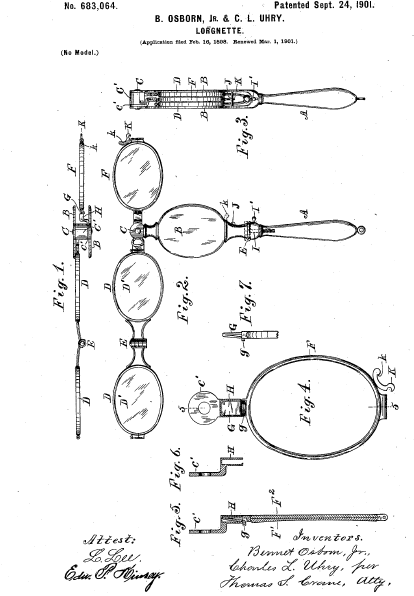
In 1898, Bennet Osbourn and Charles Uhry filed a patent to improve and expand the capabilities of a popular style of hand-held eyeglasses called the lorgnette. Originally, the lorgnette was designed to simply correct for nearsightedness or be used as a cosmetic accessory. However, these two men believed the users of this device would benefit greatly from having the additional functions of magnification and reflection. To accomplish this, the inventors added an “auxiliary frame” to hold another lens that would act as a mirror or reading-glass, depending on the user’s choice, as well as maintaining the convenient portability of the foldable case. These features would increase the attractiveness of the lorgnette, as people – especially women – could now surreptitiously check their appearances in public; for those with farsightedness or generally weak vision, the addition of a magnification lens would help with reading and be an alternative to the bifocal.
Creator
Bennet Osborn, Jr. and Charles L. Uhry
Source
Google Patents
Date
16 February 1898 (Filing Date)
Contributor
Nick Jain
Type
Patent
Identifier
US683064A
Text Item Type Metadata
Excerpt
“In either case the functions of the [lorgnette] are very limited; and the object of the present invention is to enable the instrument to perform the additional function of a mirror or reading-glass, which We effect by jointing an auxiliary frame to the pivot within the case and providing the same With a glass adapted for reading or one for reflecting, as a mirror.”
Files
Collection
Citation
Bennet Osborn, Jr. and Charles L. Uhry, “Lorgnette Patent,” HistoryStudent—Omeka Sites, accessed November 16, 2026, https://schrag.reclaim.hosting/omeka/items/show/383.