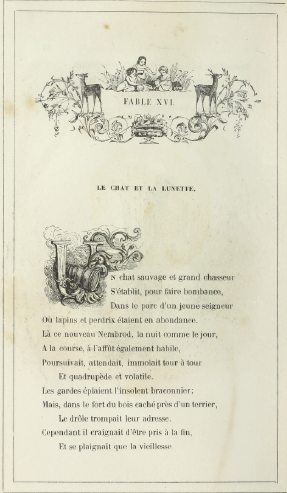
Le Chat et la Lunette
Dublin Core
Title
Le Chat et la Lunette
Description
In 1838, the celebrated French poet Jean-Pierre Claris de Florian conveyed numerous lessons through a fable involving an unwary cat discovering a pair of opera glasses, the successor of the lorgnette. The cat, hunting in a guarded section of a lord’s house, uses the opera glasses to “enhance” his weakened vision in order to better spot his prey and avoid detection; however, he unwittingly reversed the ends of the tool to accomplish these tasks. Ultimately, the cat overestimated his prey’s proximity, thus alerting it to his presence, and failed to escape the guard because of underestimating his proximity. This passage emphasizes the abilities of the opera glasses through the cat’s folly, which were intended to magnify faraway objects such as in a theater (but could also create an illusion of extra distance if viewed through the opposite end). Florian presents his argument in concluding the fable, warning readers that they may suffer if they blind themselves to potential risk when focusing on desire.
Creator
Jean-Pierre Claris de Florian (Author); Victor Adam (Illustrator)
Source
https://babel.hathitrust.org/cgi/pt?id=uiuo.ark:/13960/t2w42rp13;view=1up;seq=80
Date
1838
Contributor
Nick Jain
Rights
Public Domain
Language
French
Type
Poem
Text Item Type Metadata
Excerpt
English Translation: “We see over there what we displease/ We see here what we desire.”
Files
Collection
Citation
Jean-Pierre Claris de Florian (Author); Victor Adam (Illustrator), “Le Chat et la Lunette,” HistoryStudent—Omeka Sites, accessed November 16, 2026, https://schrag.reclaim.hosting/omeka/items/show/410.