Alcohol - Present
Introduction
In the present era, alcohol can be seen at almost every social gathering. Alcohol also is becoming available in a widening variety of options, as seen with the development of gluten-free, flavored, non alcoholic, and specialty alcohols.
If alcohol comes in such a large variety, then why do people choose to drink it? What does the variety show about the meaning of alcohol? What do current advertisements show about what the present era values with alcohol consumption? There is also varied social groups that place different values on alcohol; this is particularly seen when considering the many different intended audiences that advertisements target.
The "present" when discussing the innovation of a topic is oftentimes a fickle concept. Rather than exploring the social implications of alcohol based on a mere number of years, it was decided to instead view the innovation of alcohol within the greater context of consumer patterns in the twentieth and twenty first centuries. Therefore, the present period being discussed can range anywhere between afer Prohibition to 2016-- a time period in which "Big Beer" (a term describing mass quantities of similarly tasting beers, such as Budweiser, Miller, and Coors) was the preferred beer to consume. But as we move on towards the end of the Present page, it will become apparent that a new niche for craft and microbrews has been carved out. The debate between big beer and craft ale is certainly lively, as seen by the article in GQ by Chef David Chang proclaiming "I Hate Fancy Beer" (1) and brewmaster Garrett Oliver's response "I Hate Crappy Beer (2)." This demonstrates how the beer industry is currently evolving, which will be briefly discussed presently and morein-depth in the Future section of our presentation.
1. David Chang, "My Name is David Chang, and I Hate Fancy Beer," GQ Magazine, 11 September 2014, http://www.gq.com/story/david-chang-cheap-beer.
2. "My Name is Garrett Oliver, and I Hate Crappy Beer," GQ Magazine, 11 September 2014, http://www.gq.com/story/garret-oliver-crappy-beer.
Marketing Strategy & Public Perception

Alcohol advertisements tell us a lot about societal vales and these ads also use many different tactics to appeal to consumers. This advertisement for Brazilian Nova Schin Non Alcoholic beer says so much about our modern societal values. It's a commentary on beauty standards, the sexualization of women, and the vice of drinking alcohol. Some might argue that this advertisement is empowering to women, especially pregnant women because the woman pictured is pregnant and still beautiful, and can still drink beer. However, this ad is supporting an almost unachievable beauty standard for women, especially pregnant women. Some might also find it offensive that this ad sexualizes the beauty and magic of pregnancy, and also draws humor from an image of a pregnant women jeopardizing the safety of her unborn child by drinking beer that is not obviously non-alcoholic. This ad even goes as far as to encourage alcoholic pregnant women to hold on to their vice of drinking.
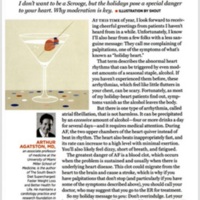
This article from a 2008 edition of Prevention Magazine highlights traditional American consumption of alcohol during the winder holiday season. The article is written by a medical doctor, Dr. Arthur Agatston, who discusses a health concern that is commonly reported during the winter holidays. He explains that many patients complain of heart palpitations or pressure/tightness in the chest. He warns that these are symptoms of excessive alcohol consumption, and that even moderate amounts of the "holiday staple" can lead to a potential hospital visit. According to Agatston, four or more drinks a day for several days can lead to blood clots and possibly strokes. The article gives the reader insight into the cultural uses of alcohol, particularly celebration. It also gives the reader an insight into the cultural tendency to overindulge in this celebratory drink, as well as the health risks associated with this overindulgent behavior.


"The most interesting man in the world" has become a well known advertisement character in the 21st century. He is always shown doing interesting things, surrounded by beautiful women, and drinking Dos Equis beer. This advertisement shows that in the present era, alcohol plays an important role in social gathering and individual characters.
This advertisement campaign also plays around with the modern definition of masculinity. It shows that a man's identity is reliant on the type of beer he drinks.
However, masculinity and sexuality are not the only defining characteristics of modern beer advertisements. Budweiser has taken a decisive turn away from the allure of promiscuity and the perpetual "bachelor" in order to cater towards a more family-friendly audience. While it is obvious that the relevant social group between both Dos Equis and Budweiser is one and the same on a general level (the potential consumer), the subcategories are vastly different. While Dos Equis portrays alcohol as a means to sexualize the life of the bachelor, Budweiser does just the opposite. The placement of the dog in the advertisement leads to an increase in the "heuristic processing, concurrent processing, and ultimately attitude toward the ad," (1) thus creating feelings of nostalgia, togetherness and family bonds.
These different targeted ads demonstrate the difference in relative social groups (bachelors vs. families), and also that the consumption of beer is experienced differently by these contrasting social groups in modern society. Interestingly enough, in these cases, they promote opposing experiences: while Dos Equis encourages one to "stay thirsty" and preserve one's youth through thrilling experiences (namely implying promiscuity), Budweiser actually glorifies the "family man" on a farm, tending to the responsibilities of the animals (as seen by the male character in the commercial). It is the duality of the presentation of beer in these advertisements that demonstrates the duality of alcohol in modern society-- it can both imply sex AND friendship. Now that society is shifting its gaze from mass consumer products that Americans simply trusted based on brand recognition to "artisan" foods with a more individualized flair, which will be discussed in the "Future" section. (2)
1. Karen M. Lancendorfer, JoAnn L. Atkin, and Bonnie B. Reece, "Animals in advertising: Love dogs? Love the ad!," Journal of Business Research, Elsevier, May 2008.
2. Dominick Celentano, "Artisinal Food Products are Reflective of a Consumers Backlash," The Balance: Food and Beverage, 6 October 2015.
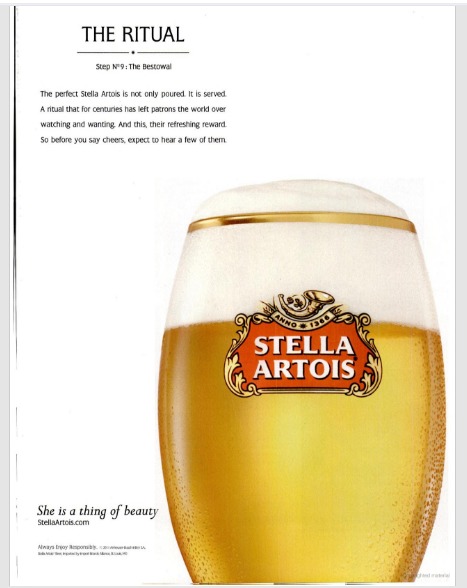
The following advertisement seeks to answer and shed light as to why people consume and purchase beer, particularly Stella Artois. As the ad suggests, Stella Artois is not simply just a beverage that should be quickly poured and drank. However, it remains a process in which one slowly "serves" and savors the "refreshing taste" of the beer. Moreover, the marketing does not only target the beer itself, however remains in conjunction with the glass it's being served in. As Kranzberg's third law suggests: "technology comes in packages, both big and small"(549). The advertisement not only seeks to "cheer" and glorifying the tasteful, but is also tied to the glass branded with the Stella Artois logo. Altogether, the ad seeks to market the two together in an indistinguishable partnership in which the consumer should purchase. Not only does the consumer need to enjoy the taste of the beer in a slow, appreciative, and "ritual" like way, but also must utilize the glass as well to fully understand the "beauty" and taste of Stella Artois.
Continuing, Stella Artois calls the beverage a "thing of beauty" which in turn sexualizes and thus sensationalizes the product. During the present time, advertisements often gender-label particular technologies in order to target particular social groups. For instance, the ad implicitly wants to target male social groups, as it is emphasizing Stella Artois "attractive" and "beautiful" nature. This ad ultimately reinforces the masculine nature of purchasing and enjoying a "thing of beauty." Ads within this present time often rely on the sexualization of their products in order to drive their consumers to continue purchasing their technologies. Concluding, the advertisement sought to reinforce the slow, steady, and "ritual" like manner in which one should enjoy an alcoholic beverage provided by Stella Artois. Due to its attractive nature, especially in conjunction with the glass it is being served in, the brand thus seeks to target specific social groups, in this case males in particular, to encourage their consumers to purchase their product.
Changing Preferences
Over the course of time individuals preferences towards consuming alcohol has changed. Whether that maybe because of the brands they wish to consume, the different types of products to join the market, or because they are following the trends that have emerged in society. The reality is that preferences have changed and the shift in interest of consumers has sought congress to grant equal protections to the suppliers.
How have preferences changed?
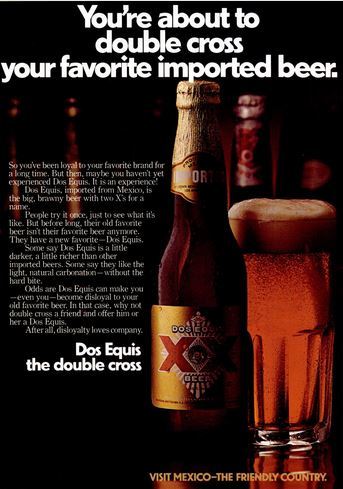
First and foremost it is important to note that preferences for different types of alcohol changes based on the geographic location, products available and the individuals consuming it. For the purpose of this research, we are looking at the shift of preferences within the United States. The United States like many countries is an importer of foreign beers and an exporter of domestic beers. For many years (and some still do), foreign beers have run advertisements harping on brand loyalty. For example, on the left is an advertisement placed in New York Magazine that ran in 1976 by Dos Equis. You may recognize the brand now with their newer, modernized campaign, 'the most interesting man in the world'. In 1976. the Mexican beer brand was not well known in the United States but had begun to gain some ground shortly after. The purpose of them running the advertisement was to have individuals double cross their preferred choice and try something richer in taste. For a long time, post-prohibition, beer manufacture's marketing teams have tried to market their beer over those of their competitors. According to a December 2012 report published by the Beer Institute, Americans consumed an estimated 6.3 billion gallons of beer that past year. The reasons for individuals consumption is discussed above but what is important to note is that the consumption focuses on the main brands of beer that you see when walking through the isle at a supermarket. It is important to note when the report was published and till this day the consumption of beer in the United States in relation to the rest of the world has continued to decrease.
The decrease is attributed to different products entering the market such as craft beer and gluten-free alternatives. Craft Beer along with other alcoholic productions made in smaller batches or those made with local ingredients are the most popular amongst those considered to be millennial's. According to the Brewers Association, traditional marking and advertisement from major manufactures does is not considered attractive to this group of individuals, they'd prefer to have something local and of high quality (1). As more and more individuals cross over the threshold of turning 21, the number of people consuming craft beer is on the rise, sales of craft beer reflect this statistics with an increase in sales around 20%.
Preferences have changed but not across the board. While there is this shift leaning towards Craft Bear which is very popular amongst millennials and some older than them, consumption of big distribution beer's has decreased as less people have begun to drink it. The loss of those individuals is not directly correlated with the higher number seen with smaller distributors. However, due to the recent spike of more individuals consuming craft beers and other beverages from smaller distilleries. This social trend especially amongst younger consumers has given power to the smaller distilleries saying they should be valued just as much as their larger counterparts. That's exactly what happened with the 'Craft Beverage Modernization and Tax Reform Act of 2015'. which took over a decade to reach bipartisan support.
1. "6 Characteristics of Millennial Beer Drinkers You Need to Know - Brewers Association." Brewers Association. Brewers Association, 09 Oct. 2015.
Congressional Action Based on Changing Preferences
In the book the Social Construction of Technological Systems, Trevor Pinch and Wiebe Bijker discuss the importance of considering social groups and the impact that relevant social groups have in the development of the technology. With the start up of craft beers in the early 2000's it has continued to progress nationwide as a growing trend. It success has been linked to grasping the customer base of individuals cross the line of the legal drinking age. Because of the large demand, suppliers have been able to have lobbyist fight for their rights on Capital Hills. In a way consumers have decided how they want the technology catered to their needs (local and small batches as opposed to industrial scale) are the reason microbreweries and distillers have the support they do.
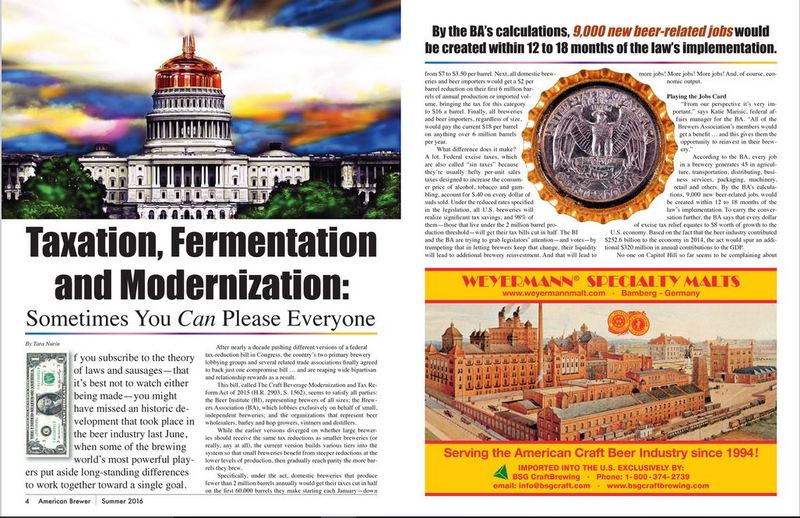
The 'Craft Beverage Modernization and Tax Reform Act of 2015' took almost over a decade of legislation and lobbying before bi-partisan support was reached this summer which passed the bill. According to the article published in American Brewer, Taxation, Fermentation, and Modernization: Sometimes You Can Please Everyone, Tara Nurin discusses the impact that this bill has on various distillers but does note that all groups were compensated in one way or another. A big win is for small distillers, breweries, and local growers that "produce fewer than 2 million barrels annually would get their taxes cut in half on the first 60,000 barrels". It is important to note that there is no minimum number of barrels that need to be produced in order to for suppliers to receive this benefit. This incentivizes startups/Kickstarter to take consumer feedback and take risk without risking as much liquidity. Nurin mentions that with the tax cuts, smaller producers will be able to reinvest that extra liquidity back into their product and technology in addition to having the ability to create jobs.
Conclusion
From the perspective of the consumer towards smaller and higher quality products that is discussed in the Brewers Association article this benefits them as well, the product they seek is more expensive but it actually less expensive with the tax cuts which is then reflected in the price. The transition of the decreasing trend in big industrial beer to craft beer and smaller distilleries shows the shift in preference of society. When the product has an impact on the right social group, a change in the technology is possible, whether that is for the better or the worse.
It brings us back to our main question why do people drink? Is it the taste of the product, the various products that can be chosen from or the flavor of those products? With millennials otherwise known as generation 'y' they continue the trend of the changing patterns and reason as those before them since the post-probation era. Follow us on our future page to further understand how these patters will evolve or completely change in the future.