Chairs - Past
Posture vs. Comfort - The "Back"lash
On page 1062 of The Rise and Fall of American Posture, it is stated that “Stuffed seats were [seen as] detrimental to health’ and [...] smacked of [a] lower-class lack of discipline” (Yosifon). Sitting up straight was associated with good character and good health, and failing to do so was seen as nothing short of barbaric.
As early as 1870, the lounge was beginning to be advertised, presenting new opportunities for people to sit with a more relaxed posture. In addition, inventors were beginning to patent adjustable chairs, designed with comfort in mind.
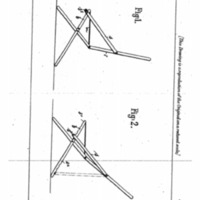
In 1897, Fritz Vogel patented a design for an improved adjustable chair. His patent emphasizes the cross bar that is "fitted with india-rubber sleeves or collars and capable of engaging notches in the legs for the purpose of adjusting the inclination of the back."
Despite this, "...rigid upholstery and established convention held most sitters carefully upright" (Yosifon 1062).
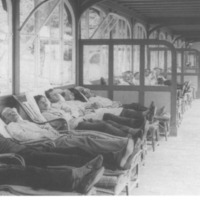
However, by the early 1900s, various types of comfortable furniture, such as loungers, cure chairs, and day beds were used almost exclusively in European sanatoriums. Not only was this comfortable furniture heavily utilized within such institutions, it was also in high demand by them in order to accommodate for the large amounts of tuberculosis patients coming through their doors.
Likewise, as comfortable seating for the unhealthy was becoming commonplace, chairs were also being used in other ways to remove everyday ailments.
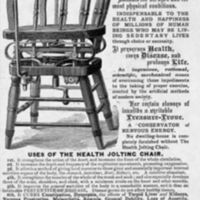
In 1885, Harper's Weekly printed an advertisement for the Health Jolting Chair. It was a hard-backed chair, claiming to be "convenient", "comfortable", and “the most important health mechanism ever produced”.
The comfortable furniture within sanatoriums was used for quite some time. It wasn't until the 1950s that the sanatoriums began to close down, and the furniture began to find applications elsewhere, such as the chaise lounge within the home. At this time, another prominent piece of living room seating was also becoming prevalent--the recliner.
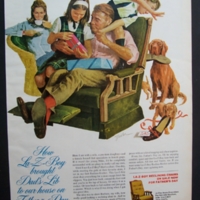
A mid-50's advertisement for Father’s Day showed off one of La-Z-Boy furniture's new products, the Reclina-Rocka. In the advertisement, the father can be seen reclining, with his wife, children, and dog surrounding him. The ad emphasizes the father's need for comfort within the home. This type of ad would not have been published fifty years prior.
Society stigmatized sedentary behavior, believing that it was reserved for the sick and elderly. The asylums' high demand for comfortable seating is best explained by the belief that only the sick and elderly could be afforded the "luxury" to lounge around. Nowadays, reclining and lounging have become more commonplace, but are still associated with laziness, especially when done in large quantities.
Chairs in the Workplace
Although there was backlash to the disappearance of Victorian-era sitting standards, the redefinition of the regality associated with sitting down allowed for more comfortable seating to have a function within the home and society at large. Workplaces were no exception.
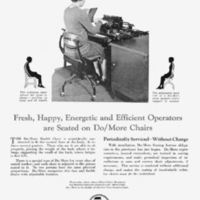
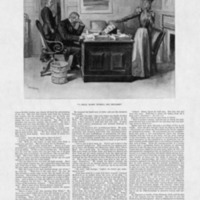
In an early-1900s workplace, seating arrangements without cushions or backs were believed to enhance productivity. However, workers complained about having a variety of health problems due to the lack of support that their workplace seating had. In addition, companies began to notice that workers were actually found to be less productive when given uncomfortable seating. In order to combat these issues, companies began offering more comfortable seating to workers. "Comfortably productive" chairs were favored among workers.



Chairs and Status
However, even as comfort was being highlighted within the home and at work, schools continued to promote the importance of posture in an individual's health and development. In The Posture of Schoolchildren, author Jesse H. Bancroft states that children were taught that bad posture was a waste of energy and detrimental to the functions of the body’s vital organs (2).
While many of the claims about posture were suspiciously pseudoscientific, the book was successful in associating a societally unattractive quality, such as laziness, with bad posture, even if the two were not always connected. This was the result of a larger societal goal--the encouragement of people to sit up straight in order to emphasize their humanity. Good posture was seen as one of the “marked characteristics that differentiate[d] the human race from lower animals” (Bancroft 4).
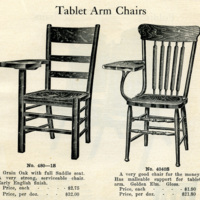
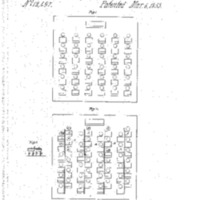
Likewise, to this day, school chairs are designed with subordinance in mind. The chairs are rigid, unadjustable, and shaped for placement in rows. Even though schools are a student's workplace, they have largely resisted the promotion of comfort and ergonomics with their walls. The "one size fits all" desks are tailored and arranged for use in what is supposed to be considered a productive environment. As early as 1855, a patent was granted for an arrangement of school chairs that was designed to make conversation between students inconvenient.
Chairs and Regality
Just as desks are designed to be placed in rows, thrones are designed to showcase the regality of the individual sitting within them. On page 52 of George R.R. Martin’s famous book A Song of Ice and Fire, he states that "Sitting a throne is a thousand times harder than winning one. Laws are a tedious business and counting coppers is worse. And the people….there is no end of them. I sit on that damnable iron chair and listen to them complain until my mind is numb and my ass is raw. They all want something, money or land or justice."
The quote highlights the importance and gravity of thrones. It articulates the correlation between power and sitting that was especially prevalent in ancient cultures, and still remains relatively true today.
For example, in Ancient Egypt, "...depictions of forward-tilt seating appear to be restricted to the nobility, whereas commoners' seats have horizontal seat pans and peasants squat or use roughly hewn wooden stools" (Pynt).
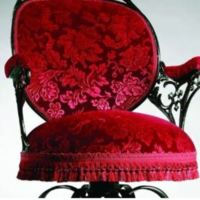
Chair design is one of several factors that ties into the status associated with a particular chair. One advertisement for a colonial rocking chair helped allude to the status associated with chairs. The chair makers assert that the chair is crafted for someone with privilege, indicated by the ornate description of the chair's design.
Design continues to play a role in how chairs are viewed within society. Nowadays, large-backed chairs are associated with a company's CEO while shorter-backed chairs would be used by the employees.
The Rise of the Office Chair
There has been ongoing chair-related research and development for thousands of years. Chairs play an important role in establishing an individual's status and relevance at home, at work, and in society as a whole.
The concerns of the past have carried over into the present, albeit in different forms. However, one of the most extensively-used chairs--the office chair--has been around for less than 300 years.
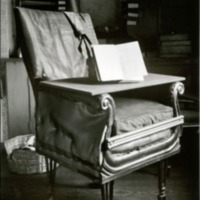
The origin of the office chair parallels Charles Darwins' Origin of Species. Charles Darwin is credited with designing the first office chair, which he described as "a wooden arm chair with wheels". He decided his lounge chair was not fit for his writing, working, and researching, as he needed to have more mobility to be productive.
Darwin's design was officially developed for market by Thomas Warren as the Centripetal Spring Armchair. Warren's design kept the rolling mobility of Darwin's inventive chair, but increased its comfort and fashion to appeal to a broader market.
Conclusion
While comfort is important, different types of chairs have been developed for different purposes in society. Despite this, just as health, status, and productivity were emphasized in the past, similar issues are being addressed and discussed in today's society. Health within the workplace, specifically in regards to ergonomics, has gained increasingly large amounts of attention.