Bicycle Clothing - Past
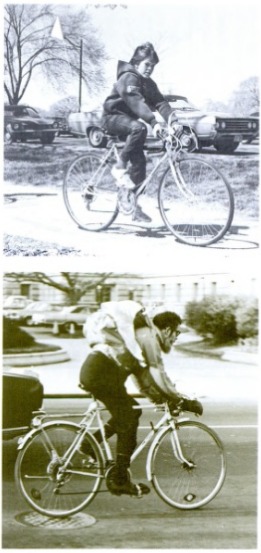

In 1974, the U.S. Department of Transportation advised readers to "make yourself visible Even in daylight, bicycles are hard for a motorist to see. Some aids are: brightly colored helmets, vests or jackets; a red or orange flag on a 6-foot long antenna . . . Use reflective materials liberally on the bike and your clothes if you travel at dusk or after dark." Yet aside from the trouser clips worn by the man in the bottom photograph on page 13, none of the many riders pictured in the booklet appear to be wearing hemets, vests, or any other specialized bike clothing. These photos suggest that such gear was rarely used in the mid-1970s.
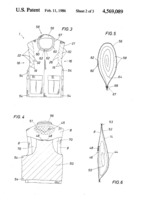
For inventor Gary Neese, who patented a "jacket/vest" in 1984, bicycling was just another outdoor activity, along with "jogging, golfing, skiing, hunting, [and] fishing." Participants in any of these, he believed, could benefit from having a garment that could be adjusted to account for changing weather, or stowed entirely, and from being able to display a large panel of bright or reflective material. Neese did not seek to accommodate special needs of cyclists. For instance, his vest features large pockets on the front, whereas most specialized bicycle clothing features pockets on the back, which are more conventient for wearers who are bent forward over handlebars. Neese's invention does seem prescient in its ability to convert to something less obviously designed for the road. "When the wearer of the jacket/vest is not engaged in outdoor activities," he explained, "the safety panel can be retracted into its storage compartment thereby improving the appearance of the garment." Decades later, designers would still be looking for ways to make bicycle clothing both practical and good looking.
Eric Freeze wore out his pants on a Mormon mission in France. He describes it as such, "We biked until we'd worn fist-sized holes into the crotches of our worsted wool pants, until the patches we hand-stitched onto them fuzzed with pillings and wore through."