Pocket Knives - Present
The pocket knife has a long and varied history, and it is difficult to determine what separates a modern knife from an old one. Even so, one of the most important innovations in pocket knives is the locking folding blade, pioneered by Buck and popularized on the market in 1963. Since then, a wide variety of knives utilize some form of locking mechanism, and this innovation has allowed for new styles of tactical knives, as well as the development of folding knives that have the functionality of fixed blades combined with the convenience of folding knives.
Knives as a Weapon
Pocket knives, like any tool that can be dangerous, have been subject to a large number of regulations. Many, including politicians, have argued that knives are a weapon and have no place in the public’s hand or should be limited in its carry in certain locations. Knives have been targeted due to large scale policy changes, such as post 9/11 security updates. Knives have been targeted specifically for being a knife, but also classified as weapons for their features, such as switchblades and locking pocket knives.
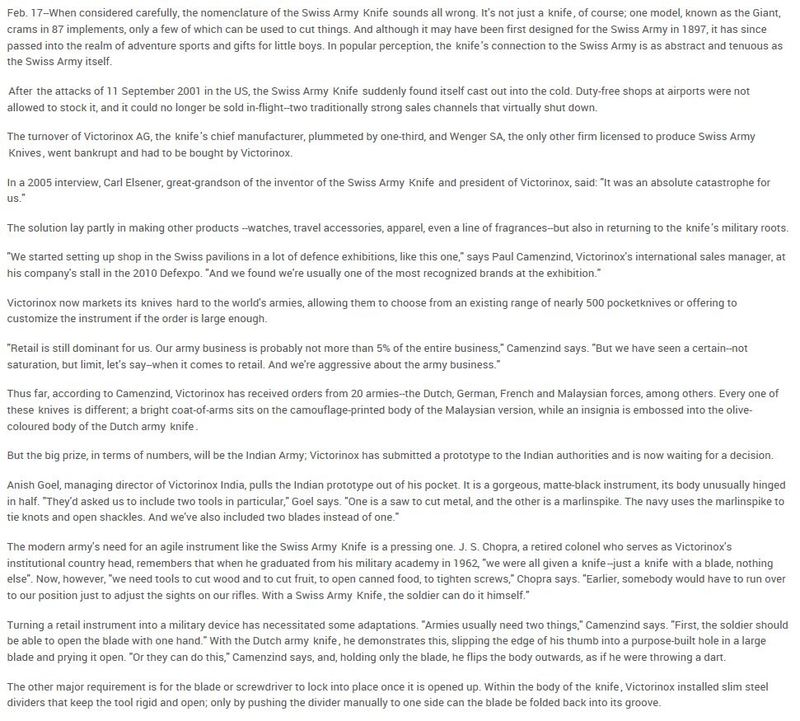
An article by Samanth Subramanian talks about the ramifications of 9/11 on the manufacturers of Swiss Army Knives, and how they have had to adapt to the changes brought about by the event. According to the article, the turnover for Victorinox, the leading manufacturer of Swiss Army Knives, dropped by 1/3. This forced them to look to other areas to sell their knives, because the aftermath of 9/11 saw many consumers reevaluating the role of a pocket knife. Before, Swiss Army Knives were sold at Duty Free stores and on flights themselves, but these two markets were shut down overnight. In response, Victorinox has sought to expand their markets by selling Swiss Army Knives to armies. Over 20 different countries have contracted with Victorinox knives to outfit their troops with Swiss Army Knives. While this only accounts for about 5% of their sales, this still has returned the function of these knives to a military use. As such, some modifications to the traditional knife have been made, including a locking knife blade and a more textured grip. Thus, part of the change in function is to make the knife more “tactical”, and also to diversify the company so that it is resistant to future shocks in the market.
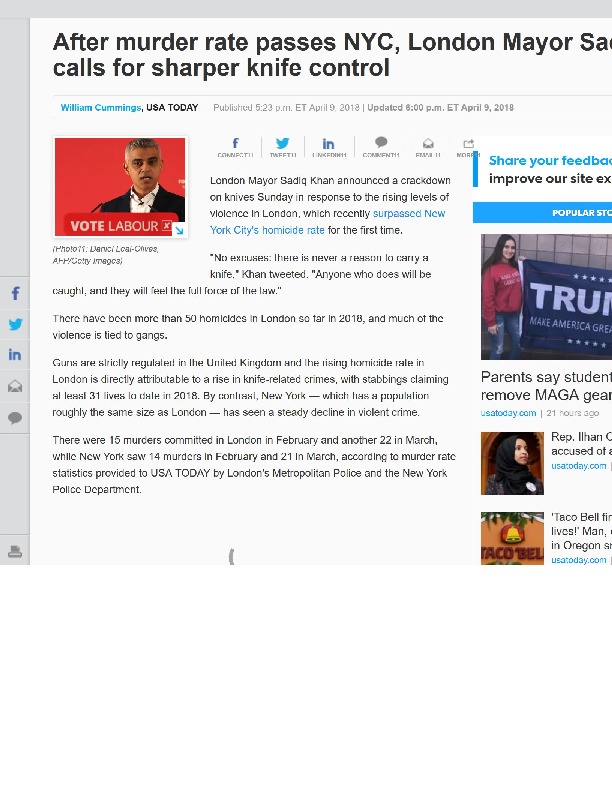
As a response to an increasing problem of knife crime in London, the Mayor determined people don’t need to be carrying knives. He said, “… there is never a reason to carry a knife.” Then Kahn even went on to say that self defense is not a legitimate reason to want to carry a knife. The response by Sadiq Khan is a response that is become common place when attempting to tackle crime. Rather than treating the knife as a tool that was misused, Khan chose to classify the knife as a weapon. Khan, in this case is looking only to one relevant social group, the people who use the knives for a malicious purpose, and ignoring another relevant social group of people who use knives as tool to their detriment.
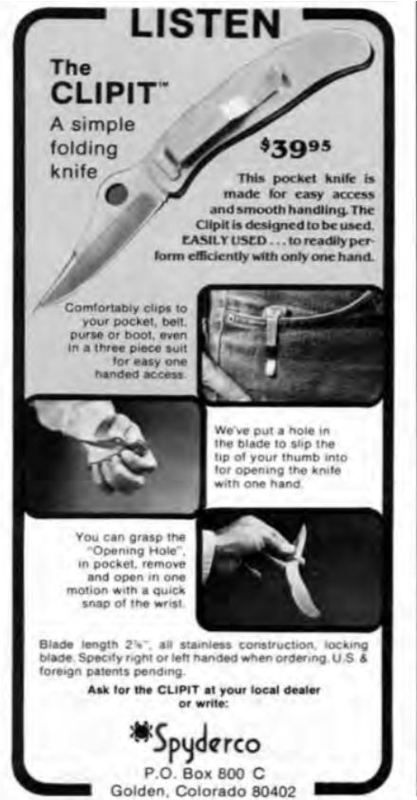
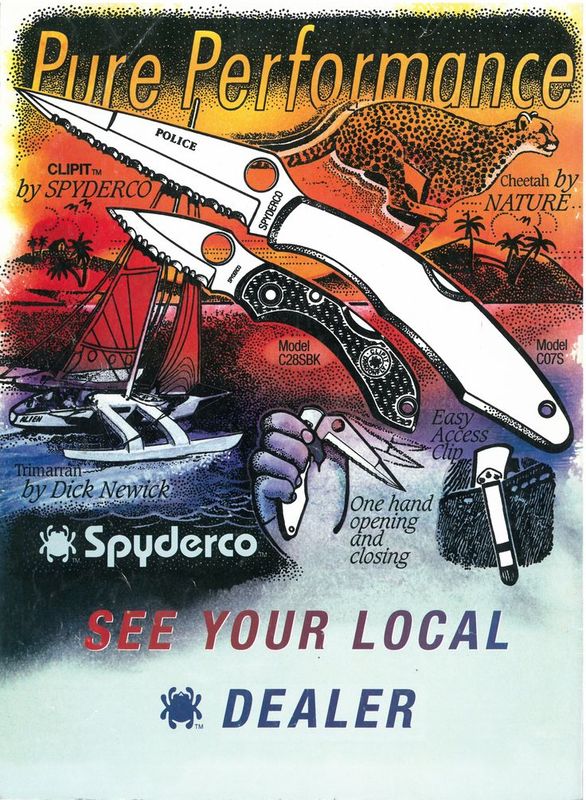
Classifying a knife by its features is an approach that some have used to categorize knives as a weapon. One such knife is the Spyderco Endura Clipit, the first mass market tactical folding knife that was sold. This knife solved a few problems from the police and military community who wanted a knife that could be accessed and opened quickly, as well as be folded comfortably and fit within one’s pocket. This pair of advertisements highlight the two brand new functions that Spyderco pioneered in the early 1980’s including a “pocket clip” for easy access and the “opening hole”, which is a large circular hole drilled through the blade itself, for quick one-handed opening. This design of the pocket clip combined with the opening hole made the first truly “tactical” pocket knife a reality. Following the release of this knife and knives like it, police and military did not have to carry a fixed blade knife and could now use a folding one to the same effect (thanks to Al Buck’s locking mechanism invented two decades earlier). Essentially, the Spyderco Endura Clipit became the first pocket knife with the full functionality of a fixed blade knife. This also revolutionized knife carrying by average citizens for self-defense for the same aforementioned reasons. Because of these new developments, Spyderco actively had to advertise their new knives as complete tactical tools and try to highlight the differences in functionality between the old slip joint knives and their new tactical ones. Especially in the early years of manufacture for these knives, the words “POLICE” were prominently displayed within the advertisements or on the blades themselves in order to show how their knives are to be used as a defensive or tactical weapon. Through these innovations, Spyderco successfully reimagined what a folding knife could be and became one of the premier manufacturers of high-quality tactical knives for use as a weapon. The optimized function of the Spyderco pocket knife was no longer seen as a tool, but as a weapon.
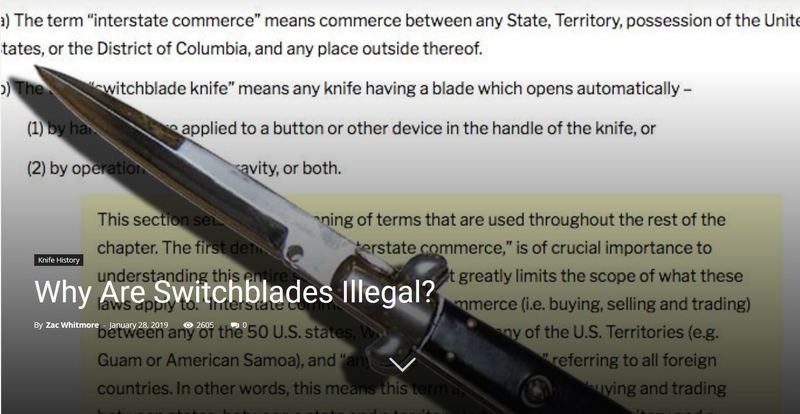
No pocket knife has been more controversial or misunderstood than the switchblade. The article “Why are Switchblades Illegal?” by Zachary Whitmore discusses how what began as a normal knife designed for customers who needed a quick action knife that can be deployed with one hand ended up becoming the be-all-end-all cause for juvenile delinquency and burgeoning gang violence. By the end of the 1950s, a knife which was once sold to Boy Scouts with disabilities had been subject to a federal ban. The author of the article states that the ban was championed by congressmen who wanted to symbolically show their constituents that they were taking a stand on crime, and that many of the statistics that were displayed in favor of the ban were either inflated or untrue. The article concludes by reaffirming that the switchblade is just like any other knife, and has potentially life saving uses for mountain climbers, parachutists, etc… who need a compact portable knife that can be instantly deployed with ease by using only one hand.
The NRA fought for their rights as a result of the reclassification of certain assisted opening folding knives such as switchblades by US Customs and Border Patrol. Being that the two knives are different from each other citizens across the country were enraged by the fact that their knives were being taken away. The original reclassification would only have affect importation of these knives, however the state courts often rely on federal interpretations when applying state knife laws so this had a larger impact. As a result, the NRA joined with the American Knife and Tool Institute and Knife Rights Inc. to take action against congress and lobby. Eventually, on July 9, the Senate made an amendment to the Federal Switchblade Act as part of the Homeland Security appropriations bill.
Knives as a Tool
The single blade and multi-tool folding knives are extremely convenient gadgets able to fit in one’s pocket. Both serve evident purposes as tools in both outdoor events, such as hunting or camping, or indoor tasks, such as tightening a screw or cutting a loose string off of a sweater. Although single blade functions are open to consumer interpretation, multi-tools have a wider array of tools with more specific purposes. Folding knives make appearances in all corners of society, including advertisements, in public, and in the media. In the book, Moby Dick, a pocket knife is described as having multiple tools. It included tools such as corkscrew, screwdriver, tweezers, awls, pens, and even a countersink. This description depicts the myriad of purposes the tool can be used for. While the term "multi-tool" was never used, it was implied. The usage of the term kitchen sink suggests that the tool has everything you need, for any situation.
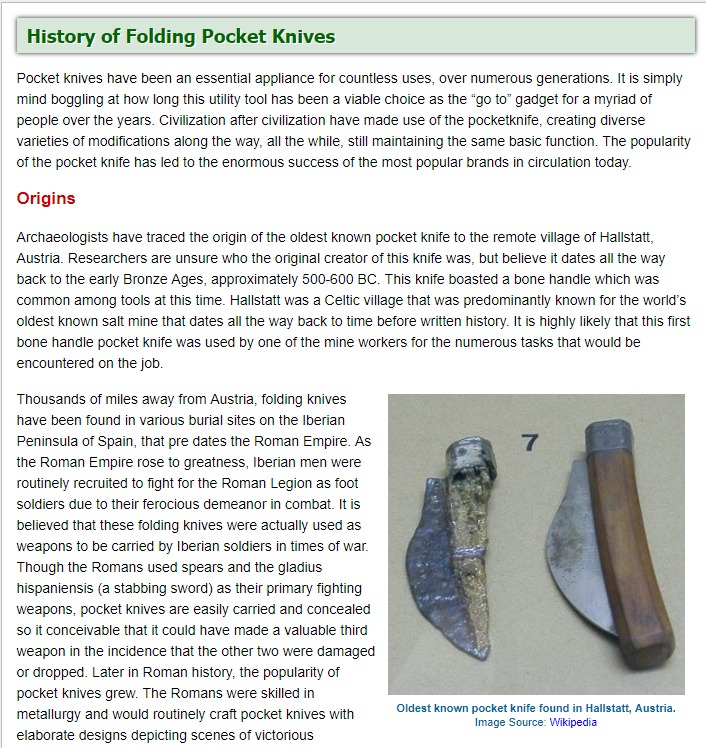
The use of folding knives dates back to the Bronze Age, where they were carried by laborers to serve as tools for menial tasks. The pocket knife in its modern form evolved during the 1600s, when springs were implemented into the folding mechanism. The spring aids the user once the knife has been partially opened by extending the blade the rest of the way. This modification improved the performance not only as a tool, but also as a weapon. Soldiers or thieves could quickly reach for and deploy the blade, as well as conceal it with minimal effort. Spring mechanisms played a large part in the evolution into switchblades, in which the blade extension is triggered with a button.
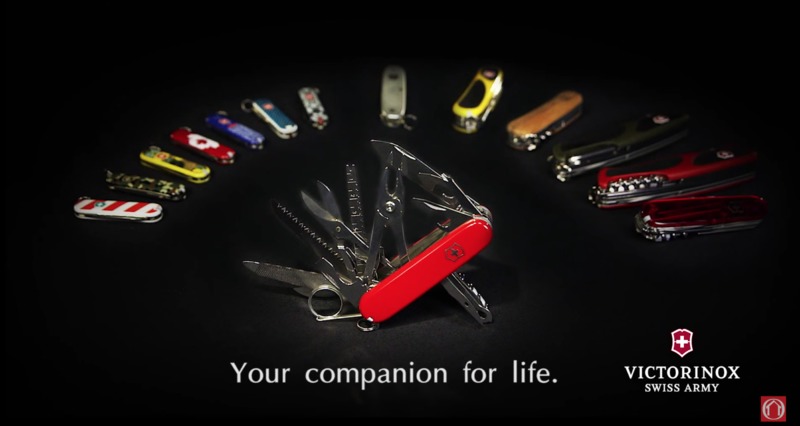
The Victorinox Swiss Army Knife created by the House of Knives distribution company is one of the most widely recognized multi-tools available, even today. The advertisement displayed is a short video that is able to show off the many uses of he knife quickly. The Swiss Army Knife is not just for the outdoor enthusiast, but as seen in the video it is also for an individual with everyday needs. It serves not only people who need access to a knife to cut things, but also people who need a corkscrew to open a bottle of wine, scissors to take the tag off of a fresh pair of pants, and even a pen to write down some important information quickly. The Swiss Army Knife is for all walks of life because it is so versatile. It should be your companion for life, according to their marketing.
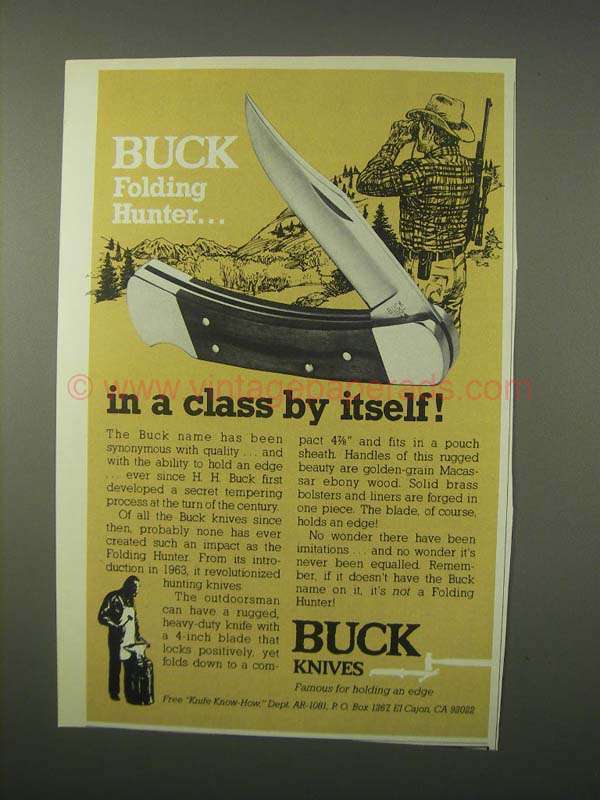
The Buck Folding Hunter knife, which is one of the most recognizable and widely used knives in the world, increased the quality standard for folding knives across the market. This is partly because it was the first commercially available folding knife to have a locking mechanism that would completely lock the knife in the open position. This function allowed the knife to perform the same tasks as a fixed blade hunting knife while preventing unintended closure of the blade. This is an extremely useful feature for consumers, as the locking mechanism could prevent injury and increase the sturdiness of the knife during rigorous use. As the advertisement says, the knife has a four-inch blade, yet folds down to under five inches when not in use. This made it possible to carry a knife that could do all the work of a fixed blade, yet retained the convenience of a folding knife. The ad goes on to say that the Folding Hunter has been imitated a lot since its inception, and it is true that most knives today employ some form of locking mechanism, which was first introduced by the Buck Folding Hunter.
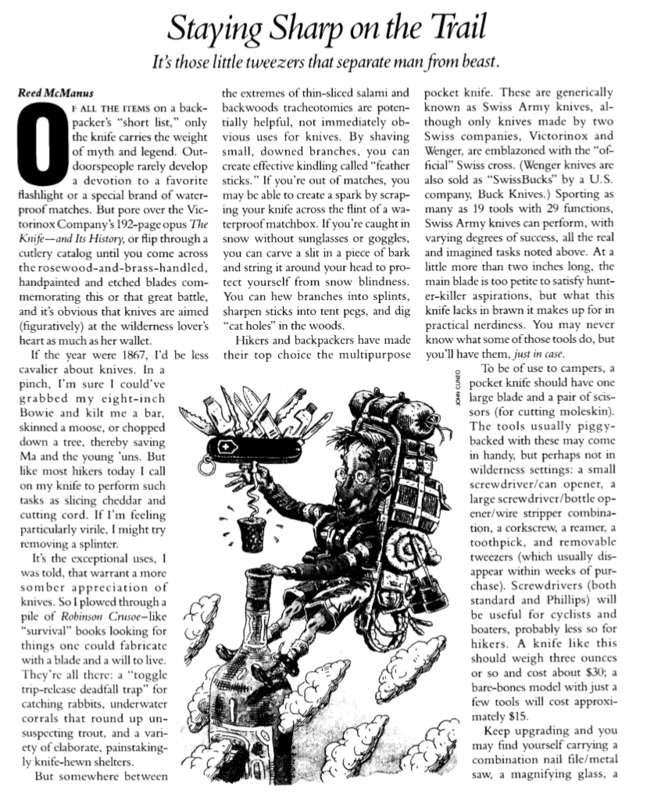
The article "Staying Sharp on the Trail" depicts a cartoon of a hiker holding a Swiss Army Knife with all the gadgets released for the world to see. For the outdoors person there is nothing more useful and sacred than their knife. Many would say that their Swiss Army Knife is the most important tool they own. This is because it was made for the functioning individual with many needs. The blade is a little more than two inches long so it can’t be used for hunting, but it gets the job done for most cutting tasks. The amount of gadgets on a Swiss Army Knife goes up with the price such as a small pair of scissors, a screwdriver, bottle opener, bottle opener, tweezers, and a toothpick. The more that is spent on the knife the wilder the combination of gadgets on the knife gets. There can even be a magnifying glass. Even though some of the gadgets go unused, it is still comforting to know that any situation can be handled with the Swiss Army Knife.
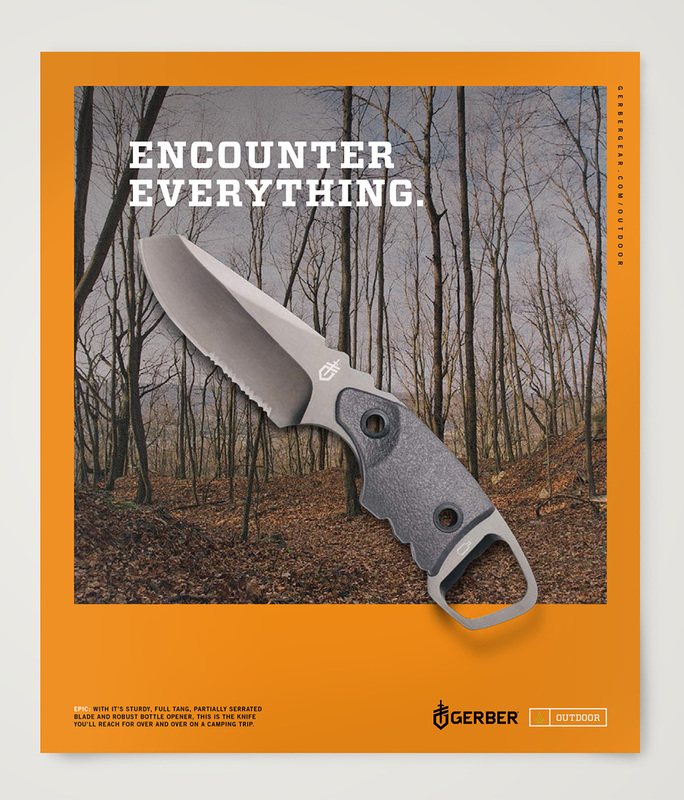
Knives without multiple tools on them also embody interpretative flexibility. In the Gerber Epic advertisement, the knife is pictured on a simple background of a wooded area with the caption “encounter everything.” The only obvious features of the Epic are the blade and a bottle opener on the handle. This is a strategy used by Gerber in order to allow the consumer to imagine their own ways of using the tool, such as for cutting rope or whittling. By not restricting the functions of the knife to one advertised activity, they are able to reach a wider range of audiences.
Knives for Kids
The debate of whether or not knives are tools or weapons continues, especially in the world of youth. The appropriateness for allowing children and youth to use and own pocket knives is based almost entirely on if one considers a knife a tool or weapon. Organizations such as the Boy Scouts and Girl Scouts help to define this debate.
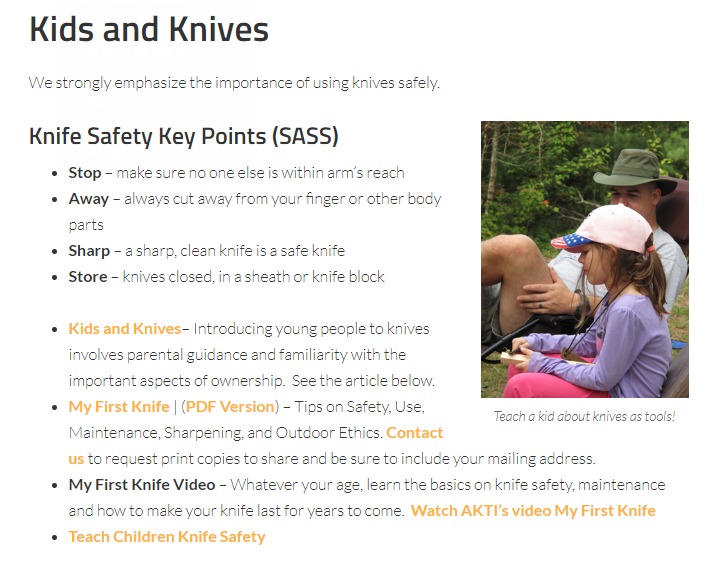
"Kids and Knives," published by the American Knife and Tool Institute, explores the controversy of equipping minors with pocket knives or multitools. The author of this article claims that gauging the maturity of the children in question, along with educating them on safe use, makes it appropriate. This claim is heavily debated in a society that experiences a high amount of violence, especially in school settings. The purpose of a pocket knife is mainly to perform menial maintenance and camping tasks, but it can also be used as an effective weapon. This also applies to adult usage of knives. For example, they are not allowed on airplanes or on corporate properties, as the risk of knives being used as weapons outweighs their potential to be used for constructive means. This social conflict on the "real" purpose of knives is not only a debate about its functions, but also an analyzation of its users. This conflict, however, has not stopped manufacturers from targeting children in their advertisements.
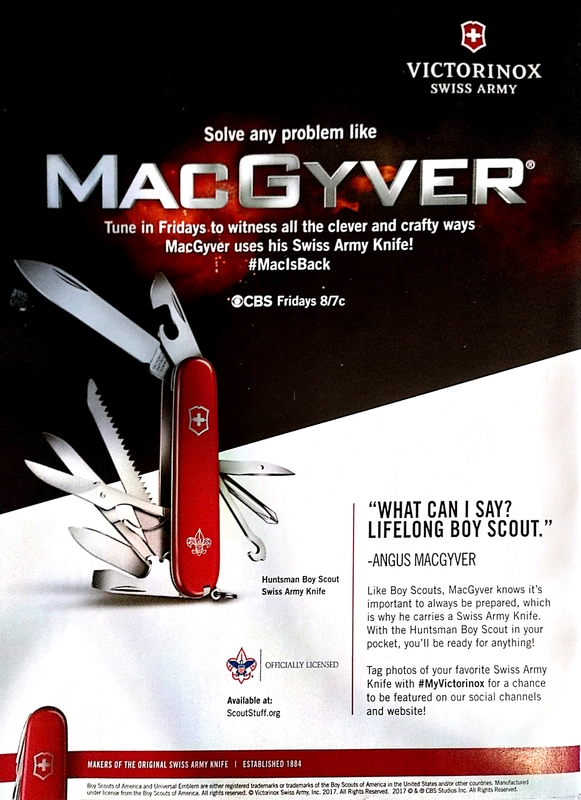
The advertisement for the Victorinox “Huntsman Boy Scout Swiss Army Knife” was found on the back cover of an issue of the Boy’s Life magazine. The advertisement very clearly is selling the product to outdoor enthusiasts (Boy Scouts) which can be seen in one, the name of the knife, two the branding of the BSA logo on the knife, and three, the quote from Angus MacGyver saying that he is a “lifelong boy scout”. In this sense, the pocket knife is being marketed and defined as an all-around useful woodsman’s tool. Angus MacGyver is a hero to Boy Scout like individuals as he is very clever and crafty (as stated in the ad), likes to follow the rules, and is an all around “cool guy”. In this sense, the ad is saying essentially that “if you want to be like MacGyver, then you need a Swiss Army Knife”. Secondly, the knife is marketed as a means to “always be prepared”. The Boy Scout motto is to “be prepared”, and a dilemma that scouts often face is that they do not always know what they need to do in order to be prepared. This knife claims that “if you carry a Swiss Army Knife, then you will be prepared”.
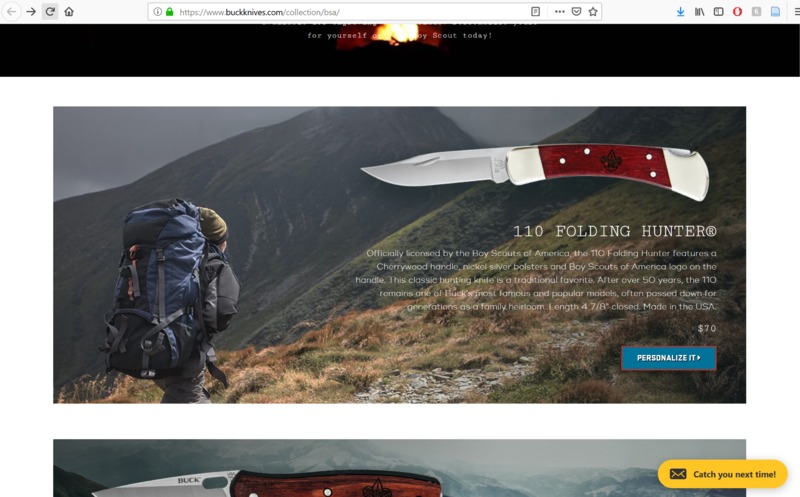
The advertisement from Buck is another example of knife companies targeting Boy Scouts. It states it is licensed by the Boy Scouts of America and has the BSA logo on it. This is one of the relevant social groups. While the knife is targeted specifically towards Boy Scouts, there is an overlap that exists between Scouts and other relevant social groups such as outdoorsmen, backpackers, hikers and campers alike. The advertisement is also meant to appeal to people who favor tradition. The knife is described as a “classic hunting knife” and describes how the knife has been famous for over 50 years. The advertisement includes an option to personalize it. This may appeal to people who want to traditional knife, with some of their own personalized touches on it. The ad also states it’s made in the USA. This is appealing to people who may want to buy American made products. This all makes it an American knife with historical value, but also a customizable knife for people who like the outdoors, such as Boy Scouts. While the advertisement doesn’t have the same “cool factor” that the MacGyver knife has, it attempts to draw in buyers using tradition and Americanism, as well as customization, as an appeal.
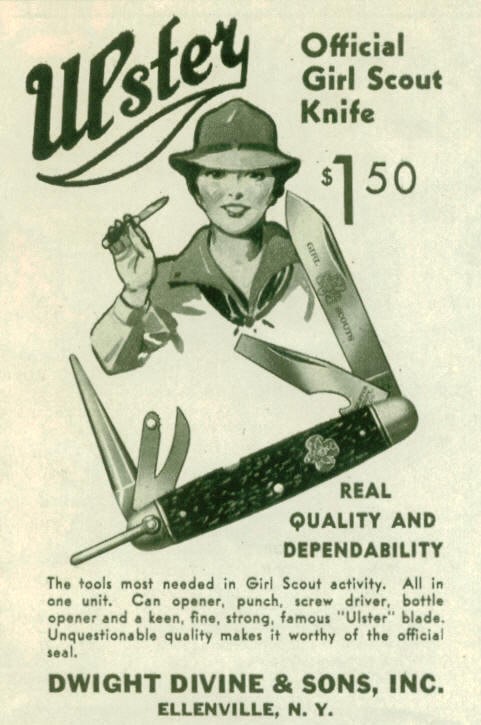
The advertisement by Ulster knives from 1934 is selling an official girl scout pocket knife. The knife is being marketed as dependable, high quality, and has the most commonly needed tools in girl scout activities. Because this ad is from 1934, it would appear to be old from a social perspective, but the knife depicted is almost identical in form and function to one that could be bought today. Thus, the advertisement is recent from the perspective of the technology itself. This ad is especially interesting because usually knives are depicted as a man’s tool, but this knife is specifically designed and marketed for girls. By advertising the knife in this way, Ulster makes the assumption that girl scouts are doing activities that require a pocket knife, such as camping and handicrafts. Thus, if a girl scout buys the knife, she will have the tools she needs for such activities, and will be better off than a fellow scout without the knife.
All three of the ads that are targeted at children describe the knife as a well needed tool for the average Scout. Overall, the ads make no mention of the potential nefarious purposes for pocket knives, and instead focuses on their functionality and features. The ads also create a social appeal, having MacGyver’s knife or a traditional American knife.