Timekeeping - Past
INTRODUCTION
When did humans begin to need time? What was the purpose of time? What devices lead to current timekeeping? These are the questions we hope to answer with our past page. The progression of early timepieces, the need that necessitates each device, and the subsequent impact that each piece has on the next innovation and generation. Our past period expands from the first sundials through the centuries to a point where timekeeping has become a common and necessary part of society to need the official, legal, standardization of time.
WHERE WE CAME FROM?
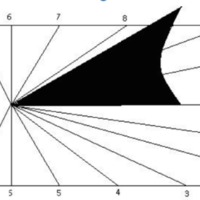
Have you ever wondered what life would be like without clocks? We think about how our ancestors knew when it was time to wake up or go to sleep. The answer to that was the sun, specifically a sundial device. Sundials date back to 5000 BC. It is believed that cavemen were the first people to use some sort of solar time keeping device, followed by the Greeks, Egyptians, and Babylonians who improved the technology and accuracy of it. Modern-day sundials consist of a dial surface with hour lines marked and a gnomon, which is an object with a sharp edge. The gnomon is aligned parallel to the rotation of Earth’s axis. As the day progresses, the sun moves across the sky, causing the shadow of the gnomon to move. Depending on where the shadow lands on the hour lines, indicates the time of day. Sundials come in all types of varieties and sizes. As time keeping became more important to people, even pocket sundials were created. However, some of the basic models continue to exist today such as Equatorial and Horizontal sundials.
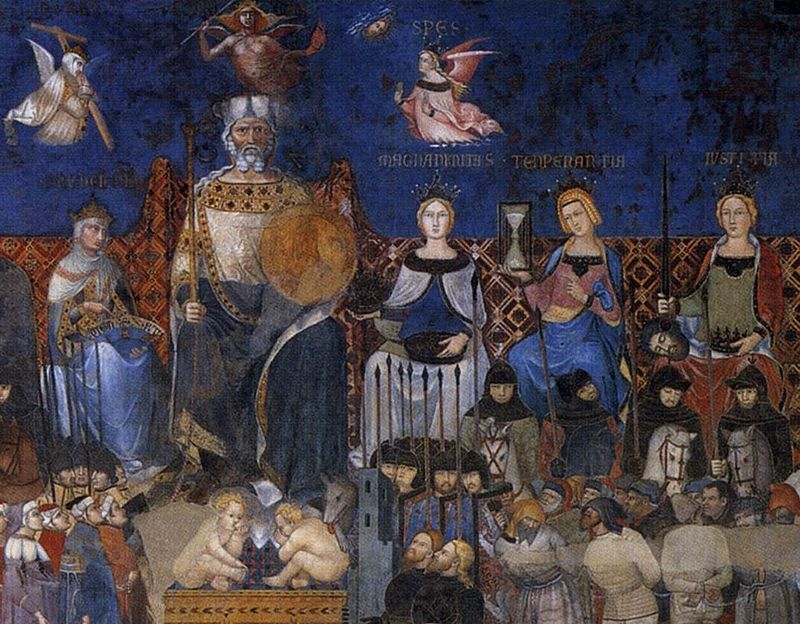
One of the early time keeping devices is an hourglass. Since before the 1800's there was no real need to keep track of time at a precise measurement, it is hard to track down exactly when the hourglass was invented. Timekeeping was important in regards to sailing and that is where the hourglass was used the most, but one of the first documented cases of an hourglass is seen in the painting Allegory of Good Government. This painting was created in 1338 whereas historians believed the hourglass dates back to the 11th century. Yet, there is no certainity. Historians argue over the origin of the hourglass as it is hard to dertermined. There is some evidence poiniting to the hourglass's creating before 1338, but the Allegory of Good Governement is one of the strongest examples available.
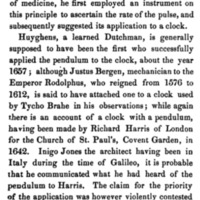
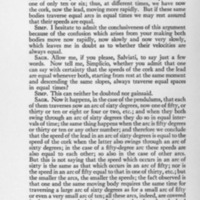
As we explore the progression of timekeeping and the iconic pieces that reflect the needs of the consumer, the pendulum clock is the next adaptation of measuring the omnipotent TIME. From sundial & hourglasses, the pendulum is a reflection of the transformed need for accurately to orient the day.
The pendulum clock has a rich history, rooted in the description of the pendulum phenomena by Galileo in his text “Dialogues Concerning Two New Sciences” in 1638 (an exempt presented to the left). The renaissance, astronomer, physicist, and physician envisioned the pendulum for medical applications in measuring his patients' pulses by utilizing the pendulum arcs’ consistent nature. A consistency that is later transformed by Christiaan Huygens to create the pendulum clock in 1658, marking its beginning as the popular device to provide accuracy to an ever complicated world. As the European Industrial revolution began, the need for accuracy for the regulation of both machine and human resources, allowed the pendulum clock to be a relevant tool for laborers, business owners, producers, and government officials alike.
The second text, published in 1852 illustrates the fascination that audiences had at the time over the history of time as well as reveals the debate over ownership of the pendulum clock between Christians Huygens and various other mechanics and scientists in the 17th century. The application of pendulum technology provides the possibility of the majority of people to have access to the same type of timekeeper that allows for synchronization of masses, further enabled by the ability to mass produce due to the Industrial Revolution. The pendulum clocks are also one of the first timekeepers to use harmonic oscillation for timekeeping.
BEGINNING OF STANDARDIZATION
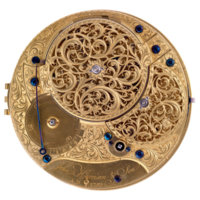
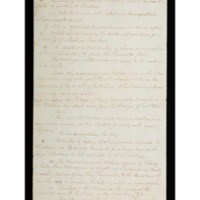
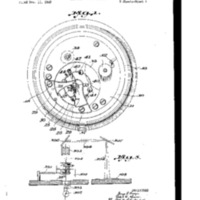
The Chronometer is now a little known invention, but it’s history is a fascinating one. Without the chronometer lives would have been lost, ships destroyed and very well could have changed the face of history as we know it today. Without the chronometer, there are doubts that Britain would have been called Great Britain. The word ‘chronometer’ comes from the combination of two Greek words ‘chronos’ meaning time and ‘meter’ meaning measure. Quite literally a chronometer gives us the measure of time. So how does this relate to ships being destroyed, lives lost and all that other stuff that sounds like it belongs in an action movie? It has to do with a simple fact that longitudinal position can be determined by knowing the time in two different places. If I know the time in location A and I travel to location B on the earth, I know that when the earth rotates, the sun will appear to move overhead. So here’s how to do it, you set your clock in city A to city A’s local time (in this example 12:00 PM). You then travel to city B and you wait until city B reached local noon (the sun being directly overhead) and compare it to the watch which shows city A’s local time. You know that the earth rotates once every 24 hours, so then it becomes a matter of simple geometry and fraction to figure how far away in longitude you are away from where you started. The ‘Board of Longitude’ a board of big wigs and scientific geniuses of the day offered a prize of 20,000 pounds sterling to the winner who could solve the problem. The man who (eventually) received his prize is a man who goes by the name of John Harrison. Here are some of the papers relating to his work. He was able to create the first accurate chronometer that could survive the pitch and roll motion of the seas and not change easily. John Harrison was born on April 3, 1693 and died on March 24, 1776. But as you can plainly see a patent was filed in the 1940s explicitly for the marine chronometer maintenance, meaning it was still in use around that time. Of course, later quartz crystal oscillators took over the market afterwards, but John Harrison left a lasting impact on the world.
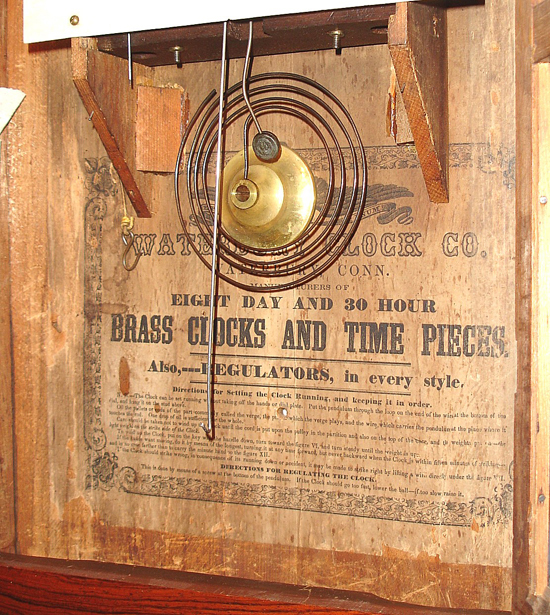
This is a picture of one of the very first labels for a brass clock. This was around the time that time began to be standardized out of necessesity. This specific label is from 1860, which was still ahead of the game when it came to brass clocks being in the homes of many individuals in the Western World. This specific label is for the Waterbury Clock Company and its first official advertisement was in 1867. Which shows that this is one of the very first instances of individuals interacting with this clock.
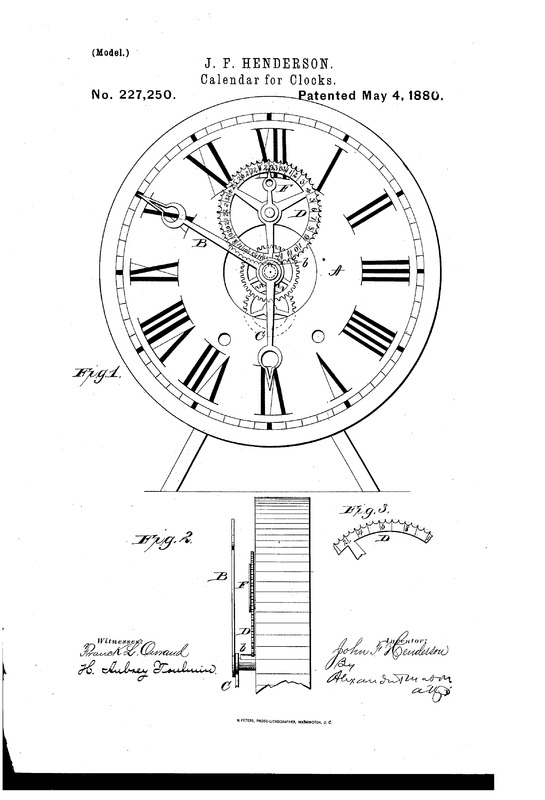
This patent was to create a standarization for calendars for clocks and watches old and new. The patent describes the center dial that contains 62 cogs that function with the big and little hands to tell the day. The patent describes how the invention can accomodate for leap year and can be applied to past and future clocks and watches. This patent is significant because it helps set a standard for time keeping in accordance with the date. It combines the time and calandar to set a precendence for time keeping in the future. Since clocks and watches were becoming more standardized in the late 1800's, this patent goes along with this idea of standardization and a part of what we see with clocks today. When one looks at their phone or alarm clock, they will often see the date along with it and this idea can be seen at the creation of this patent.
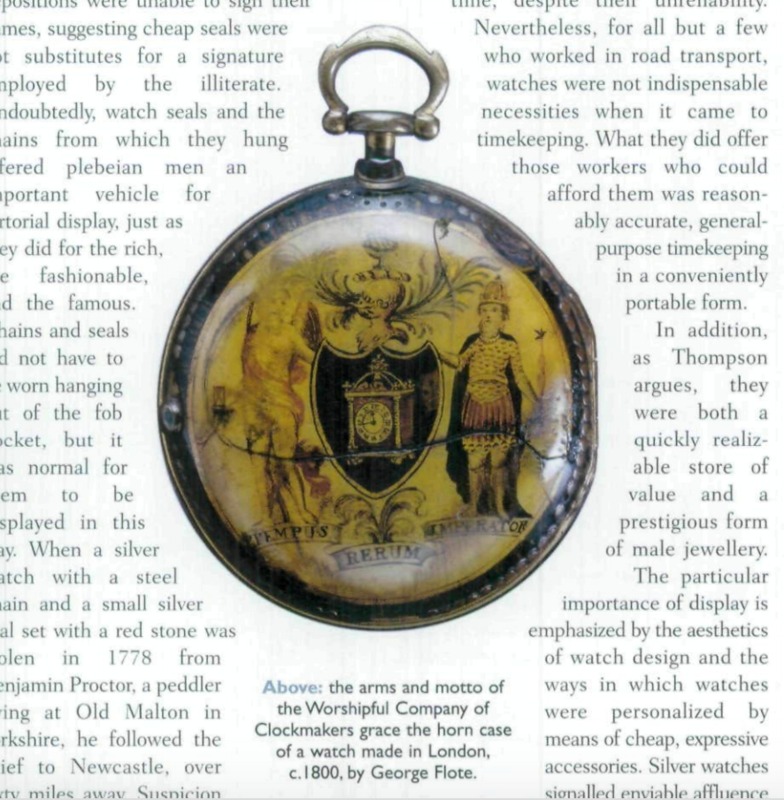
In an article written by John Styles, he argues the reasoning behind why men during the 1700s carried pocket watches. Styles begins with the story of William Hutton, a humble working man, and how he was able to acquire two silver pocketwatches. At the time of the 18th century, silver was a luxury and not affordable to the average working man. As a result, there were many males from the lower class (farmers, artisans, etc) prosecuted in court for stealing expensive pocket watches! Why was it so important for them to have one? Around the time of the Industrial Revolution, there seems to have been a rise in the importance of time pieces because people's notions of timeliness at the workplace were changing. Time was a way to keep track of labor, both of the machine and worker. The demand of synchronization, making sure that the laborers were meeting the boss's quantifiable demands (production) was also a reason why workers felt the need for such a device. However, some people during that time felt that the pocket watch was a sort of status symbol or fashion statement. As the technology for the watch got better, they also became more decorative. Some pocket watches had ornate designs on the cases or were made with enamel or fine china dials. Although pocket watches today are a rare sight to see, they have a history of showing the beginnings of standardization of time.
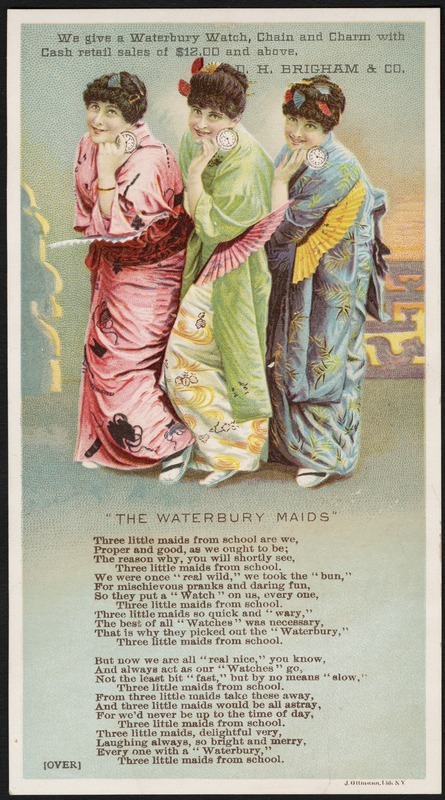
This particular advertisement is simply a reflection of the fact that watches and other timepieces are becoming affordable for the general populous and that being on time and on schedule is becoming increasingly important in society. The poem beneath the advertisement touts the virtues of Waterbury watches being “not the least bit ‘fast’ nor too ‘slow’” clearly indicating that the watches do not run too fast nor too slow, but at a set pace that makes them practical. The rest of the poem touts the virtues of the three maids because of the watches they own, clearly indicating that the watches will turn “real wild” girls into nice girls, because it keeps them on schedule.

In 19th century, timekeepers have paradoxical impacts, on one side with each advancement, there is an improvement to the accuracy and precision which has practical applications in industry. This allowed industrial producers to maximize their resources accordingly, both machines & labor. Lewis Carroll’s Alice’s Adventures in Wonderland published in 1865, is an illustration of this paradoxical nature, even though timekeepers allow for its relevant groups to increase efficiently, it constrains those groups to time’s unidirectional changing nature. Alice’s adventure in Wonderland as a whole is a reactionary work against this constraining nature of the society in 19th century England, with young Alice wistfully seeking an escape into a timeless fantasy world. However, the creature that leads her into this fantastical world is also constrained by a timepiece as well, as the “Rabbit actually took a watch out of its waistcoat-pocket, and looked at it and then hurried on” (Carroll 2). The reflection of society’s constrained by the accurate and precise timepieces seeping through Carroll’s children’s literature. The escape of Alice to the fantastical “Wonderland” is a statement by the author of an accelerating society due to the Industrial Revolution and the advancement of technology.
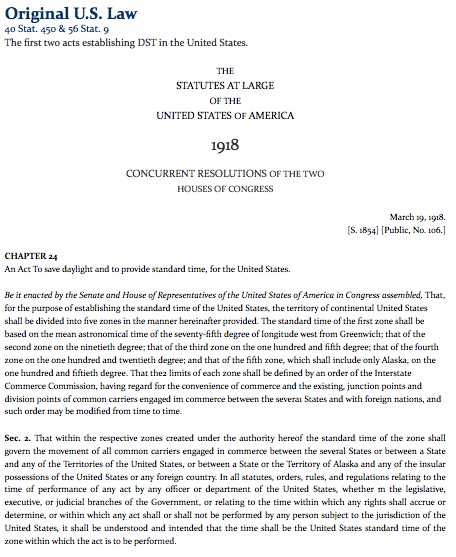
As devices became standardized, the nations as a whole necessitated an official standardization of time and the creation of time zones to effectively synchronize areas of the economy. Standardization became a subject of discussion in the early 1900s in Europe as well as the United States. However, this discussion was left forgotten as the world was grappled with calamities of global warfare and its resulting hardships. Standardization of time became a convenient solution for economic and energy shortages for lawmakers and bureaucrats alike, both in Europe and United States. Thus, in 1945 the U.S. Congress established daylight savings (DST) and time zones in Original U.S. Law 40 Stat. 450 & 56 Stat. 9 to be regulated by the Interstate Commerce Commission. This standardization allowed for energy efficiency during wartime, by utilizing as much daylight as possible as well as economical benefits of increased labor and synchronization of industries. Particularly the regulation and management of there continental railroad, an important part of the U.S. expansion post War War II.