Pocket Knives - Future
Knives as Tools
Innovations in Knife Handles
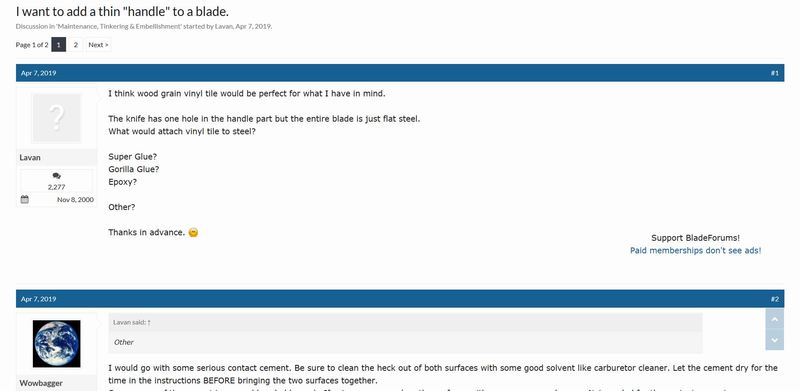
A common way for consumers to voice their concerns about a product is to post their grievances on internet forums in the hopes that either another user or a manufacturer can solve the problem. Keeping this in mind, Lavan, a user on bladeforums.com, created a thread titled “I want to add a thin handle to a blade.” In this thread, he requests help to decide what materials he should use to attach a thin handle around an existing handle in order to make it larger, easier to grip, and more aesthetically pleasing. Another user known as Wowbagger quickly advises Lavan on the bonding material to use, and then moves on to say that “If there is one criticism I could make of the current knife offerings it would be that the handles are, almost to a knife, too thin . . . much too thin.” This sentiment is shared by the rest of the users in the thread, as many of them have already made such modifications to their personal knives. Many individuals believe that as the pocket knife has become easier to conceal and carry, the ergonomics of knives are forgotten. Although these users seem content in making their own custom handles, it seems that companies should heed their concerns and begin producing knives with larger, more ergonomic handles that fit better in big hands.
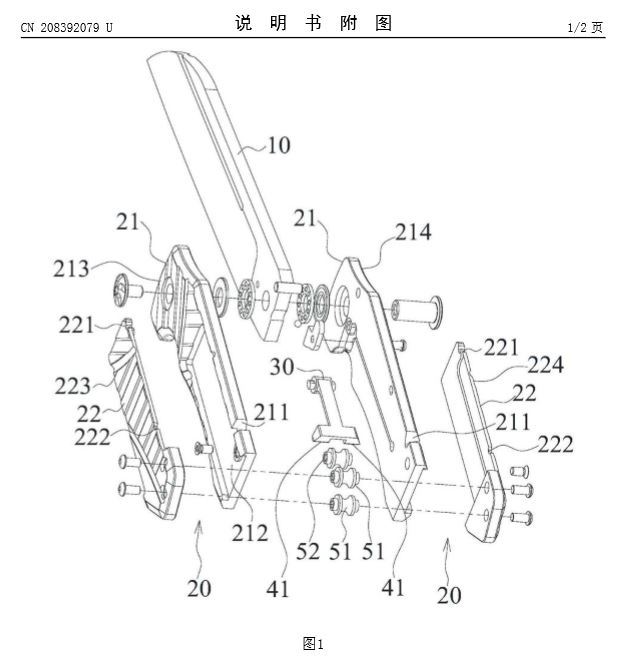
In a similar way to the above paragraph, patent CN208392079U focuses on innovations for an improved pocket knife handle. The patent is for a new type of folding knife, where the handle telescopes so that it can be shortened while the blade is in use. According to the patent application, one issue with current knives is that the length of the handle must match the length of the blade. This is because the blade must fold into the handle, and if the handle is too short, the folding functionality will be pointless because the handle will not protect the blade or the user; however, the applicant posits that there is a demand for having a shorter handle without sacrificing the length of the blade. Thus, one solution to this issue is to have a telescoping handle, which this patent makes a design for. The patent is emblematic of both the past and future of pocket knives. Obviously, the patent is for a future innovation, and this innovation seeks to solve a convenience issue. The patent also demonstrates the history of pocket knives in that greater convenience was the original reason pocket knives were developed.
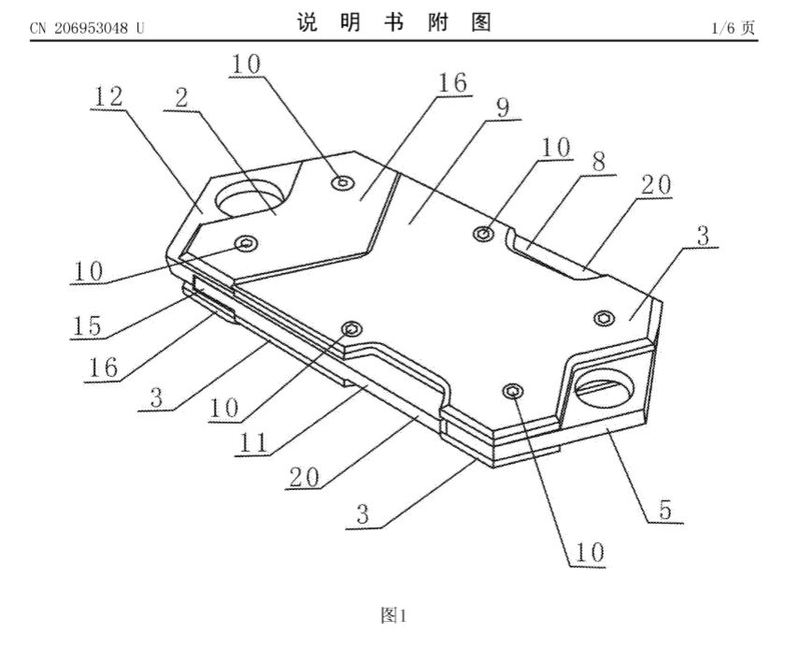
The patent entitled “Pocket Knife” by the inventor 蔡碧璐 (Cai Bizhen) is an interesting break from the normal shape and form of the pocket knives of today. It is a small, flat, dog tag sized knife that can be attached to a lanyard or keychain. What makes it so unique is that the blade itself detaches from its sheath, and then, once flipped around, reattaches to the sheath, making an extended handle. Essentially, the sheath for the knife also serves as its handle. In addition, the knife is lockable and simple, and as the inventor claims, “fashionable”. The knife is an interesting tell for where the future of pocket knives will go. In this design, the ancient method of a blade attached to a handle with a hinge is supplanted by a fixed blade knife that attaches to its own sheath to extend its handle. This goes to show that even technologies that have been thought to have reached closure can still evolve into completely different forms. Overall, patent number CN206953048U is a novel and useful take on the pocket knife that deviates from its present design in a radical way.
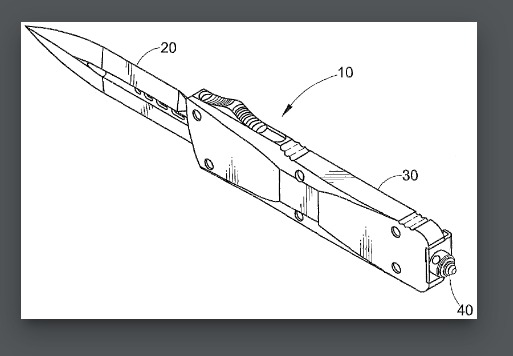
Patent US20080222895A1 by Anthony L. Marfione and Anthony G. Marfione is for a pocket knife with a glass breaker attached to the end of the handle. The main purpose of this design is to create a knife with a handle that can support the use of the window breaker. Their claim is that most knives with window breakers are not strong enough to handle the force of using the glass breaker. The knife is appealing to relevant social groups that are concerned about needing a glass breaker, such as a police officer or first responder, or even just a concerned motorist. These same groups are especially concerned about having a knife that can handle the stress of breaking the window and get the job done in life or death situations. This patent once again supports the idea that future pocket knife innovations are focusing on the designs of handles rather than locks or blades.
Knives and Technology
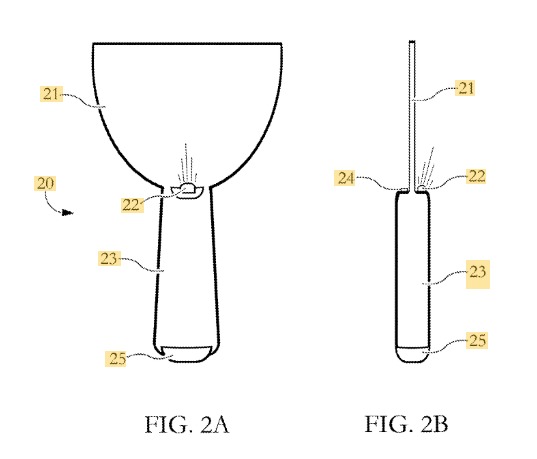
Besides from changing the handle of a knife, some future innovations and ideas have turned to implementing electronic compatibility within knives, giving knives and multi tools a plethora of new possible functions. Patent US20110289780A1, filed by Florian Tiegs, describes a useful lighting utility implemented into a hunting knife. Filed in 2010, the diagrams depict a knife with a light source located in the handle. The power supply, also located in the handle, lights the LEDs which use the blade for guidance. This knife was created as a hunting and utility knife, as the literature beneath the patent specifies that the light is intended for use in outdoor areas, where activities such as wood carving and skinning animals are commonplace. The lighting utility could be activated during nightfall, eliminating the need to hold a lantern or flashlight at the same time one is using a knife. This function also dramatically improves knife safety, as a common cause for injury while using a knife is using it in low light conditions. Although pocket knives and lighting utilities are not novel in and of themselves, this invention demonstrates a level of technological advancement that was simply not achievable until recently. Furthermore, this patent suggests that implementing more electronic functions into folding knives is both plausible and logical.
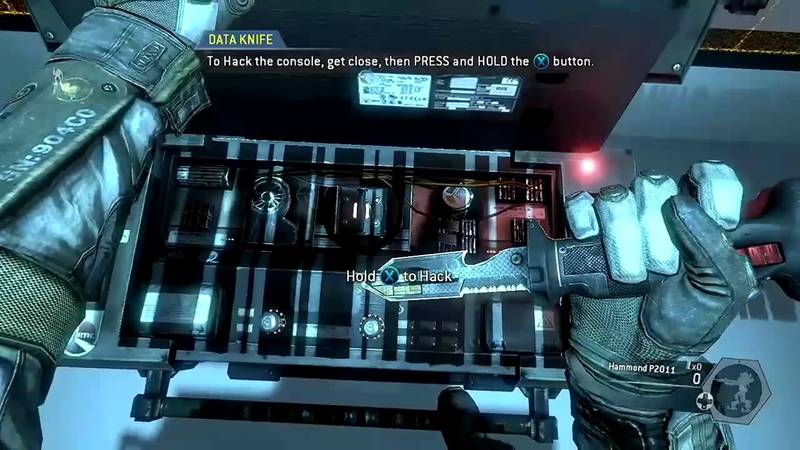
The aforementioned idea of integrating pocket knives and electronic/virtual devices has also penetrated the realm of science fiction. The data-knife from Respawn Entertainment’s video game series Titanfall is a multi-use tool that not only acts as a knife and web-belt cutter, but also a computer hacking implement. Set in the distant future, Titanfall is a game series which chronicles the war between a multiplanetary mega-corporation and a resistance force, with heavy uses of automated and robotic weaponry. The primary function of the tool in the video game is to plunge it into enemy robots and autonomous weaponry in order to “hack” it and bring that piece of machinery onto the friendly force’s side. The feature adds an interesting dynamic to the game, as an autonomous weapon or robot could quickly switch sides based on a single player “hacking” into it. This relates to Kranzberg’s second law, that invention is the mother of necessity. As alluded to earlier, within the canon of this video game, robotic and automated military forces are the foremost threat and make up the bulk of warfighting forces. Therefore, this knife was invented to mitigate that threat in a more useful manner by forcefully reassigning the machines rather than simply destroying them. Although the idea of stabbing a knife into any location on a robot or computer and then hacking into it seems far-fetched, perhaps as military and civilian automation increases, a knife such as this would have important applications.
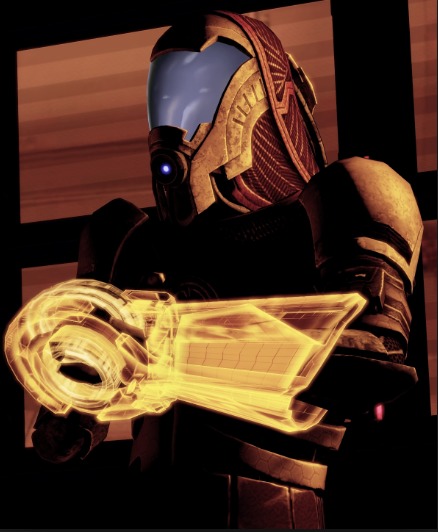
Much like the data-knife, the omni-tool from the video game Mass Effect: Andromeda serves as a futuristic multitool for the civilians and soldiers of the galaxy. In a world dominated by cybernetics and space travel, this tool performs both technological and physical functions for the convenience of its users. For practical uses, this tool can provide a flashlight, a camera, and a scanner. The device, which is worn on the arm, can also be used for programming, hacking, and communication. These are all tools that can be found separately in the present day; however, many features are either unnecessary or currently impossible to manufacture. The omni-tool can create objects spontaneously and convert items into a gel-like substance for creating new ones. Kranzberg’s third law, stating that technology comes in packages, explains why the omni-tool is so important in this virtual world. The universe in which this game takes place is full of cybernetic implants and tools, and requires daily repairs of technology and the ability to communicate over long distances. From a militarized viewpoint, the omni-tool is necessary to gain enemy data by hacking, scan fellow combatants for equipment damage and biometrics, and communicate effectively with command teams. Although a multitool as advanced as the omni-tool is not anticipated to be invented in the near future, some modified or simplified form will likely be manufactured as the rest of technology advances.
Knives as Weapons
Refinement and Modification
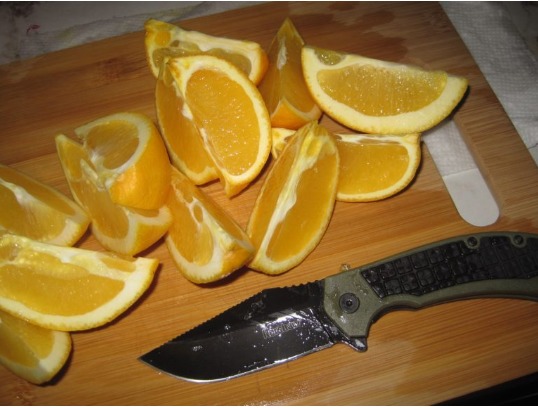
Pocket knife enthusiast Scott Rauber frequently posts product reviews on the forum All About Pocket Knives. In his review of the Kershaw Faultline, he highlights some of the key components that folding knife companies must design correctly in order to meet customer expectations. The first functionality addressed was the assisted opening mechanism. In the Kershaw Faultline, he states that he was “disappointed to find that it wasn’t assisted open” and that “there could be trouble” regarding injury risks without it. Instant accessibility is not only a comfort for users, but it also allows the knife to open predictably without interference from the hand. The second functionality discussed was the pocket clip. Rauber states that the pocket clip on this knife was too tight, and that he could not easily remove it from his pocket for use. This led him to use it rarely, instead opting to use other knives. From this review, we can gather that the innovation in the folding knife market is not so much directed towards new functionalities as it is towards perfecting existing ones.
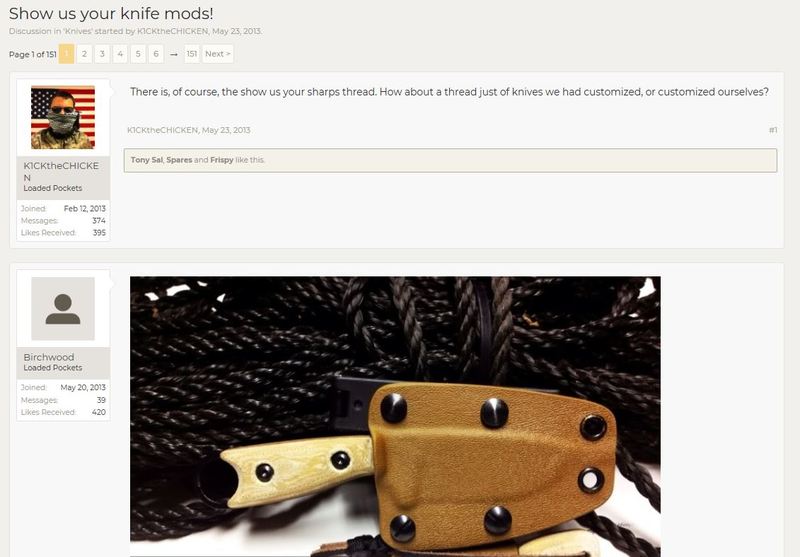
The sentiment that new functionality is not the focus of innovation is also reflected in the discussion thread on EDC Forums, which showcases users sharing ways in which they have modified their knives. While individual users do not specifically ask companies to make changes, the overall theme of the posts is that consumers are more focused on modifying the aesthetics of the knife rather than the function. In particular, there are many posts that show off new handles, which are changed from plastic or composite to wood. These transformations seem to highlight a deeper desire for knife users to have a more handcrafted feel to their knives, and this feeling is missing from many of the “tactical” knives that are on the market today. Another popular modification is changing the color or finish of a knife, which will once again give it a different look without changing its function. Overall, the vast majority of modifications displayed on the forum are based on style rather than function, suggesting that closure in the technology has been reached for these users, and they are simply looking to have a knife they can truly call their own.
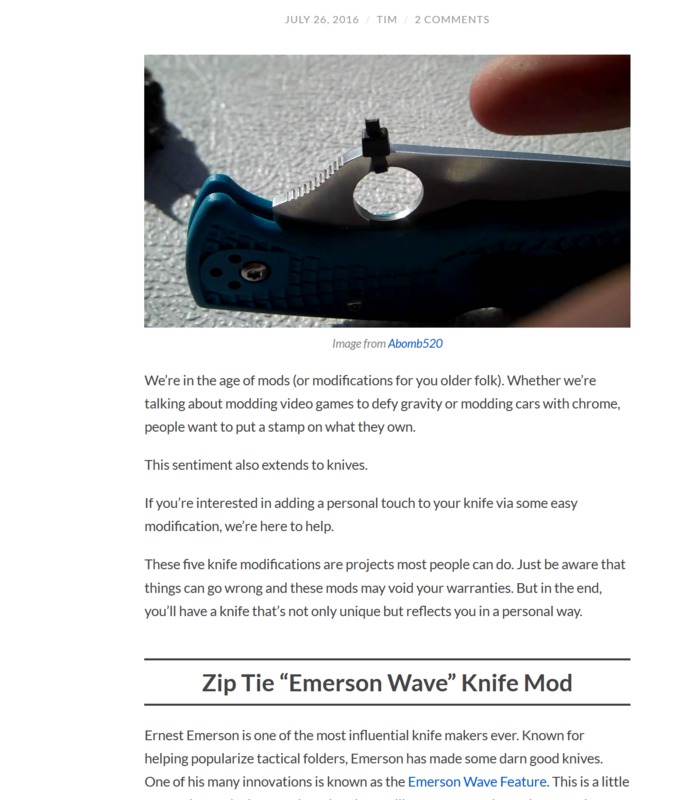
The zip-tie modification is intended to mimic a feature that is only offered on a knife feature known as the Emerson Wave. The Emerson Wave is a protrusion on the thumb opening of a knife that catches on one’s pocket while pulling it. Once it is pulled out of a pocket, the function allows the knife to automatically deploy without the user needing to open it with his or her thumb. Consumers discovered that they could add a zip tie to the thumb opening of their knife to mimic the Wave’s feature. As evidenced by this post, a user may really like some features of one knife but not like the price of it, and find a way to add feature to another knife in an inexpensive fashion. This modification allows the knife to be instantly opened as it is taken out of the pocket which is a useful feature for using the knife as a weapon. If someone needs the knife quickly, say for self-defense, instant access is a huge advantage in a fight where seconds can count. This simple modification allows other social groups that might not be able to afford a high end Emerson Wave knife to enjoy that feature on a different and more inexpensive platform. In short, tactical features on knives are desired by the masses but are not always easily accessible.
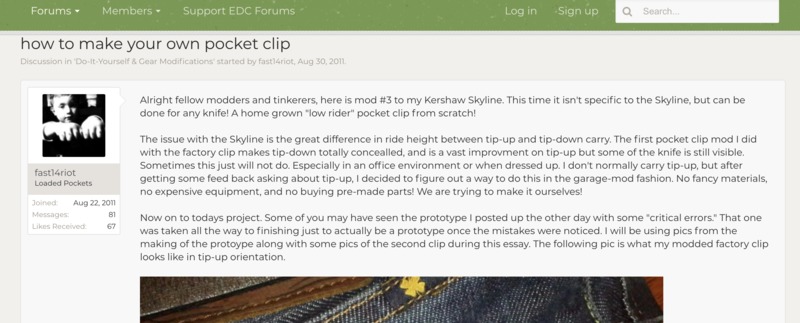
Much like the zip-tie modification, forum post by fast14riot shows how this user wanted to make a simple adjustment to a pocket knife in order to make it have a pocket clip. The idea for this modification is born out of a desire to be able to attach the knife to a pocket for ease of access without having to search through the pocket for it. The creator of the thread, along with the many others who posted, were looking for an inexpensive way to create their own pocket clips for their knives since not every blade comes with one. Once again, this is less of an example of inventing a new accessory for pocket knifes, but instead is an example of modification based on price constraints. This thread also showcases the desire to mix and match different knife accessories from different knives in order to combine the best designs of each knife into one overall package.
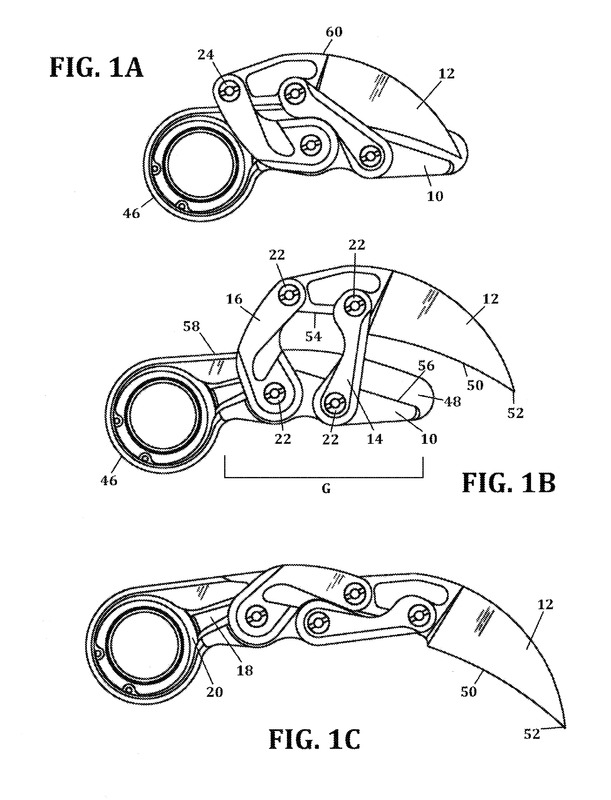
The patent US20180154531A1 by Joseph Caswell is a pocket knife that resembles the karambit. This patent was created to solve the issue of being able to quickly pull out a blade in emergency situations. Instead of relying on a pivot point to release the blade, this karambit style knife is deployed by firmly gripping the handle to present the blade. For this reason, it is considered an emergency defensive knife to only be used in self-defense situations. Additionally, the knife’s locking mechanism is incredibly strong due to there being two connecting points attaching the blade to the handle instead of just one, quadrupling the force required to break it reducing the overall chance of failure. Overall, this knife offers speed, compliance, and strength, where other blades fall short, thus making it a great tool to have when in an altercation.
Science Fiction Weapons
While most of the innovations for weapons have been grounded in improving existing technologies, the science fiction depictions of knives as weapons are all a bit more abstract and creative. With that being said, these depictions also present a strong idea of the direction in which people think knives are heading. One common thread in each of these artifacts is the idea that the blade should be attached to the wrist or arm for easy access, hidden from view for greater concealment, and rapidly deployable for optimal offensive or defensive effectiveness.
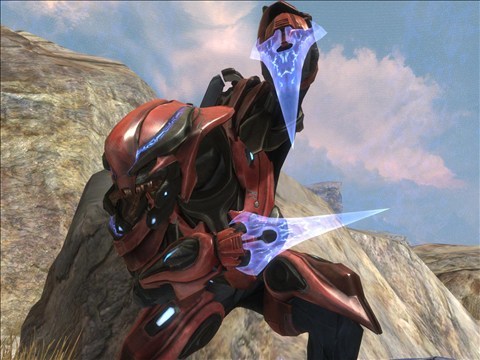
One instance of a science-fiction knife as a weapon is in Halo: Reach, which is a video game set in the year 2552, and depicts a science-fictional war between humanity and a group of alien races called the Covenant. One of the weapons that the Covenant uses is the energy sword, and a related weapon is the energy dagger. The energy dagger is not a pocket knife in the traditional sense, but rather, it is a wrist-mounted device that, when activated, deploys a magnetically contained plasma field in the shape of a blade. This dagger is primarily used for hand to hand combat, and specifically is utilized for assassinating enemies, because it can be easily concealed until it is ready to be used. While the primary use for the energy dagger is as a weapon, it could also be used in a tool context. For instance, since the blade is made of magnetically contained plasma, it can cut through metal and plastic, which could be used to cut through a door or destroy an electronics panel. Furthermore, the blade can also be used to cauterize wounds, which would prove useful in a combat scenario. Even so, the primary and intended use for the energy dagger is as a weapon. It is worth noting that while the Covenant uses these energy daggers, humans still use conventional combat knives, so it appears that the creators of Halo do not foresee any major innovations in knife technology without outside involvement.

The wrist-deployable knife is once again found in a scene from "Terminator 2: Judgement Day", which depicts a T1000 robot turning its arm into a sword. This "sword hand" is being used to kill someone. This use of the sword hand is an example of a "knife" being used as a weapon. The changing of a hand to a sword is a use of the advanced technology used by the T1000's to complete their mission. This kind of technology can be expanded to show how a possible technology can be developed to create an object that can quickly changed into another object at will. Therefore, it is possible that a shapeshifting material such as this could be used to create the ultimate multi-tool, though this scene depicts it only as a weapon. This may be useful for specific social groups in the future with our ever changing society, requiring more and more functionality.
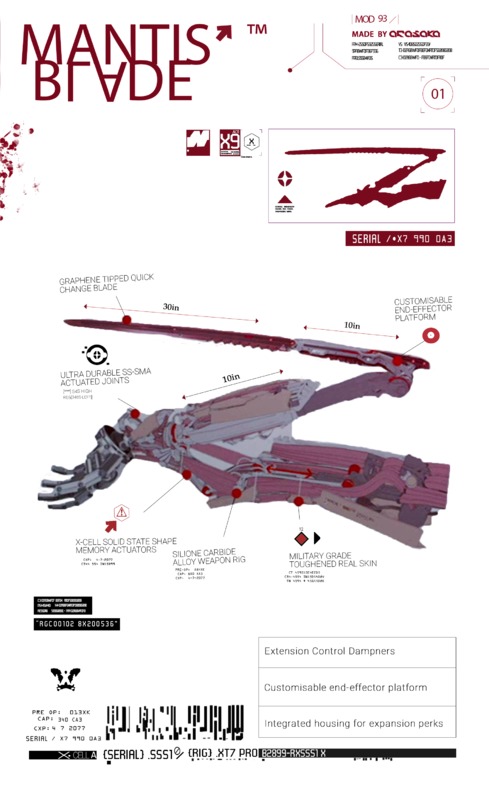
Another instance of a hidden, rapidly deployable blade is the Mantis Blade from the video game Cyberpunk 2077. The blade serves as a science fiction weapon for thugs, assassins, and generally bad people. It takes place in a dystopian society run by corporations that disregard lower class individuals, which causes them to turn to a life of crime. The only way to get ahead in this futuristic world is to purchase cybernetic enhancements for your body. The Mantis Blades turn the forearm into a folding blade that can really be used for any situation. The massive blade can be pulled out to slice oranges, bread, and people. Despite the games violent setting, the idea of the Mantis Blade does provide a very interesting futuristic development for knives and tools alike. Cybernetic enhancements for any tools based off occupation could very well be the future.