Bread - Past
"The Best Thing Since Sliced Bread"
The Invention that Started it All
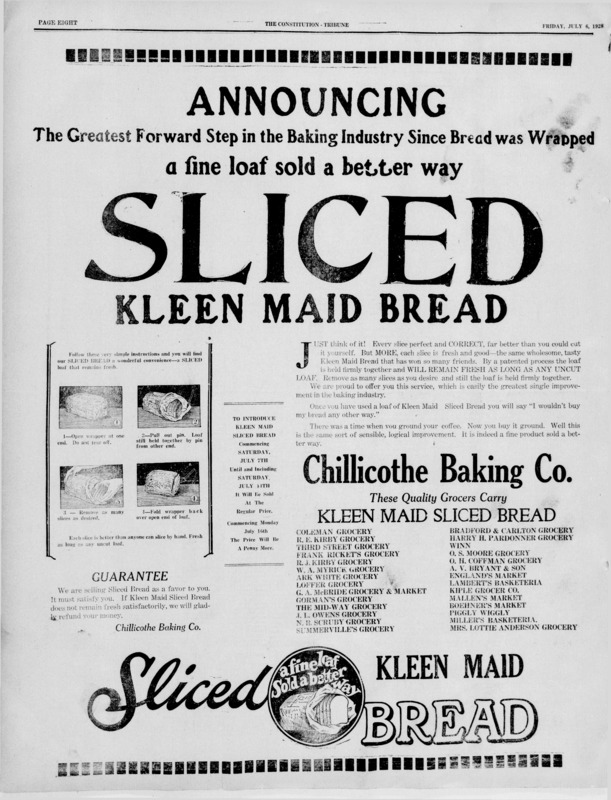
“The best thing since sliced bread!” Whether it is a salesman on QVC praising the latest closet organizer or millennials talking about wireless headphones, this phrase has been used for decades by people to describe an object that changes their lifestyle. What is it about sliced bread that makes it such a significant and pivotal technology that has the world comparing newer innovations to it? By looking into the past, we can not only get the history of sliced bread, but insight into the culture that existed prior to it and the waves in bread technology that it created. Interestingly enough, not having pre-sliced bread served as a huge issue to multiple people. Housewives were not the only ones struggling with slicing bread, but nurses did, too, finding it difficult to slice so much bread for the patients in hospitals. Although many bread slicing and bagging machines were invented and patented, none matched the one made by Otto Frederick Rohwedder. Using his skills and knowledge of watches and jewelry, Rohwedder invented the first automatic bread slicing and bagging machine for commercials use in 1933. Up until then, only unsliced bread was sold, showing how, even with bread slicers present, the idea was not popularized until the baking industry popularized it, showing how the power was in their hands.
Neverthless, the inventions and innovations of bread slicing and bagging machines did not hold the spotlight on the bread technology stage. During this time, "new breads" were also being produced and advertised, trying to find the health alternative, showing that health has always been a driving factor behind bread technologies.
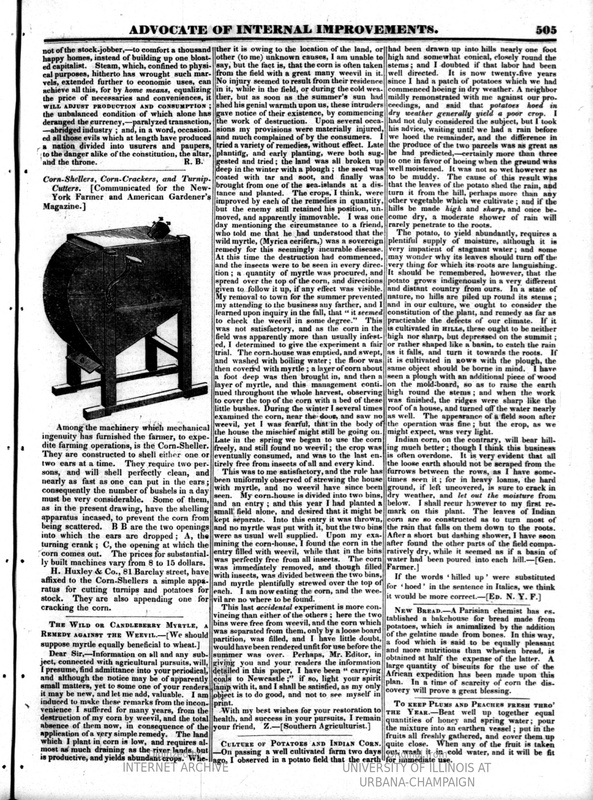
This short segment from the 1834 edition of the American Railroad Journal titled "New Bread" describes the revolutionary discovery of the recipe for what it is now considered 'white bread'. It goes to detail how it is made from potatoes and gelatin that comes from bones and then put through the new bakehouse which was recently established by a Parisian chemist.
It continues to list the benefits of this 'new bread' and while there is nothing critically wrong with current wheat bread, you should switch your diet to white bread because the American Railroad Journal told you to. These benefits include; 1) White bread tastes just as favorable as wheat bread, but has higher nutritious value. 2) White bread can be made at near half the price which is an additional bonus because in the 1830's, America was experiencing a shortage of corn due to numerous poor harvests. 3) Both America and Euope were making great strides inland in Africa, still considered the 'Dark Continent'. As bread became a staple of European and American diets, white bread was found to be preservable in biscuit form and this was extremely beneficial as Western expeditions ventured inland into Africa where only preserved bread was available to them.
This segment of the article is extremely concise which is beneifical when attempting to convince the reader to try the product you are putting forward. It introduces what the product is, how it is made, what is made of and the benefits it serves to the public at large. Everything a consumer could desire to know listed in a single succinct paragraph.
Bread Slicers
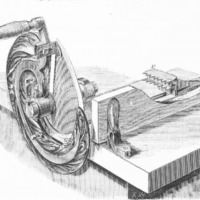
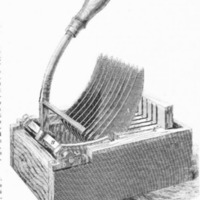
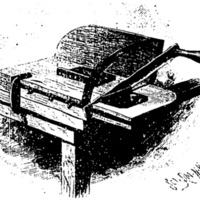
These three bread slicing machines, all made in the later part of the 19th century, were created to fulfill the same goal: slice bread faster. As seen by the drawings, these bread slicing machines look similar and have almost the same mechanics. The slicer is horizontal on the bottom with a handle that controls the blades, making cutting easy and quick. What is interesting is how the use of these slicers in a home is never mentioned. Only one discusses how much time it will save in places where bread needs to be served in large quantities, like restaurants, hospitals, and boarding houses. This shows an interesting transition between the late 1800s and the 1930s, when Rohwedder’s machine provided sliced bread to hundreds of people.
What happened between the late 1800s and 1930s that lead to a commercialization and wider use of sliced bread? By studying the evolution of these bread slicers, an emergence of a middle class can be seen. Assuming that these slicing machines were produced, why would a middle-class family need one if they have servants that slice their bread for them? They only benefit the workers, who, nevertheless, probably did not have the funds to afford one for their household. However, as we have a middle-class that we are more familiar with in the 1920s and 1930s emerge, buying sliced bread is extremely helpful for the family, as it relieves some of the work done by the housewife.
During the production of bread slicers, the experience, not the actual loaf, is new. Just by cutting it, time is saved, especially for large institutions where large amounts of sliced bread are necessary on an everyday basis. Although this is convenient for the workers who need to quickly administer a copious amount of bread, there is no need for this in a smaller household. A family of four would not need twenty slices of bread. But how did sliced bread make its way into the home? Packaging and marketing, paired with the convenience of having sliced bread, starts the transition, sliced bread slowly making its way into the household.
Packaging and Marketing: Making Bread Convenient
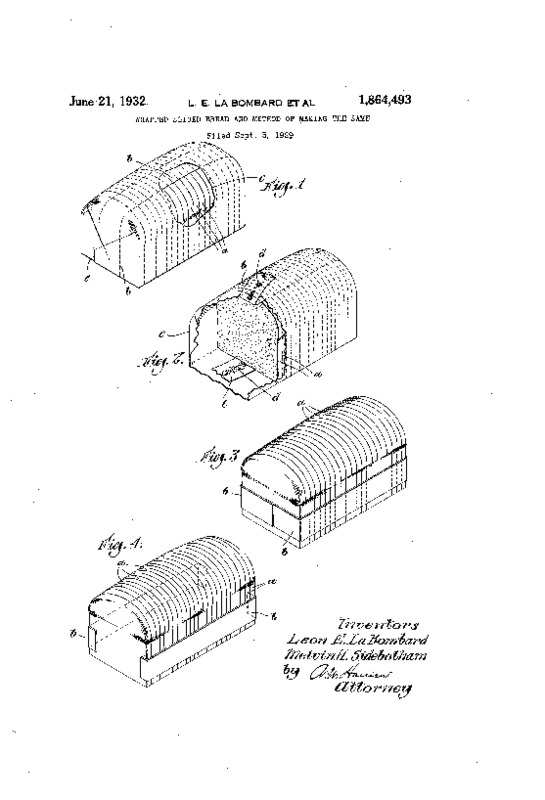
This patent is trying to solve the problem created by bread slicers: keeping bread fresh. As previously stated, during this time period, inventors tried to come up with different ways to package and manufacture bread. Bread slicing machines were time-saving and convenient, mainly used for large institutions where whole loaves of bread would have been eaten. A need to package, save, and preserve the bread shows the bread moving more and more into the everyday household. Inventors knew this, drawing out multiple options, as seen by the patent here. There are safe-to-consume adhesive tabs and different forms of plastic wrapping. The inventors of this patent kept the users in mind, making it as safe and easy to use as possible. Although this packaging does not make bread new, it adapts new bread (sliced bread), solving any previous problems that occurred before. Not only are the large institutions able to salvage any bread that was not eaten, but sliced bread can be experienced in the home, becoming more convenient for everyone to have.
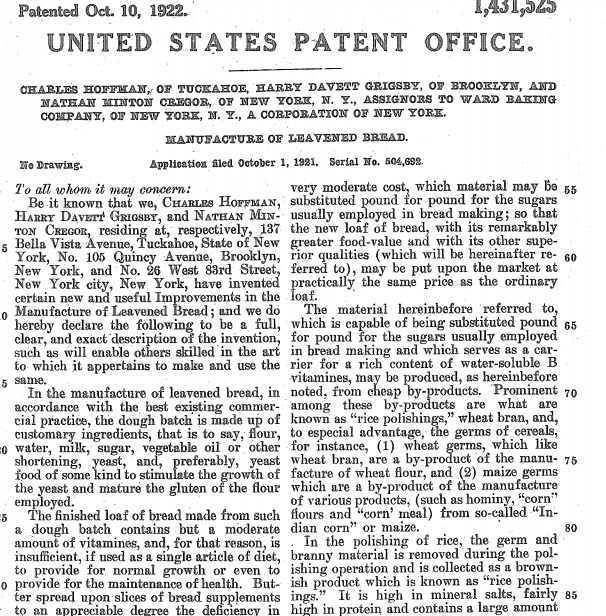
Its clear American consumers want bread that is fresh and stays fresh, but what about other means of freshness, or bread that lacks in nutrients? A patent titled "Manufacture of Leavened Bread" patented on October 10th, 1922, proved that fancy wrappers weren't the only solutions to freshness, and more importantly that nutrient-dense bread was just as important as freshness. Charles Hoffman, Harry Davett Grigsby, and Nathan Minton Cregor claimed that bread consisting of the usual ingredients of flour, water, milk, sugar, vegetable oil, and yeast, “contains but a moderate amount of vitamins, and, for that reason, is insufficient, if used as a single article of diet, to provide for normal growth.” Thus their need for a new invention of leavened bread was born; one that contained the necessary nutrients for proper growth.
Majority of the patents were for some type of bread clamp or resealer, and bread bags or wraps that claimed to retain freshness longer than currently available bags. What these men are doing is instead of designing accessories, they are going back the technology itself, examining its current state, and developing a plan to make it better, to make it new. Bread will always be a past, present, and future technology.
This patent proves bread modification or improvement is not a 21st century phenomenon. Although the machines, such as the bread slicer and toaster, gained more attention and took over the bread industry, these men showed bread itself also needed improvement. Although the bread slicer was made for convenience, this patent can be seen in the same perspective. If bread in its current state does not hold as much nutrition as desired, then a recipe for nutritious bread fulfills both the health and convenient issues during this time.
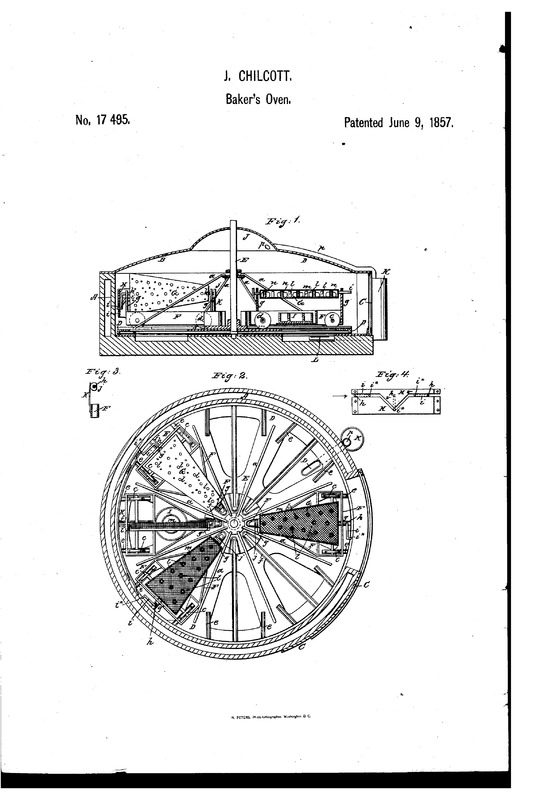
In 1857, John Chilcott successfully applied for a patent of his innovation, the Baker's Oven. The oven, also practically used as a travel vessel, appeals to the bread norms of the 20th century which made Chilcott's patent of 1857 so unique.
The oven is designed into sections and different levels in a travel trolley. The design is set so you can have x number of loaves per baking period that come out of the over seemingly identical. This is the perfect style for the mass produced, non-flavored identical nature of 20th century bread. It is not produced consistently nowadays or desired by supermarkets due to the ever changing and prgoressing nature of conjunction junctions, but it's successfiul patent filing showed John Chilcott to be an innovator far ahead of his time.