Timekeeping - Present
INTRODUCTION
Beginning in the 1950’s, timekeeping became standardized. Once there was an accurate system of keeping time, technology started to advance to where timekeeping became more precise in addition to other features being added to time devices. Out of this came the question: what is the function of precision in timekeeping? The present section first explores the idea of time precision in the Olympic sport of swimming, then transitions into fiber optics, which can be used to calculate a more accurate & precise for other technologies. Finally, concluding with the combination of precision and function with flying alarm clocks, smartwatches, and mechanical watches.
GETTIN' PRECISE!
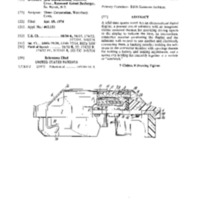
In this documentary titled “Crystals go to War” we can see that quartz crystals were increasingly being used for the war efforts (World War II that is). Although quartz crystals in this documentary are being used for wireless and radio technology, we can see that their mass production and the efforts to manufacture them quickly is what partly drove scientists to use them as a sharply defined frequency standard. Quartz crystals are a core component to many electronic devices today as they can be used in a type of circuit often referred to as “Quartz Crystal Oscillators.” An oscillator is a device that typically generates an electronic signal with periodic motion. In “Crystals Go to War” the quartz crystals are being used to generate high frequency electromagnetic waves for the purposes of communication. In the case of watches however, the quartz crystal oscillator generates a signal of a sharply defined frequency and the digital electronics inside a watch counts the number of pulses generated by the oscillator. The number of pulses counted is proportional to the amount of time that has passed. As we can see, this principle is later used as the basis of the patent for the digital watch.
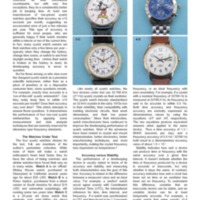
This paper from NIST (National Institutes of Standards and Technology) published this paper on the accuracy and stability of quartz crystal watches. Although scientists have much more accurate standards for measuring the passage of time, the quartz crystal watch is highly important due to the fact that most consumer electronics that requires precise timekeeping or displays the time for a user, uses the quartz crystal oscillator as it’s basis for precise timekeeping. In this paper scientists tested the stability of quartz crystal oscillators as temperature fluctuated, a very real consideration to take into account. The paper concludes that with some additional compensation even the cheapest quartz crystal watch can lose far less than one second a day. A great achievement for a technology so miniaturized.
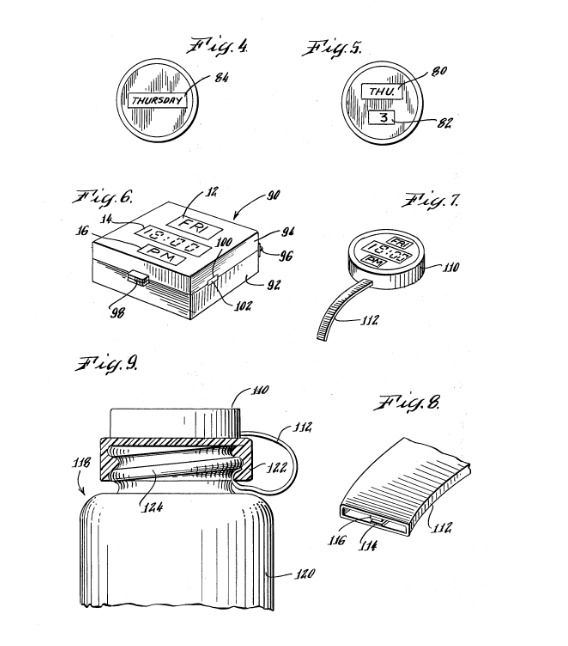
This device was patented by Bart J. Zoltan, with the entended use that enables patients to keep track of the time they took their last dose of medication. There is a time keeping device located on the cap of a typical medicine container that displays the time and day of the week the container was last opened by the patient-user and continues to display the time it was opened to serve as a reminder. The time keeping device can feature alarms (visually or audibly) to alert the patient when to take the next dose. There are works to make the cap adaptable to use with standard medicine containers thus making it reusable for other pill bottles. This type of invention improves the need of accuracy for patients who are dependent of a strict medication schedule and also users who have trouble remembering when their last dose was taken (ex. a person with alzheimers).
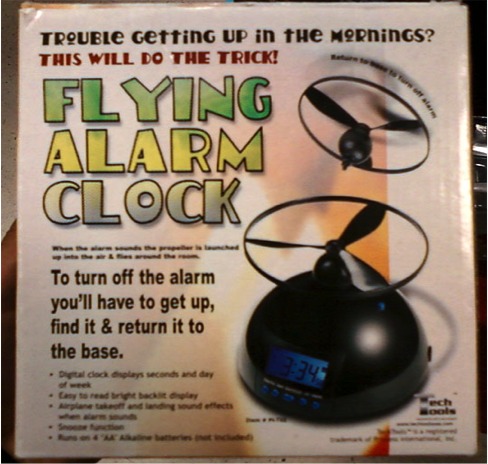
As timekeeping technology has advanced, additional features were introduced to tell more than just the time of day. Although the main function of a clock is to tell time, alarms have become a second component to it. People who go to work or school are dependent on an alarm to wake them up. However, sometimes alarms fail. Maybe a person is a heavy sleeper or they like to hit the snooze button too many times. Various inventors have added creative ways to solve this problem. The flying alarm clock is a possible solution to combat sleeping in. This clock was created by TechToolsUSA and how it works is that the person sets up a time he/she wants to get up and as soon as the alarm rings, the clock would propel itself in the air and hide in a location within the room, forcing the person to get out of bed and find the clock to turn the alarm off. Although a flying alarm clock is unusual, features on clocks such as radio or a dock to connect your phone to are more common. Most timekeeping devices today are digital when in the past mechanical clocks and watches were prominent.
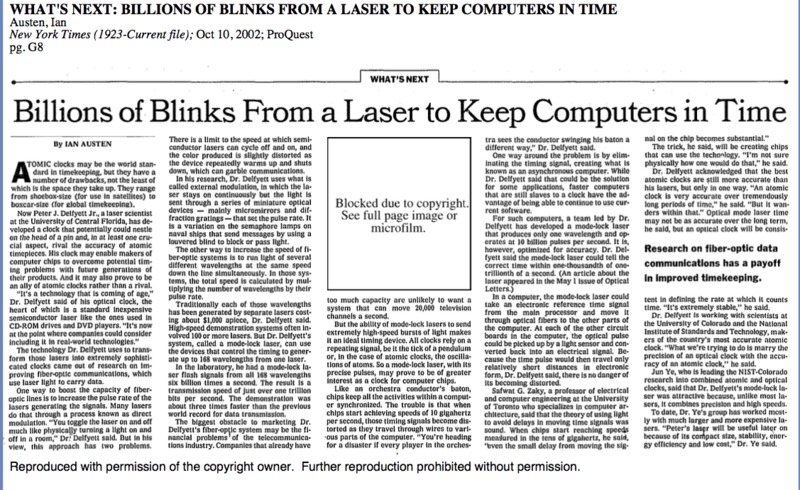
The function and attributes of timekeepers evolve within the technological framework of the society and the time period. In part due to current technological advancements and the standard set out by smart phones, modern timekeepers are expected to be precise and compact. As introduced above, atomic clocks have been the standard of accuracy for timekeeping, however an aspect it lacks is the compactness that consumers, industries, and all relevant social groups desire and expect from their timekeepers. In this exhibit, an article in the “New York Times”, details the emergence of new way to set the standard for precision timekeeping, including the compactness. Fiber optic technology, that we commonly associate with network access, transfers data through laser light. Now this same technology is being applied to create an extremely precise timekeep in electronic devices by using the high speed bursts of light from lasers to create “an electronic reference time signal...move it through optical fibers to other parts of the computer” (Austen 2002). Most electronic devices, have microchips that synchronize all of the activities within each device but due to the time it takes for the signals to travel, this can lead to inaccuracy. Dr. Delfyett, a laser scientist at the University of Central Florida, created the mode-lock laser, which the National Institute of Standards and Technology hope to marry with its atomic clock to create a device that is both precise and accurate, respectively. The invention of this device, is a snapshot of the present state of timekeeping, where timekeeping has evolved to expect and seek very high levels of precision. As new technological systems and applications develop, so does the ability and practically of having a timepiece, of expecting a timepiece, that provides high levels of accuracy and precision.
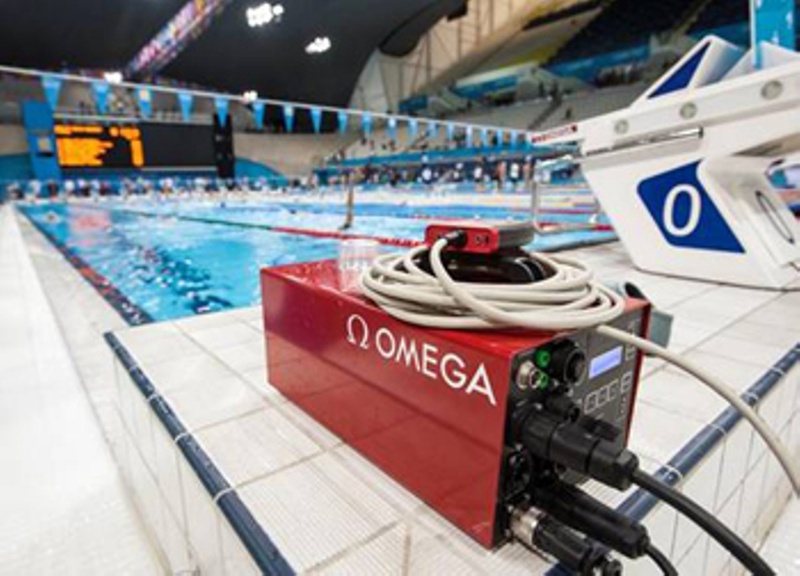
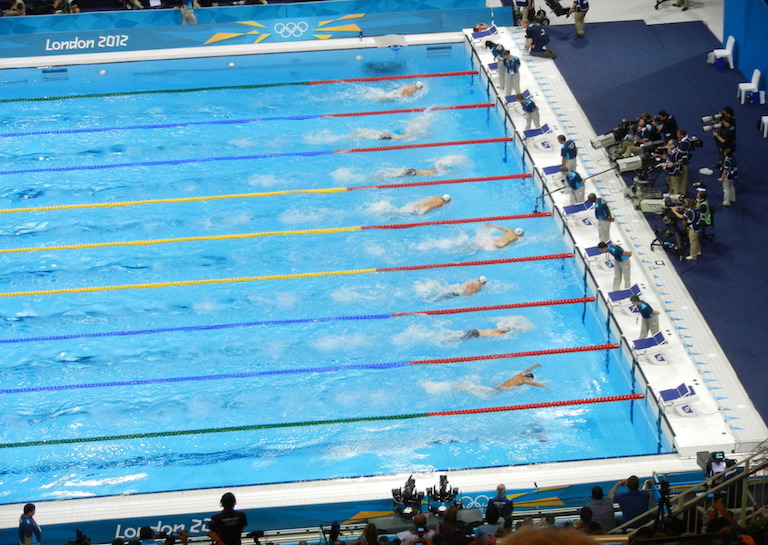
For the 2012 Olympics, Omega, the timekeeping company for the olympics, rolled out its advanced timekeeping technology. The quantum Aquatic Time has an ehanced resolution to one millionth of a second. This technology also has a resolution that is 100 times greater than their previous technology and precision 0.1 parts per million. This is due to the use of a Micro Crystal compnent in the timer. There are also other factors that contribute to the timekeeping of Swimming in the 2012 olympics. The use of Touch pads and High-speed video cameras along with the updated timer. However, depsite how precise this technology is, the Olympics Swimming used a hundreth of a second as the smallest measurable margin in a swimming competition. The article talks about how the current technology is five times more accurate than the past technology but still timing comes down to a hundreth of a second. An article from interestingengineering.com talks about the physics of an olympic swimming pool. When it comes to math, there is a point where significant digit becomes meaningless and does not accurately represent the data collected. An olympic-sized pool is 50 meters in length. The article discuesses how 1 thousadth of a second is equal to 2.38 mm of travel but the tolerance on an olympic sized pool is 3 centimeters in length in variance per lane. Which creates a problem using a thousandth of a second or anything more precise. There is not way to ensure that the winning swimmer did not have a shorter length of pool to swim, statistically speaking. Which begs the question, when does precise time keeping come to precise that it is no longer accurate? Well Olympic Swimming is the answer because for this specific instance, the significant figures speak on the accurarcy. Hence, why Olympic Swimming is measured down to the hundreth of the second despite having the technology to be more precise. Because being more precise do not mean being accurate.
PRACTICAL PEOPLE PRECISION
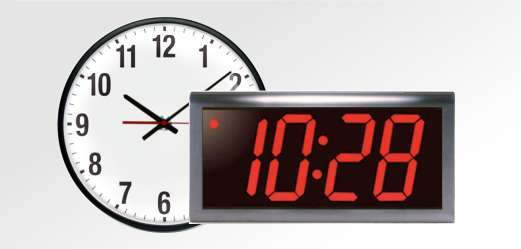
During the standardization of time, there first came analog clocks but eventually the digital clock also came out. Today in 2016, both analog and digital clocks are still used. But which is more precise and why do people prefer one over another? A study of Dutch speakers investigated how the speakers processed and prduced relative time expressions. This study was conducted using a repetition priming program. Participants started by naming time expressions based on an analog clock then they looked at a digital clock and named time expressions. Participants referred to digital clocks by referring to the hour, half past the hour, or a quarter to whereas when looking at a analog clock, there was a difference in one or two hour and in five or ten minutes. The conclusion being digital clock naming was shorter with a five to ten-mminute difference than that of an analog clock. However, thereer was no difference in naming the hour. "These finding suggest that conceptual facilitaion occurs when conceptual transformations are shared between prime (analog clocks) and target (digital clocks) in telling time." Based on the results of this study, Dutch speakers were able to be more precise in time keeping when it came to an analog clock. The data also revealed a link between the ways the clocks are displaced visually and the production of time expressions. The results seemed to point to personal preference in using either analog or digital clocks.
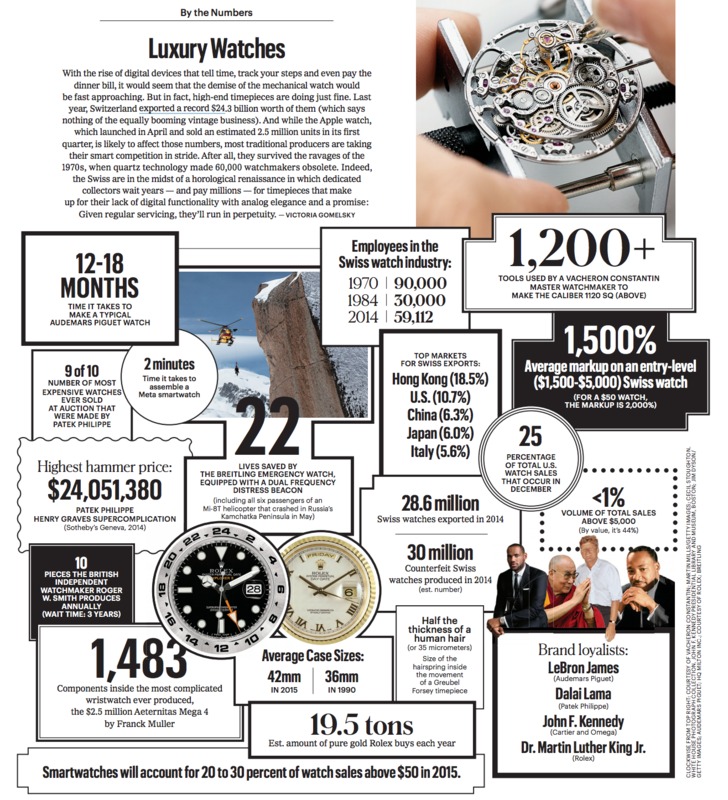
With the rise of digital watches, many people believe that mechanical ones are becoming obsolete. An example of a digital watch is that of Apple, which not only tells time but also has available features similar to that of the iPhone. A lot of people prefer digital watches, because they claim that the quality is more high tech. That doesn't necesarilly mean that mechanical watches are slowly diminishing. They have found a new consumer base, trend setters of the high class. The most expensive mechanical watches are made in Switzerland. Swiss watchmakers continue to see a steady consumer need of mechanical technology. A record of $24.3 billion watches were exported outside the country (Gomelsky, 2015). Although it’s more expensive to make a mechanical watch, people love the intricacy it takes to have it become a final product through the hands of watchmakers.These luxury consumers are not buying Swiss watches to tell time, it's more so a status symbol. Swiss watches are sold in high-end stores, where the consumer is typically fashion savvy and are willing to pay the price for more expensive items. So that brings into question, is the function of a mechanical watch changing to that of a fashion statement for the higher class? It could be argued that the mechanical watch is serving a dual-function. Whether digital or mechanical, these timekeeping devices aren't going anywhere as they continue to be important with keeping track of the day.
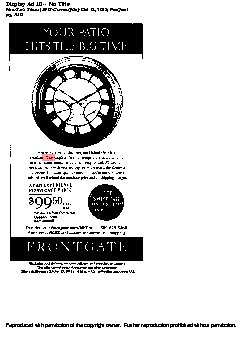
This artifact, found in the New York Times in the International section of the newspaper, advertises an oversized clock for the patio. The clock boasts an ability to convey the time as well as the current temperature and humidity levels, illustrating the versatility that is essential to compliment the contemporary lives of its users. As well as being practical in its design on how it displays all three of its components with a "multidimensional fashion that is easy to read", and in its' outdoor friendly material that is, "All weather, iron-alloy frame with brushed copper finish resists the elements". An artifact that is multifunctional, illustrating a desire by consumers for timepieces that do more than tell time. The pieces must now display information that modern consumers deem useful such as the current temperature but also in a practical and convenient package as the ad refers to the iron-alloy frame that will not rust and cause a headache for its purchasers. Illustrating that even though the ornate patio clock is a novelty of sorts for those that enjoy ornate clocks or for those with the luxury of a patio, that convenience and hassle free must be part of the package for timekeepers as well.
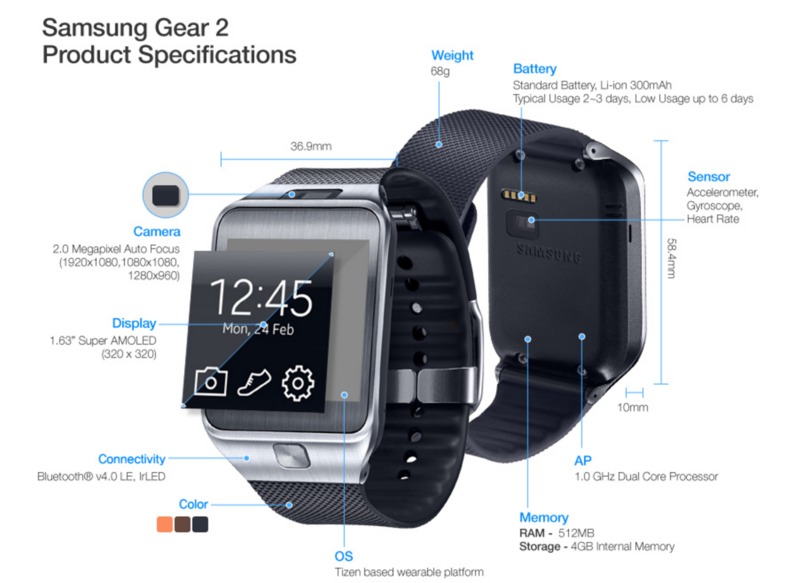
A special type of digital timekeeping are smartwatches. The brand that immediatley comes to the mind of people is the Apple Watch. Over six million people have bought and are sporting them around. There are many features in the Apple watch that make it a high demand product, such as the sapphire-coated screen, which displays a custom version of iOS, NFC to support Apple Pay, and even a navagation feature. It would be safe to assume that Apple has the number one smartwatch out there, right? However, some experts argue that the Samsung Gear 2 is the best of the best. It's features include a camera, bluetooth, a sensor to track one's vitals, and a rotating bezel which replaces the typical use of swiping. But why do people still prefer to buy the Apple Watch? It all has to do with branding. People assume that Apple has the latest technology to offer. It also has to do with being socially accepted by peers. We understand it's just a watch, but others feel lesser than or left out when they see their peers using the Apple watch and they don't have one. Society, specifically the younger generation, likes to keep up with technological trends so that they feel up to par with the rest of the people around them. Having a smartwatch would be an example of a social status symbol, on top of being able to tell time (amongst the other features they offer).
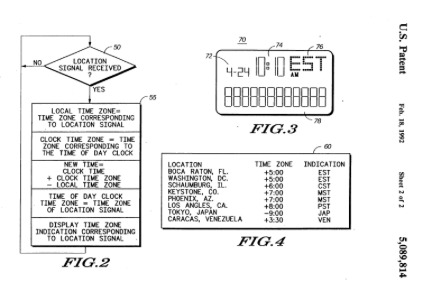
With the establishment of time zones worldwide and the increasing ease of travel to all parts of the globe, the consumer must now demand and producers supply a device that is able to conveniently change the time zones automatically. The technology patent, US5089814A, is exactly for such a device. Technology to automatically synchronize the watch to the time zone of the wearer using locating systems such as GPS (also utilizing time and space techonology). The demand for timekeepers to be as convenient and practical for all types of consumers. Even if one doesn't travel, this type of automatic technology is now expected from our timepieces, whether it be a watch or smart technology, i.e. computer or smart phone. Exemplifying the expectation of consumers on the convenience and efficiency from timepieces to maximize time and minimize the effort it takes to manually change "trivial" settings as the time zone of one's watch.