Pocket Knives - Past
Because of the relative old age of pocket knives which have dated back to the Roman times, knife technologies have gradually and incrementally improved throughout the centuries, and only until recently, has the technology dramatically changed. The paragraphs below describe various artifacts that discuss these incremental innovations and the contexts in which they occurred and the reasons for why they were made.
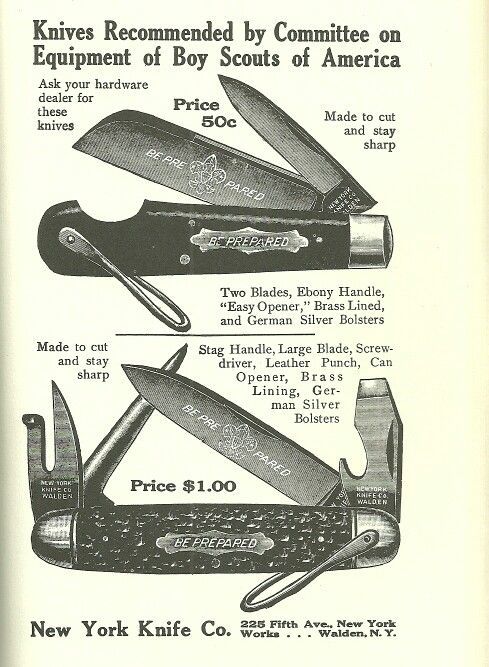
The New York Knife Co. Official Scout Knife advertisement displays the first ever official Boy scout knife. Before “Swiss Army” type multi-tools and tactical knives came on the scene, every respectable outdoorsman and especially a Boy Scout would carry a variation of the knives in the Ad. The first is of a simple two blade design, which were not lockable, and not made of the highest quality steel. The idea of having two blades was to essentially use one blade for mundane daily tasks to get dull, and to preserve the other one for finer work such as carving or whittling. The second knife is of an early “multitool” type as it has five functions that a common Boy Scout at the time would need. It contained a knife blade, a leather punch, a can opener, and a screwdriver combined with a bottle opener. Eventually, the Swiss army knife and Leatherman knife would become widespread and would have many more functions than just these five. The blades on these knives are of the slip joint variety, meaning that they are held open by tension, but do not lock in place. This was the most common type of knife up until the 1964 Buck knife which introduced a strong locking mechanism to the masses. Before that invention, most individuals carried multiple knives for multiple uses. For example, tasks such as batoning (splitting wood with a knife by hitting a ‘baton’ on top of it and the wood), butchering game, and cooking would be taken on with a sheath knife due to its larger size, but most importantly due to its sturdiness that did not exist on a pocket knife. Other tasks like cutting rope, opening letters, or sharpening a stick would be done with a pocket knife. Overall, before the advancements of locking blades, better steel, and multiple blades within one pocket knife, individuals would have to carry multiple knives, such as this knife and the one below, in order to complete the tasks that just one of today’s knives could handle.
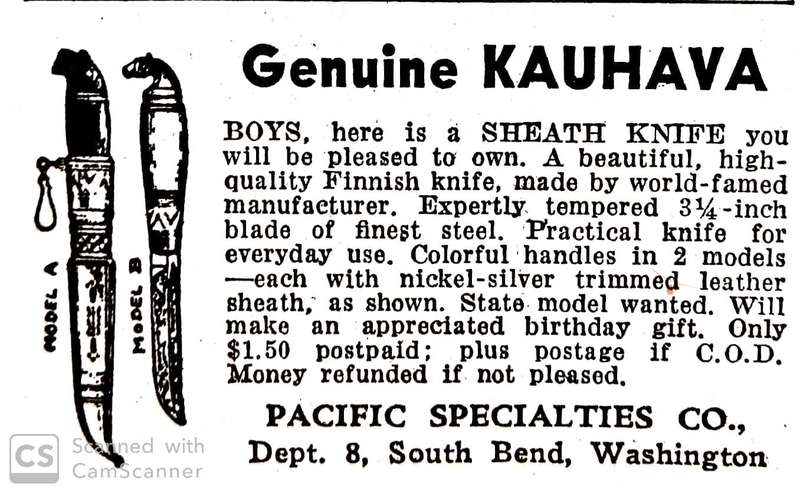
The fixed blade knife advertisement is from a copy of Scouting magazine from 1937, and shows a “Genuine Kauhava” sheath knife. Kauhava refers to a town in Finland which has traditionally produced knives, and so this advertises where the knife is from rather than a specific type of knife. The knife is advertised as “beautiful” and “high-quality”, and is also marketed as a “practical knife for everyday use”. This is because the knife has a blade length of 3.25”, which is relatively short for a fixed blade knife. While part of the appeal of the knife is that it is expertly crafted and good-looking, the other part of the appeal is that it is conveniently sized for everyday use. However, it is still a sheath knife, and the fixed handle would mean that the knife is less compact and convenient than a knife of the same size with a locking folding blade. Before that innovation, the solution to fixed blade functionality in a compact size was to simply reduce the size of the fixed blade.
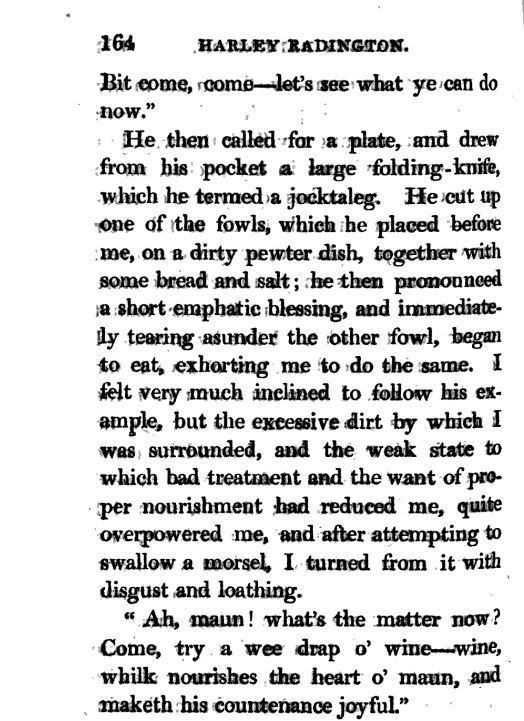
In the passage from the book Harley Radington, written in 1821, the title character recounts how a knife is used as a common tool when visiting his family in the country. The book begins with Harley traveling from the city to the country, and he visits with family members who live in a far away part of the land. While there, he describes how at one point, a man named Mr. Grantly took a pair of "cold roasted fowls" and a knife, which he called a “jocktaleg”, and cut up the birds to eat. While brief, the mention of the knife being used has important implications. First, Grantly called it a jocktaleg, which is a Scottish term for a knife, although it is not commonly used. Second, the fact that Harley, a city dweller, felt compelled to mention the incident, may mean that he does not use folding knives on a regular basis for things like cutting up food. Finally, the way in which Grantly pulled the knife and birds out of his pocket and just “cut them up” likely means that he did it without much thought, and that he uses his knife for such things on a regular basis. From this depiction, it is apparent that in rural areas, like where Grantly is, knives are used as tools every day for a variety of tasks, including slicing birds for breakfast.
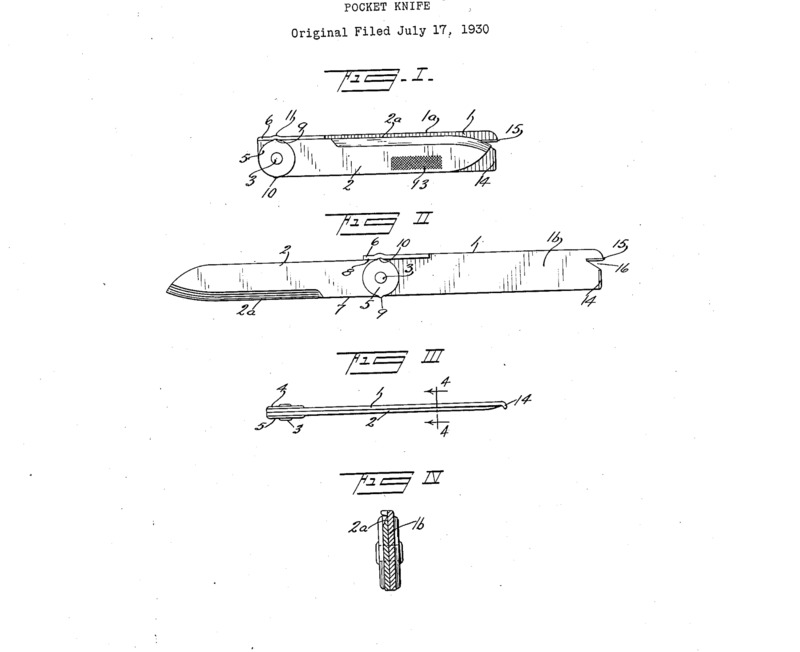
Patent 1,994,215 by Charles Gaunt is for a pocket knife that has improvements that are useful for cutting messy items, specifically fruit. The knife has an open design useful for wiping away fruit residue or fruit peels. It also has a bottle opener which is obviously useful for opening bottles. These features appeal to social groups that may want to be able to open a bottle and also cut fruit and easily clean the blade, such as casual outdoorsmen. The open style design of the knife may also be appealing to other social groups that would need a tool that is easy to clean. For example, hunters and outdoorsman may want to be able to easily clean their knives in the field. Assumedly, Mr. Grantly from Harley Radington would have appreciated this function after carving up his fowls for breakfast.
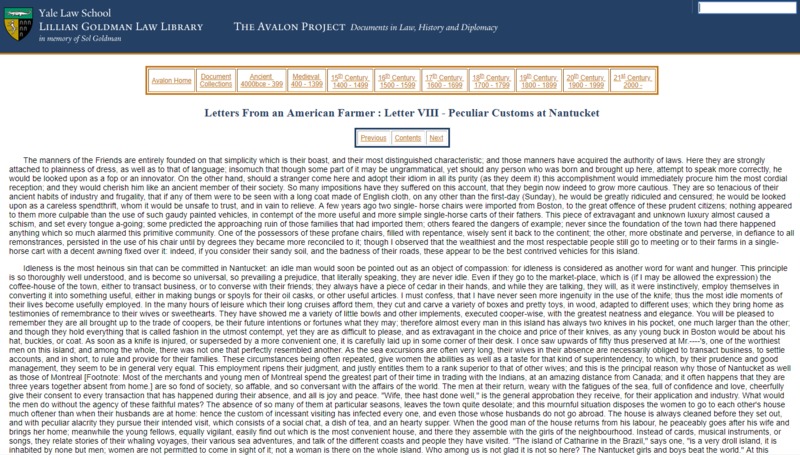
In a letter from an American farmer in Nantucket in the late 18th century, the various uses and characteristics of pocket knives were discussed. The first purpose listed was for entertainment. Before modern transportation, traveling was a lengthy and grueling process. The farmer claimed that men would whittle and carve wood to create decorative pieces and toys for their family members to pass the time. These items were also sold to others if they were made with excellent craftsmanship. For these purposes and more, almost everyone within the farmer’s premises carried two knives in his pocket. Later on, certain knives, such as the 1912 Boy Scout folder above were designed to contain two blades to eliminate the need to carry two different blades which specialize in different tasks. Knives were chosen for their quality and design in order to suit the owner’s preferences. The last observation that the farmer makes is that pocket knives were replaced or traded in for upgraded versions. Using knives for multiple different tasks, as well as habitually upgrading them, is a trend that continues up until the present day.
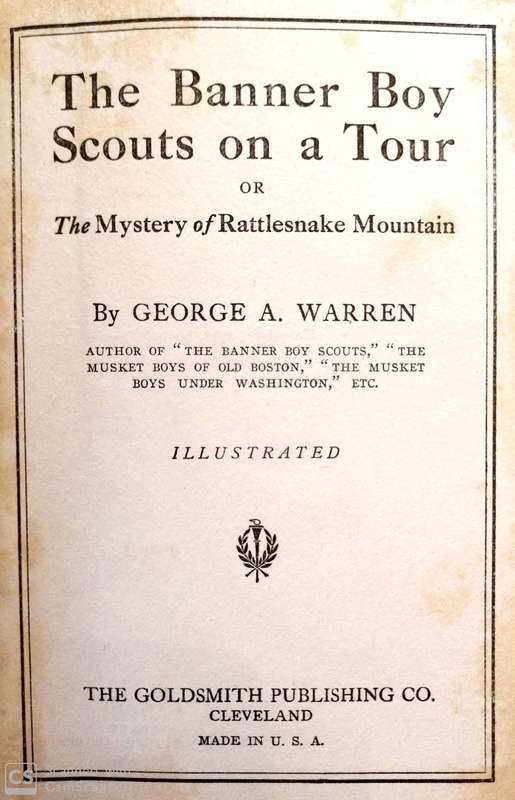
The novel entitled “The Banner Boy Scouts on a Tour” is a work directed towards children (specifically Boy Scouts) that was written and published in 1912. At one point during the novel, a younger scout whimsically gets caught into a tree by a gale force wind catching his tent like a sail, and an older scout is tasked to save him. On page 273, the older scout, Paul, is described as always having “his stout pocket knife with him” and that “it was his habit to keep all of the blades very sharp”. The pocket knife described in the article is most likely the first edition 1912 Official Boy Scout Knife as written about above. Fortunately for the scout stuck in the tree, Paul came to cut him out of the tangled-up mess. From this passage, Paul is clearly illustrated as a good role model for the novel's readers not only in bravery, but also in proper handling and use of a knife. Interestingly, the novel also describes the difficulties that Paul had in trying to not only open his knife, but also find the knife deep in his pocket, while at the same time trying to climb the tree. The author then describes Paul as not knowing “how he managed to get that knife out of his pocket” and that after he spent “a little” trying to pull out his knife, “he had found it”. This paragraph clearly shows the shortcomings of Paul’s pocket knife, specifically regarding its difficulty to access in situations where only one hand is free. Fast forward 70 years, the Spyderco Clipit is invented, which, as will be seen below, gives users ease of access and also one-handed opening. In the end, Paul does manage to get the younger scout cut free from the tree, but perhaps if he had a Spyderco Clipit, he would have been able to get the young scout out of the tree more quickly and safely.
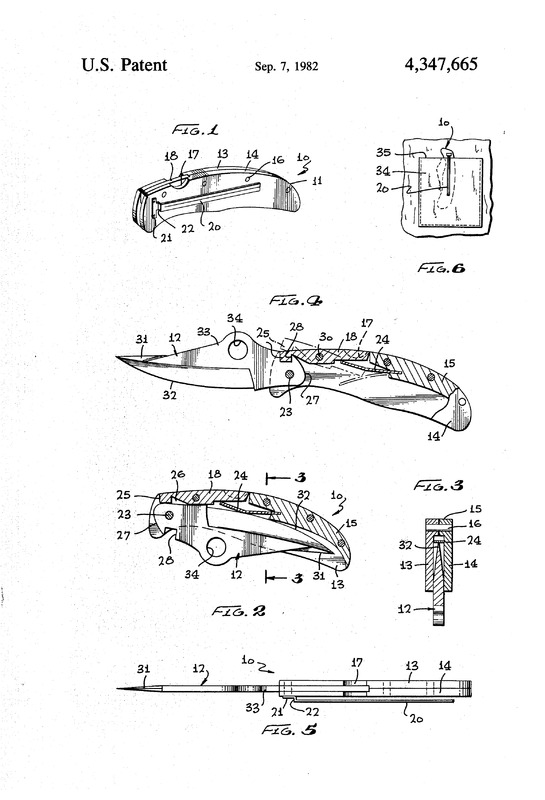
The first patent for the Spyderco knife filed by Louis Glesser illustrates the first ever “tactical folder” as they are known today. The patent filing describes three things that make this design novel, useful, and non-obvious. The first is that the knife is able to “be stored in the area of the pocket without causing damage to the fabric”. The second feature is that the knife can be “opened by one hand of the user”. The third feature stated is that the knife “does not require visual inspection [prior] to opening”. This implies that all previous iterations of pocket knives did not have those features or capabilities within them. A combination of the features as stated above, an ergonomic grip, and a single sharp blade are what could be defined today as a “tactical” folding knife, due to its original development and use by the military and police forces. Before the first Spyderco pocket knife, knives were carried in the bottom of the pocket meaning that in order to deploy it, one would have to fumble through their pocket to grab it. Also, they were prone to getting misplaced due to their not being secured to the user. Additionally, pocket knives (except switchblades) had to be opened with two hands, making it a problem when only one hand is available for use in perilous situations. Finally, it often was not easy to find the indent on a pocket knife where the thumbnail would go to pull out the blade, making the deployment process even more difficult. All of these problems caused Louis Glesser to invent the pocket knife illustrated in U.S. patent 4,347,665. These innovations that Spyderco pioneered are seen on almost every tactical pocket knife that is being manufactured today.
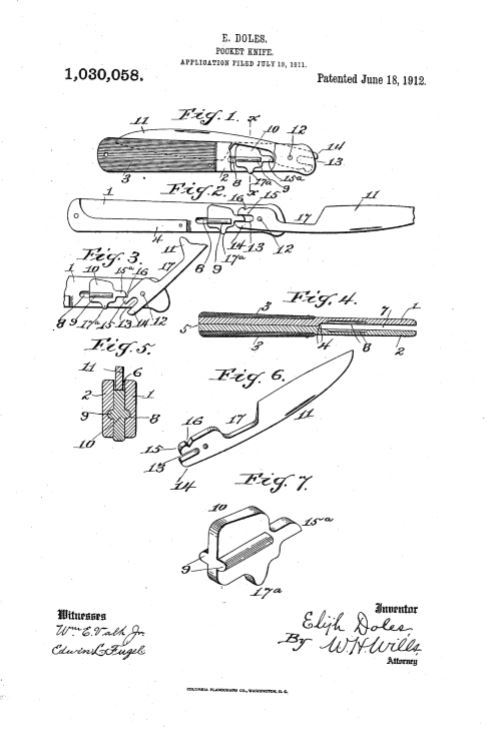
Before the Spyderco knife and the Buck Huntsman knife, many different locking mechanisms were being invented which all tried to do the same thing, give a pocket knife the functionality of a fixed blade knife while still retaining its compact size. US patent 1,030,058, filed in 1911, is for a “new and useful improvement in pocket knives”, and details a type of locking blade mechanism. The purpose of the invention is “to provide a knife blade of novel and peculiar shape or construction, and a specially designed locking device adapted to cooperate with the blade for holding or locking it in open position”. The knife being patented can lock in the open and the “partially open” position, and this allows it to be used more vigorously than a non-locking knife. This is because the user does not have to worry about the knife closing on their hand while they are using it. When partially open, the blade can be used at an angle, as shown in Figure 3. Although the utility of this is not made clear in the application, it can be assumed that it would be useful for shaving. The locking blade is an important step, but is not the final form of the technology. For instance, it does not appear that the blade can be reliably opened with one hand, and does not seem to stay securely closed. These were all improved upon at later times, but the concept of the locking blade was an important step in the evolution of the pocket knife.
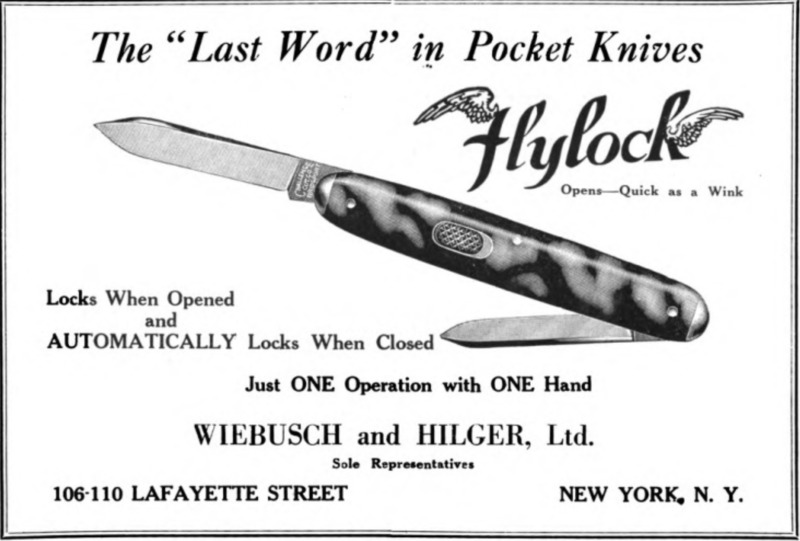
The Flylock ad depicts a knife that can be locked in the open and closed position in a different manner than the knife above. This is appealing to the relevant social groups that may require that security of a knife that can be locked open. It may also be appealing to groups that have small children and don’t want them to get into their knives, and they have the ability to lock the knife closed (child proofing the knife). Both of these social groups are seeking some kind of security aspect. The other aspect of this ad is that it is attempting to suggest something about closure. The phrase “last word” suggests this will be the end all be all for pocket knives. While this is the future, as succeeding innovations in knives are ones that can be mechanically locked, this particular locking mechanism was definitely not the “last word” as it was ineffective for quick opening, and also because the lock failed easily.
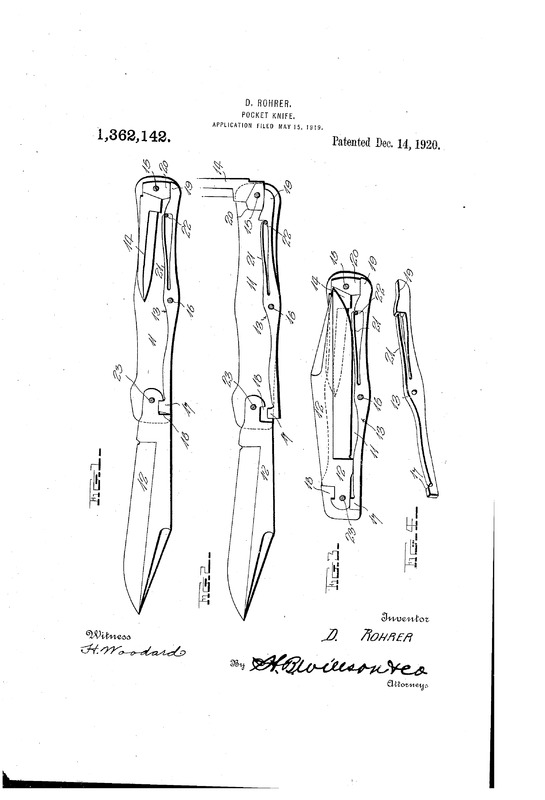
The patent US1362142A, filed by Daniel Rohrer in December 14, 1920 shows another instance of an improved locking knife for increased safety. The object of the invention is to provide a locking mechanism which will prevent the blade from being accidentally closed. However, the blade would still be able to be easily released from the lock and opened with ease. The knife was also engineered in such a way so that it is made up of very few simple parts, so that it may be manufactured cheaply. This knife also provides a separate blade built into the opposite side of the handle. The blade is smaller so that it is suited for many different jobs requiring the smaller blade. Once again, the locking mechanism showed promise, but was not adopted, widely due to its design flaws of not being sturdy enough for vigorous use.

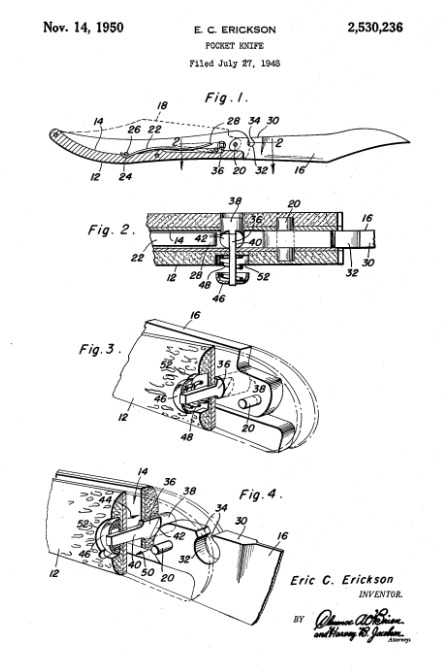
While many improvements in pocket knives focused on locking mechanisms to achieve fixed blade functionality, other patents looked for ways to have folding knives quickly open. This patent, filed by Eric C. Erickson of Queen Cutlery Company in 1948, portrays one of the first instances of the assisted opening folding knives known as switchblades. The purpose of the invention was to be able to deploy the blade simply by pressing a button. The prototype for the button release heavily relies on the blade’s ability to lock in a closed position, as explicitly stated by the creator. The blade itself must also be concealed inside the folding sheath if it is to be deemed safe. Mechanically, the assisted opening functions rely on the tension in springs and the positions of pins. When the button is pressed, the spring holding the knife in a closed position will be compressed. Since the knife is no longer being pressed into the sheath, it will naturally swing into the open position due to the force of other tense springs in the mechanism. This patent was one of many that began to create the switchblade as we know it today; however, they were not yet developed thoroughly enough to reach their modern stage of popularity. Additionally, the advancement of knives with button releases made folding knives more viable as a weapon. Some states in the US, including Hawaii, have since banned switchblades.

In the film West Side Story from 1961 there is a scene that depicts two rival gangs that break out into a brawl. The brawl escalates until the rival leaders Bernardo and Riff enter into a fist fight and eventually draw their switchblades. The blades glimmer in the light and then the deadly dance begins. The scene goes to show how the switchblade would be commonly used as a weapon. It was a go to weapon because it’s small and can fit in the pocket to be concealed, and also it is easy to operate and have the blade out quickly for offensive or defensive reasons. Within the scene a switchblade is even used to stab and kill someone, which goes to show just how deadly this weapon can be.
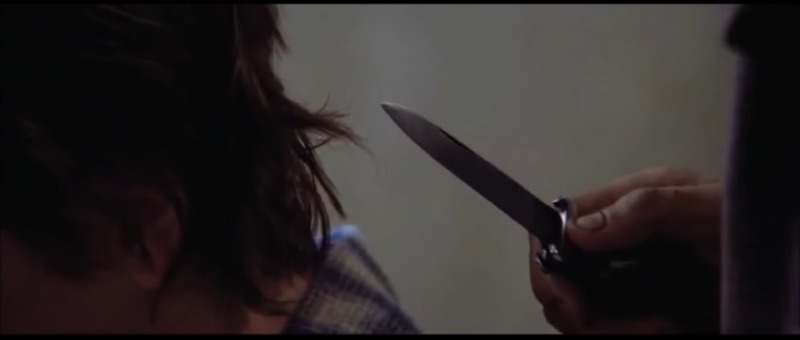
Despite the frequent display of the nefarious uses for switchblades in the media, there were some exceptions. In the scene from “The Outsiders” Johnny is using his switchblade to cut Ponyboy’s hair to change his appearance because both him and Ponyboy are on the run from the police. In this instance, the switchblade knife is used a tool to cut their hair. Many scenes throughout the movie portray the switchblade being used as a weapon, and is used to threaten people and even kill someone, albeit in defense of someone else. However, this scene demonstrates that the switchblade, which is typically depicted only as a weapon, also has uses as a tool. Furthermore, this brief episode also demonstrates the use of the knives by kids. Ponyboy is 14 and Johnny is 16, demonstrating that kids as young as 14 can use something seen as dangerous by many. Instead of injuring themselves or others, the knives are used in a safe manner and no one is harmed.
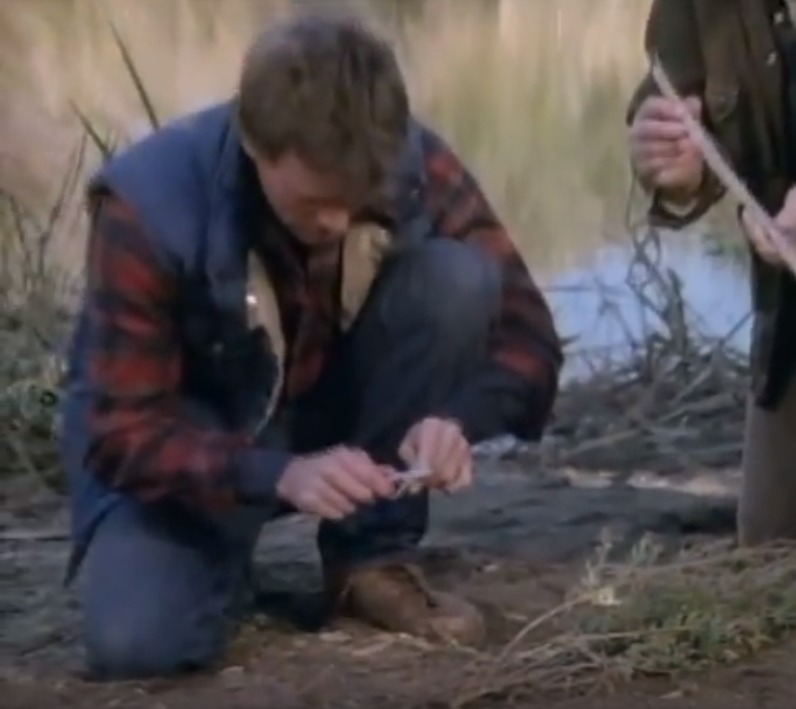
Another instance of the pocket knife being used for both good and ill is from the hit 1985 television series MacGyver, which widely popularized the Swiss Army Knife by portraying its usefulness in solving complex and unpredictable problems. For example, in the episode titled “Target MacGyver,” he uses the blade on his pocket knife to craft a blowgun using materials found in the woods. Most folding knife users do not consider this to be a realistic use of the knife in their personal lives, but MacGyver still helped revolutionize the idea that the Swiss Army Knife could be used in any situation, at any time. This was especially true for multi-tools compared to single blade knives. A screwdriver, bottle opener, or file performed tasks that a single blade could not, and these functions were also applicable in everyday scenarios. The scene in the show also inadvertently contributed to the theory that pocket knives can be weaponized. Although the knife was not portrayed as a weapon in and of itself, it was used to create one. Despite the show’s success, MacGyver was not the first to view the Swiss Army Knife as a useful tool; however, he exposed the American public to its limitless potential in functionality and created a trend that still stands in the modern day.
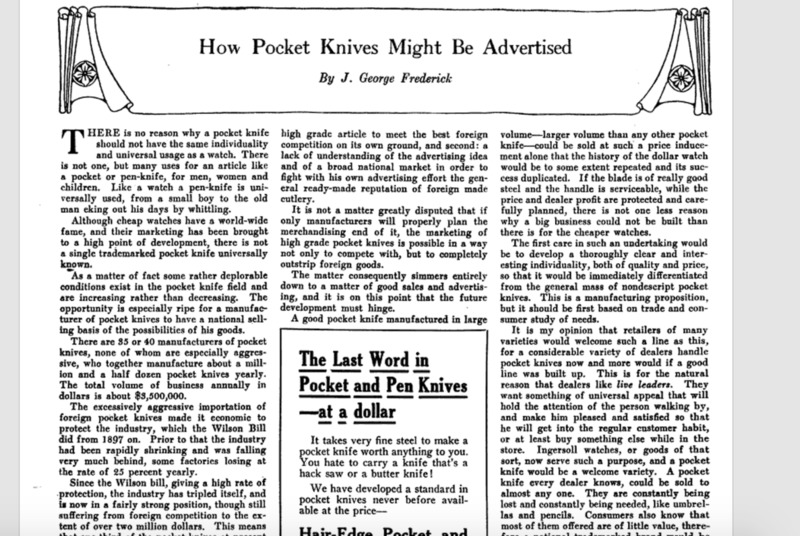
Ultimately, the innovations and updates described are only effective if they can be mass produced and marketed. As we see in the article How Pocket Knives Might Be Advertised, in order for pocket knives to reach worldwide usage there would need to be better marketing and production to match the universal tool. After all, “a pocket knife should not have the same individuality and universal usage as a watch. There is not one, but many uses for an article like a pocket knife.” Early attempts to make the pocket knife a more mass produced item suffered greatly from making a lower quality knife. Some low quality knives made abroad were passed off as American made, tarnishing the American Standard mindset. Pocket Knives needed to maintain handmade quality while servicing the universal quantity, because “every household needs a pocket knife”.
Overall, pocket knife innovations occurred after users expressed functions and uses that they wanted in a pocket knife but could not currently get, such as being able to lock the blade, dismantle it for easy cleaning, or open it with one hand. Pocket knife innovation has been focused on combining the best functions of a fixed blade knife, such as sturdiness, cleanliness, and speed, with the compact size and concealability of a folder. Additionally, the literary descriptions of knives in use highlight some of these contexts for innovation. In short, even though the standard shape and design of a pocket knife has remained relatively unchanged, the functions and designs that exist around it have evolved dramatically from their origins in antiquity. Knives are basically still a blade attached to a hilt with a hinge, but user led innovations over centuries have made this concept more efficient, safer, and easier to use.