Movie Cameras - Present
From Professionals to Consumers
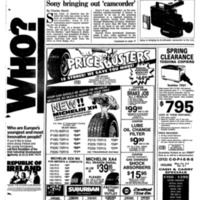
Charles Storch's article from 1985 marks a certain point in time of when the camera began to evolve into the product that consumers know today. He suggests that the a new product known as the 'camcorder' might be the successor the less user and consumer friendly videotaping products of the past, which is interesting considering that because of this and their lack affordability, mostly only professionals had regular access to video recording products. Though he acknowledges that there was not necessarily consumer demand for an alternative at the time and the camcorder’s price tag was still also not necessarily as consumer friendly as its unique features, he does make an effort to define and distinguish the new product from similar products of the past, like video and audio recorders that used half-inch cassettes, and concludes with obstacles that the new product faced at the time which primarily included overcoming the increasing popularity of and a lack of compatibility with these already existing half-inch videocassette products. Regardless, this marks the beginning of the evolution of the camera from an exclusively professional product to a more consumer friendly and accessible product.
The Consumer Advertisement
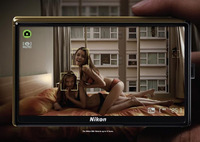
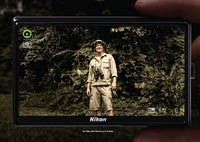
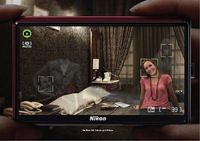
Nikon’s ads on their COOLPIX S60 from 2009 are a good example of not only the modern consumer advertisement, but of the modern representation of the camera to the average consumer. It starts with the problem that many cameras have in focusing on multiple faces, and the way it goes about demonstrating that it solves this problem is both clever and humorous. Whether it be through curious men peeking out the windows of their hotel rooms, several tribal-like faces peeking out of a bush, or ghosts, all 3 ads are effective not only in communicating the product's tagline and getting a memorable message across, but of placing the consumer/audience inside the shoes of the people in the ad, for it looks like you are the one holding the camera and taking the picture. In the end, these ads provide a good example of the definition of the digital camera to the modern consumer of familiarity and accessibility through the form of an advertisement.



Olympus’s 2009 ad campaign promoting their brand new Olympus E620 model DSLR appeal to both the average consumer and professional photographers alike, because the ad expresses all photographers’ desires to capture crystal clear still images of the ever-moving and changing world. The series of ads, part of the “Ice Block Campaign” show images of typically fast-moving objects being “trapped” inside of blocks of ice, including a flying eagle, a motocross bike, and a racing greyhound. Otherwise, the ads are fairly minimalist, with no words, accurately showing that a photograph can speak for itself. While the camera shown here is more on the higher end of photography equipment and is more difficult to use for an average person than a typical point-and-shoot camera, the ad gives the impression that this camera, with little work from the person behind the lens, is able to capture perfect action shots from moments too fast to be seen with the naked eye. Overall, the ads are effective in showing the camera’s ability to produce images that can freeze a moment in time, and making an audience out of average consumers and professional photographers alike.

The shrinking of the gap between professional and amateur photography has also been furthered by advances in mobile phone camera technology. This fourth ad, produced by Apple Inc. in 2016 to promote its iPhone 6s smart phone, targets the casual consumer market by offering an intersectional product which emphasizes convenience alongside quality. Conventional wisdom dictates that mobile phone cameras are convenient but not capable, while standalone cameras are capable but not convenient. The “Shot on iPhone” campaign represents Apple’s effort to overcome this perception by demonstrating that their iPhone’s camera is capable of capturing high quality photos. Their ads feature images which are artistic in nature, colorful, and heavily edited, thus appealing to the creatively-oriented consumer. This campaign demonstrates the increasing push by mobile phone manufacturers to occupy space in the middle-tier camera market. By competing for the share of amateur photographers who may have previously have sought a middle-market camera, but now might be persuaded to purchase a phone with a capable built-in camera instead, these companies serve to widen the convenience/quality gap in the camera industry. Because phone cameras are maximally convenient, any increase in their photo quality serves to chip away at middle-market cameras, which produce only marginally better photos but are intrinsically burdened by the fact that they require the consumer to carry a second device. Although professional-tier cameras appear safe (at least for now) from competition from mobile phones, their smaller, budget-friendly counterparts are being increasingly squeezed out of the market.
Today's Camera to the Professional
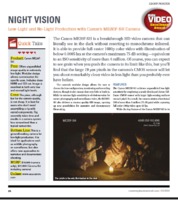
In a world where the idea of the digital camera is fairly fluid to all people, how do professionals continue to craft their own niche within the camera market and industry? Geoff Poister’s review from the September 2016 edition of Digital Video Magazine is exactly how. If any normal person were to flip to his review on the Canon Me20f-sH, it would be almost automatically apparent that he was not reading a review of the newest consumer digital camera available at your local department store. Instead, he would most likely either be turned back or impressed by the multitude of professional jargon and fancy camera words used throughout the review. Though the review does touch on some familiar concepts like frame rate and filming in the dark that might interest your average consumers who fancy themselves as habitual photographers or family movie makers, it is the $20,000 price tag that would, if nothing else, turn them off. Regardless, he does offer a useful review of a new and innovative product that a professional movie or documentary maker would more likely be able to afford and even proposes that it might be more than just another new professional movie camera, saying, “[the] camera's unprecedented light sensitivity may set the course for a whole new aesthetic in filming that will transform both documentary and narrative film production.” In the end, this article provides a good example of what continues to distinguish the professional from the consumer camera market and industry.
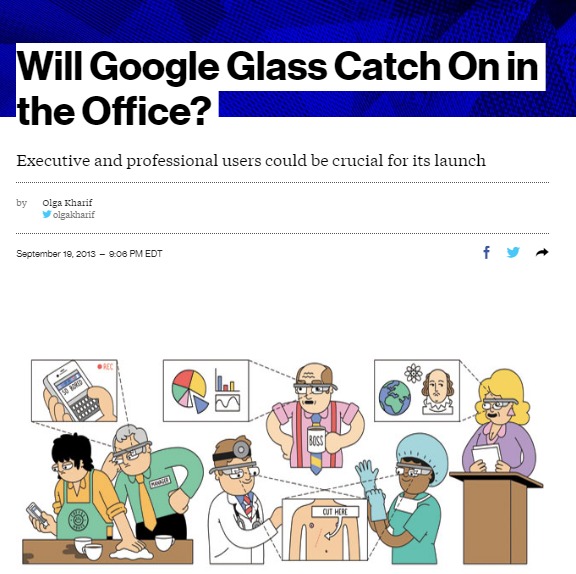
Bloomberg in September of 2013 argues that professionals are a critical group to be relied upon in the popularization and survival of new technologies like Google Glass. By adopting a new technology like Google Glass into everyday usage in an industry, professionals have the opportunity to make a technology a staple in their individual fields, and something that average consumers, students, and clients would expect to be involved in that industry. Without the support of professionals, technology is less likely to ever diffuse down to average consumers. The article at hand focuses on the uses of Google Glass in the classroom, giving an account of medical students better able to learn because they can watch their professor perform a surgery live and from first person perspective. Other suggestions for uses of Google Glass to increase productivity include the ability of truckers and drivers to use the device’s navigation tools, supervisors to watch employees through the device, speech-to text translation for overseas business transactions, and much more. Overall, this article is effective in introducing Google Glass and providing professionals and employers with incentives to invest in this device for their workplaces and institutions of higher learning, and showing how professionals are integral to embedding a new technology into everyday usage by both professionals and consumers.
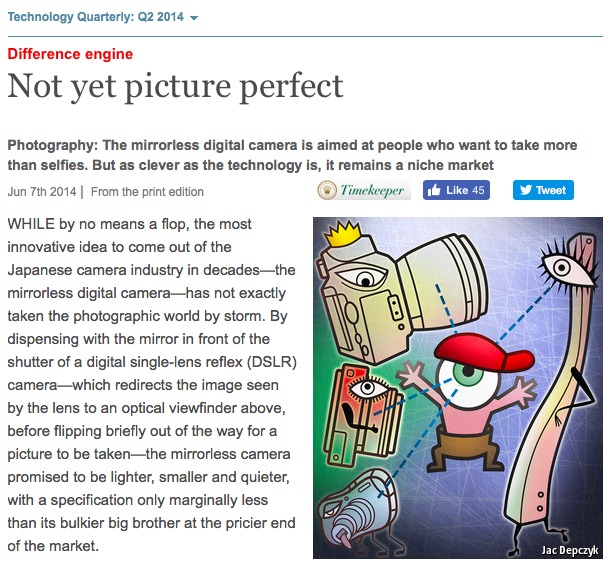
In traditional camera markets, advances technology has allowed for better and better picture quality, but this has failed to translate into increased market share. This article illustrates the evolving nature of the camera market, illuminating in particular the role of mobile phones in depressing the demand for compact cameras; it notes that in 2013 alone, compact camera sales dropped by 40%. The article attributes the success of mobile cameras and consequent demise of compact cameras to a fundamental shift in why people take photos. The author argues that, before the advent of the smart phone and social media, amateur photography was a personal task undertaken to, for example, populate photo albums with sentimental pictures. Today, however, this purpose of photography has shifted from providing personal satisfaction to sharing photos on social media platforms like Instagram, Flickr, etc.. In fulfilling this new purpose, the author argues that mobile phones are inherently advantaged because they are easy-to-use and offer the ability to instantly post photos online directly from the device. S/he spends extensive time outlining how compact cameras have been improved in recent years despite of their decreasing market share, but lamenting the fact that these advances have failed to slow its decline. With regard to the future of compact cameras, the author argues that they seem destined to occupy a niche market located amidst an increasingly wide gap between convenient mobile phone cameras and capable professional cameras.
Sony Vegas: Video Editing Today

What if you wanted to improve the captured camera footage? Once footage is captured, one can edit the footage through several means. One method of editing footage was to manually cut and paste the footage, which was risky due to the fact that the original footage was tampered with to make the final product. Another way one was able to edit video footage was to use non-linear editing systems, which didn’t affect the original copy of the footage during the editing process. Vegas Pro is a popular example of non-linear editing software.
The advertisement to the left was for the Sony Vegas + DVD Suite. This software suite has Vegas Pro, which is non-linear editing software that allows one to produce high quality videos from several sources. One can add graphics like images and text and use multiple audio and video tracks simultaneously when creating videos with Vegas Pro. This suite also has Sony DVD Architect 2, which is software that specializes in creating professional quality DVDs that have menus, subtitles, multiple audio tracks, and so on. The advertisement does an excellent job at highlighting key strengths of the software suite as well as its superiority over its competitors. As this advertisement appears in a Tech Enthusiast Magazine known as HWM, it indicates that Sony was reaching out to more than just professionals when making this advertisement.

Non-linear editing software like Vegas Pro is commonly used in the professional world. However, professional doesn't always mean corporate. The magazine article "Editors Find Big Things in An Inexpensive Package" shares several success stories of individuals who used Vegas Pro to create their own products. The first account was from John P. Laurie, who used Vegas Pro 13 to produce his indie film "Sirens of Chrome". His account discusses the ease of using the software's drag and drop timeline feature to sort the clips to his liking. He also indicates that he was able to start editing the videos with Vegas as soon as he was able to transfer the files from his camera card. These points indicate that the software is easy to use and can be immediately used with newly created video files. The second account was from Jerry Hartke, who was filming two films about Santa Claus. He is a longtime customer who cites Vegas Pro's worth by mentioning its superior colorgrading, 4K, and sound mixing capabilities. This shows that Vegas Pro is definitely worth its price. That being said, its steep price range of $399.95 (Basic) to $799.95 (Full Vegas Pro Suite) can be a turn off for the average consumer. Overall, while video editing software is more commonly used in the professional world, it is still used by individuals that aren't part of a large corporation.