Eyeglasses - Future
Taking it into their own hands
Consumers of eyeglasses find the problems with what they wear. Instead of directly asking the manufacturer to change it, they change it themselves or provide the impetus for innovation. With these changes, they eliminate previous problems and open the market up to advancements beyond corrective vision.
User-Led Innovations

In response to a 2013 professional blog post explaining the fundamental characteristics of Crizal’s multi-function lens coating, consumers declared the coating’s shortcomings, implying areas of improvement for this technology. Among the participants in the discussion, a major concern was the value gained by owning coated lenses in considering the high cost of $600. The purpose of the coating is to limit the distracting effects of glare as well as providing a modicum of scratch-resistance. However, the consumers noted a lack of quality and short life of the coating – less than two years – which was in part acceded by an optometrist, the author of the original blog post, who asserted a common life span of even less than one year. Granted, the average authors of these comments have no clear credibility other than a claimed negative experience with the product, but the corroboration of the optometrist puts this issue to rest. Crizal is no doubt in the process of developing newer and higher quality coatings, which could very well mitigate these consumers’ concerns moving forward into the future.
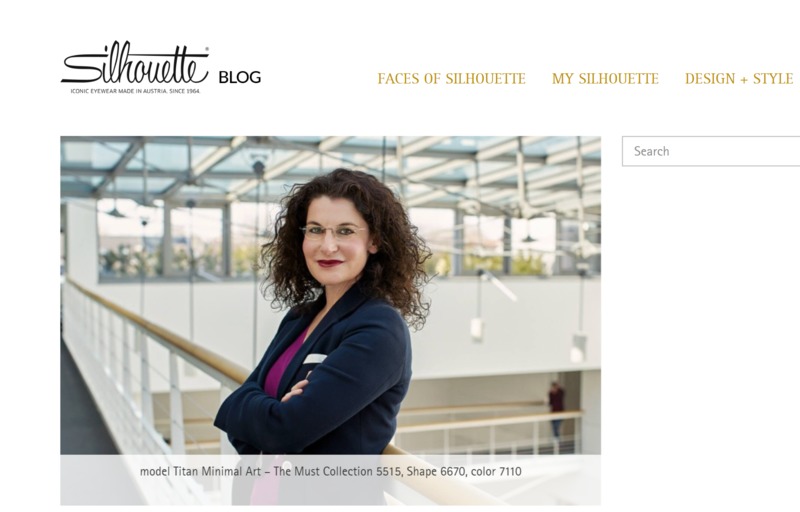
Like Crizal, Silhouette is a brand that mitigates the concerns of their consumer. Silhouette is an eyeglass brand that promotes and creates lightweight eyeglasses. Their blog “Silhouette Blog” is meant to promote this ideal of having glasses that are not obviously displayed on the wearer’s face. In October of 2018, the blog posted an article about Douglas CEO Tina Muller and her relationship with Silhouette eyewear. Muller, like many others, find that they look better with glasses which is why they don’t wear contacts, but they struggle to find glasses that are subtle and delicate. Silhouette allows for this middle ground in customers’ needs. Muller also mentions eyeglasses promotes a sense of intelligence and knowledge in the workplace, as well as just softening the wrinkles around her eyes. The desire for glasses but not extremely noticeable glasses are high among the readers and wearers of Silhouette. The history of Silhouette matches this desire; they were created as they found a demand for glasses from people that didn’t want to wear contacts but also didn’t want to wear the glasses that were on the market. Silhouette allows for customers to find that balance, and the support for this kind of eyewear is shown throughout their blog and reviews of eyeglasses. This brand and its supporters take a different turn in the realm of fashion; they want to wear glasses but not for the same sense of fashion as the mainstream audience, they value subtlety and delicacy. For Muller, and many others, glasses are part of their identity but they don’t want it to be a defining factor of their identity.
Research Based Innovations
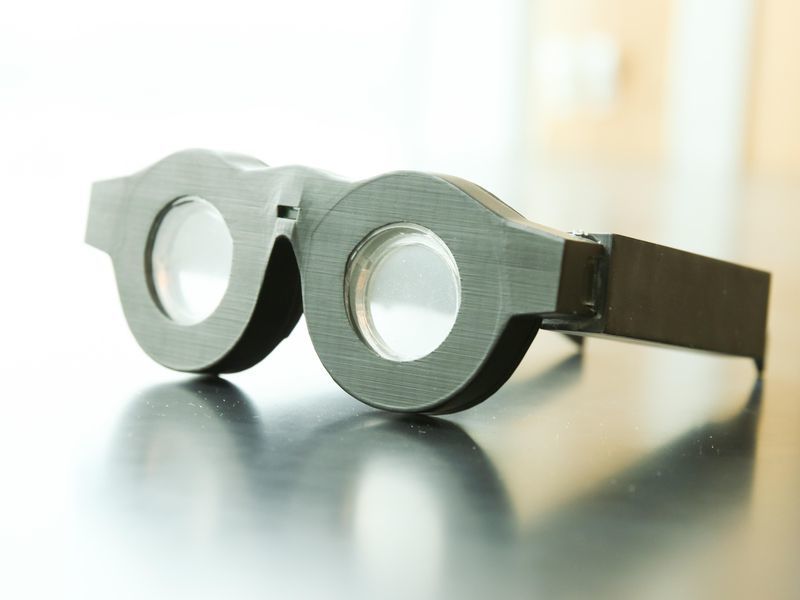
Many eyeglass wearers know that even though lenses improve vision impairment, they don’t fix the other problems that come with wearing them. These problems generally include but are not limited to: having to carry around multiple pairs of glasses for different uses, and often long adjustment periods to the eyes acclimating to on and off use. Every time we switch between pairs of glasses, glasses and contacts, or maybe our natural vision and reading glasses for up close, the muscles in our eyes are contracting and expanding to find the right adjustment. Eyeglasses exacerbate this process and can even create more problems over time. After all this time, it seems that someone has finally found a viable solution, although only a prototype. Researchers, most electrical and computer engineers, from University of Utah have developed something they call “smart glasses”. The glasses have liquid lenses that automatically adjust to the appropriate power that your eyes need to see, whether that’s for up close, far away, or a more specialized problem. The adjustment happens in about 14 milliseconds, so it goes unnoticed to the wearer. The reason these have the potential to become so successful in the future is because they would eliminate readers, bifocals, and any other more complex prescription glasses. In addition, the glasses would never have to be replaced, unless they were broken, since the glasses adjust to the wearer. With a product like this on our horizons, the stabilization of this product’s design could be a thing of the past. But we can only see.
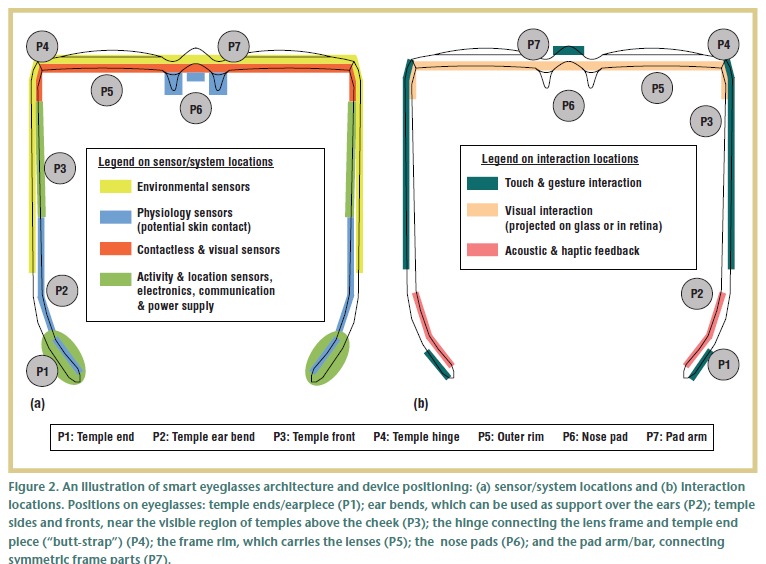
Here is another innovational idea that has great potential. The authors of this case study believe eyeglasses could fill a gap between sensing and assistance in daily life. Since eyeglasses are almost always worn throughout the day and is very common, they’d be ideal platform for additional assistive functions. Compared to google class and how they envision exploiting smart eyeglasses for assistance application through fully integrated sensing, processing, and interactive function in the regular spectacle design, in contrast to attaching devises to standard glasses. They also envision embedded software apps that let wears dynamically alter assistive functionality depending on momentary needs. Aren’t first to try to commercial this idea, J!NS MEME already out but says scientific analyses and studies of variable assistive functions are lacking. Smart eyeglasses primarily useful in sensing and processing tasks, given that eyeglasses provide access to unique sensor locations near head. They present architecture for integrating technology into traditional eyeglass designs, discuss ergonomic design requirement, and derive recommendations for further smart eyeglasses developments. In case studies, they observed potential of using smart eyeglasses for assistive functions.
Life Represents Fiction
In past decades, movie audiences have been captivated by the seemingly impossible. As modern techonology moves forward, these 'unreal' items are becoming more and more real.
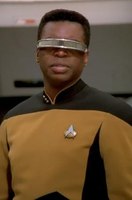
Star Trek: The Next Generation is a classic television show created by Gene Roddenberry to explore mankind’s potential for technological advancement, deep-space exploration, and interaction with alien life. Geordi La Forge, one of the key crew members on the U.S.S. Enterprise, wears a VISOR to overcome his blindness as well as perceive more of the electromagnetic spectrum than any human. This tool, while having enormous value to the wearer, appears to be a remarkably inelegant apparatus to wear, especially considering the surrounding technologies on-board the vessel, most notably the lifelike android Data. Of course, predicting what the future holds centuries in advance is an imprecise art, and Roddenberry has nonetheless portrayed what could very well be the next generation of eyeglasses.
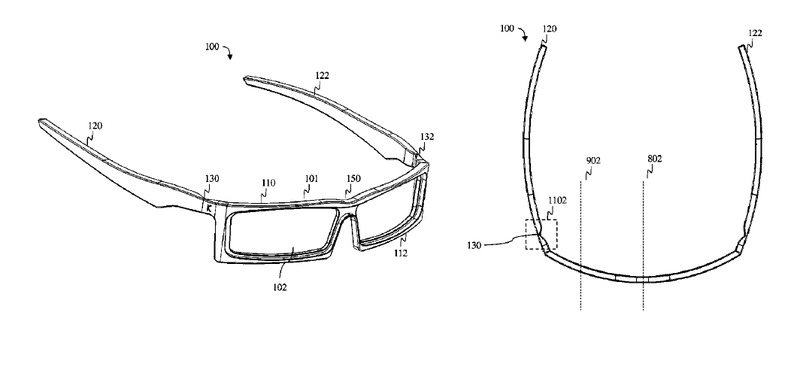
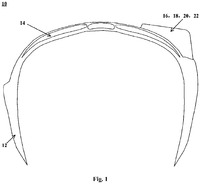
In 2017, Torsten Kruse filed a patent in order to improve the current materials functionality of the general eyeglasses frame. His design would eliminate the many components of the traditional frame, effectively generating a “one-piece” frame, emulating La Forge's iconic eyewear on a basic design level. This new frame would be created using a silicone-based rubber, which is associated with many benefits for the user. Chief among them is increased grip, especially important during hot weather or even while engaging in exuberant activities such as dancing. The user would enjoy the constant correction of vision without worrying about slippage. Furthermore, the proposal would be invaluable for frame manufacturers, streamlining the supply chain by reducing the amount of disparate resources needed to manufacture an eyeglasses frame. This in turn would potentially lead to higher profits for the manufacturers.
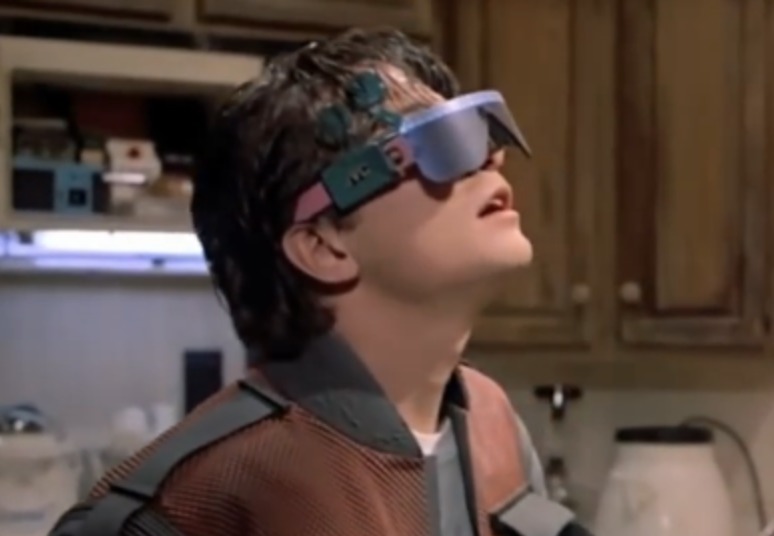
With a true cult following, Back To The Future remains a fan favorite movie even now. The depictions of future technology in the movie once captivated its audience like nothing else, now that time has passed, these technologies aren’t very far from things that are being developed now. The glasses that Marty wears to watch television could be considered a variation of the virtual reality technology at present. When he puts them on, he’s immediately immersed into his favorite shows. Once a boggling idea, the collision of eyeglasses and other technologies are becoming common place in modern society and this path will continue as more and more simple technologies become wired.
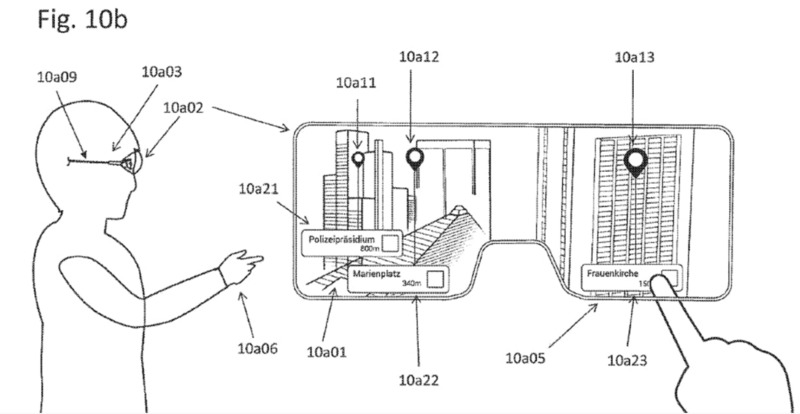
Apple has gradually become a household name and a truly incredible amount of people have an iPhone, an iPad, a MacBook, or even an Apple Watch. Over the years their horizons have broadened and they have come to dominate much of the realm of cellular and household technology. Recently, Apple has filed a design patent for a kind of smart glasses which will be made for augmented reality...similar to what Marty wears. As defined by Google, augmented reality “is a technology that superimposes a computer-generated image on a user's view of the real world, thus providing a composite view.” Although different from virtual reality, augmented reality is probably much more applicable to daily life, and in the form of easily wearable glasses, this design may just be the next new Apple product on the market as early as 2020. As the stabilization of glasses has lasted for decades, the collision of glasses and newer technologies makes a lot of sense. Think of the possibilities this technology could bring, imagine wearing a pair of smart glasses that you could use for GPS in your car. The possibilities are endless and Apple may just be the company that can pull this eyeglass upgrade into the mainstream market. Our Back To The Future dreams are coming true.
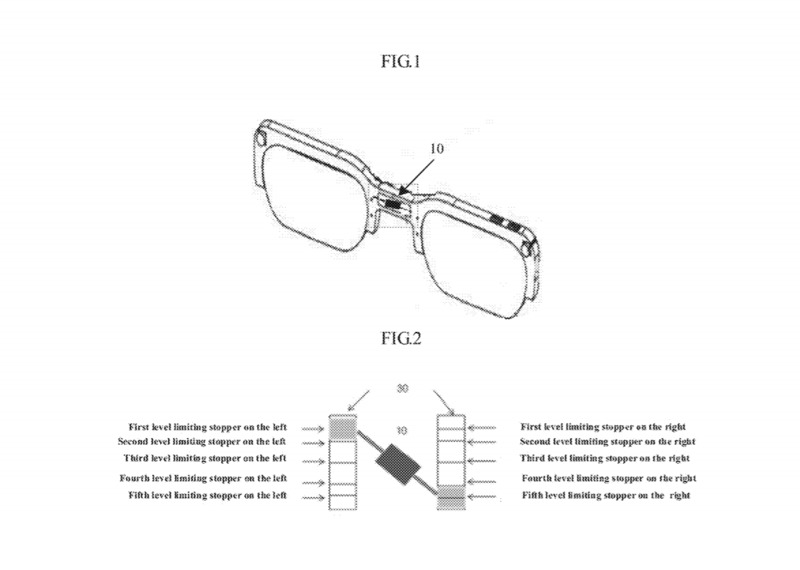
This patent is for “Device for multi-angle photographing in eyeglasses and eyeglasses including the device” is part of a field of ‘smart glasses.’ The inventors of these glasses find that the current function of eyeglasses are just for corrective or fashion purposes. But, with the help of an advancements in electronic technology, these inventors will be able to combine photographic devices and corrective eyeglasses to provide people with something extraordinarily convenient. The patent for these photographic glasses include an eyeglass frame, a miniature camera, a Bluetooth wireless transmitter/receiver, and a terminal receiver. The miniature camera is arranged in the middle part of the eyeglasses, the camera captures an image after receiving a command signal sent by the Bluetooth. This particular advancement of these glasses, allows for a multi-angle rotable photographing in horizontal or vertical positions as well as a large angle of continuous photographing to use for panoramically photographing. This invention represents Kranzberg’s law that technology comes in packages; without the previous invention of the camera or Bluetooth, these glasses would not be able to accomplish what they want to do. The invention and implementation of these glasses could completely altar fields like crime detection, criminal activity, as well as just the lives of ordinary people who enjoy photography.
This patent was proposed 2015 and in 2019 the patent application is pending. Several claims that this product is expected to execute are having an image acquisition device on the frame to take environmental images, and from those images, another device can detect human faces or foreign languages, and so much more. The patent states that an objective in mind was so that these smart glasses can recognize the name of someone you’re looking at. Another main function was to have some translation capabilities. All these activities could be given to the user either by voice, image, video, or text. The processor would belong to mobile phones. The goals and objectives for this smart glasses is very interesting and ambitious, but perhaps it our current technology allows it, these abilities are possible and this can be made effectively and efficiently.
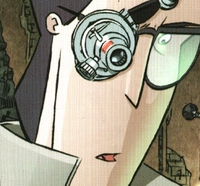
An interesting concept of eye glasses in science fiction are the ecto goggles/monocles from Ghostbusters. The monocle, specifically, is a high-tech scope that goes over one eye which can scan an entity or environment to the sub-atomic level and has night vision capabilities. In several cases, the ecto monocle was used to determine and analyze objects and people to find traces of psycho-kinetic energy (P.K.E). This gives an interesting alternative use to a now less common object, the monocle. Perhaps in the future a similar object will be invented but with more practical uses and functionality.