Eyeglasses - Past
Elite vs Public Accessibility
Despite the physical glasses being relatively the same from the 16th to 19th century, the problem that was persistent was accessibility. Like many other technologies, the access that the elite had to glasses differed from the access of the wider public. This differing access was displayed to match the reality, concluding that the general public had little choice in the quality and appearance of what they were getting.
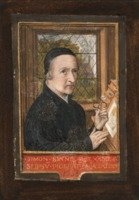
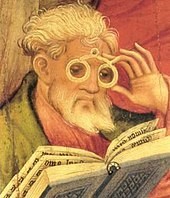
This painting, a self portrait by Simon Bening, is quite interesting in the way that it portrays eyeglasses, or ‘spectacles’ as they were referred to then. In 1558, eyeglasses had not yet taken their modern form as Bening’s portrait clearly shows. Even though eyeglasses were not yet a commodity for the masses, it was even more rare to see them depicted in paintings. The reason Bening has included them in his is because they symbolize his skillful and intensive career as an Illuminist that he had worked for nearly the entirety of his life. The eyeglasses represent a point of pride and hint at his intellectual nature as well. In the narrative concerning eyeglasses and gender, Bening’s self portrait raises some important points. Not only do the spectacles represent his intellect and career, but to a certain extent, capitalize on his masculinity. Spectacles were meant for the esteemed intellectual man and Bening shows just that.
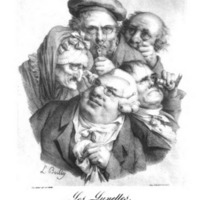
By 1821, there were many available forms of vision correction coexisting in French society as depicted by famous painter Louis-Leopold Boilly. In a way that draws the viewer’s eyes in a circle, Boilly highlights the extreme range of the different eyewear. On one end are tools for single-eye correction, the monocular and quizzing glass, which then transition to double-eye correction tools: scissor-glasses, pince-nez, and wig-spectacles. The facial expressions of the lithograph’s subjects appear to reflect the respective satisfaction with their eyewear. Indeed, the gentleman in the wig wears a smug smirk, as if supremely pleased with his fully stabilized frames. Even though opulent or high-quality tools were inacessible by the general public, all of these different forms remained in fashion in part due to historical associations with the aristocracy and even royalty. Napoleon himself was reported to own a pair of scissor-glasses to correct his vision.
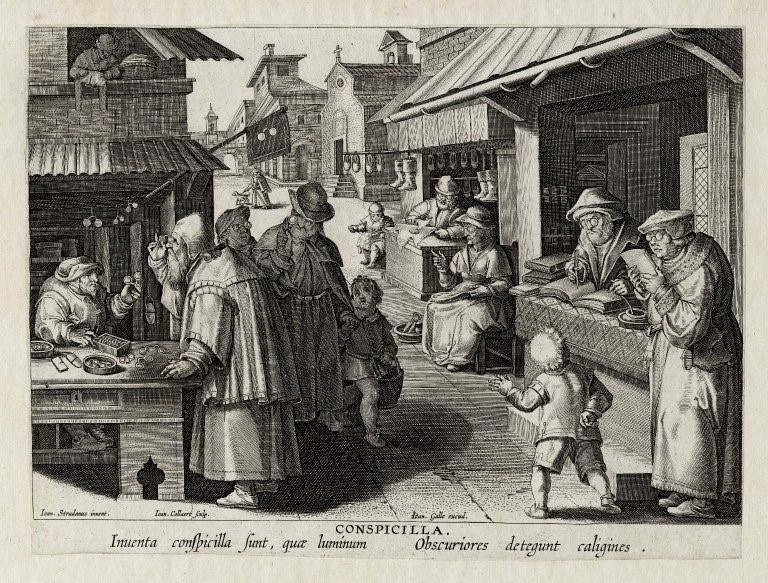
Over time glasses have gotten more commomn and became less of a status identifier. An artwork by Jan van der Straet called Nova Reperta (1600) which translates to “New Discoveries”, depicts several people wearing glasses, and some appear to be selling them. A man can be seen purchasing or trying on a pair of eyeglasses and another man is writing something in a book with eyeglasses on and a woman is reading with eyeglasses. However the seller himself isn’t wearing glasses which I find interesting. Showing the marketing capability of glasses and it's accessibility.
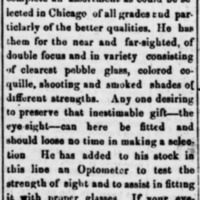
Similarly, this artifact shows that the process for trying and buying glasses stayed relatively similar over a large span of time. As the optical world continued to expand during the late 1800’s in America, and wearing of glasses became more popular, glasses developed numerous names. In the 1877 advertisement found in The Redwood Gazette, Watson’s Book Store puts out an ad to showcase the large variety of glasses that they hold in store. The extent to how descriptive this ad is shows that while glasses were becoming more common, many people were still not very familiar with them. The ad explains that Watson’s Book Store sells glasses for near and far-sighted people, double focus, made of the clearest pebble glass...These descriptions are not only for consumers to take stock of what is carried at the store, but what these glasses are for and what they may look like. It may also be important to note that this wide variety of glasses are being sold out of a bookstore where an “Optometer” can help you fit and find the right pair for you. This further shows that glasses of all sorts were not yet fully integrated into society as they are today, at this point glasses were just something to grab at a store, like books. There significance had not yet been exploited by companies and consumers.
Fashion vs Function
Even from the 13th century, the image of wearing glasses mattered to those of society, but this was complicated by the factor of functionality. The elites initially had more access to style and fashion, which over time, then trickled down into the general public. As fashion progressed, so did the function of these items and vise versa. Fashion played a crucial role in the innovation of eyeglasses.
Prescription lenses are made to correct unique vision, but it is difficult to determine when the first prescription was made for lenses. However, the first eyeglasses were made in Northern Italy around 1290. And it wasn’t until the late 13th century that corrective lenses were invented. Prehistoric Inuit’s wore flattened walrus ivory in front of their faces to block sun’s rays, allowing them to see better. In ancient Rome, emperor Nero would hold up a polished emerald in front of his eyes to reduce the suns glare while he watched gladiator fights. In Germany 1403, early glasses had convex lenses that could correct both farsightedness and presbyopia which “commonly develops as a symptom of aging.” Which shows at some point glasses are more necessary rather than for functionality.
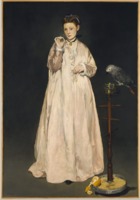
Victorine Meurent, the subject of Edouard Manet’s painting is seen holding a monocle; a cousin item of spectacles. The monocle in this painting was not meant to demonstrate the lack of eyesight that Meurent had, but part of Manet’s artistic depiction of the five senses. The orange represents taste, the nosegay that she is holding in her right hand represents smell, the parrot is represents hearing, and the monocle that is dangling around her neck held in her left hand is to show sight and touch. While the usage of the monocle is not meant correct the subject’s vision in this case, it does portray to the viewer that monocles are part of the sense of vision. The representation of the man’s monocle worn by a woman plays with the idea of fashion, not just merely symbolic representation.The sensual nature of her pose, her silk gown, and the sultry manner in which she is holding the monocle clashes with the harsh masculinity that the monocle represents. There is an aesthetic appeal of a woman holding a man’s monocle, and the conventionality of it resonates with the viewers, but there is still a curiosity of why a beautiful woman has a man’s item.
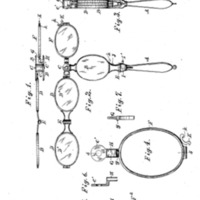
In 1898, Bennet Osbourn and Charles Uhry filed a patent to improve and expand the capabilities of a popular style of hand-held eyeglasses called the lorgnette. Originally, the lorgnette was designed to simply correct for nearsightedness or be used as a cosmetic accessory. However, these two men believed the users of this device would benefit greatly from having the additional functions of magnification and reflection. To accomplish this, the inventors added an “auxiliary frame” to hold another lens that would act as a mirror or reading-glass, depending on the user’s choice, as well as maintaining the convenient portability of the foldable case. These features would increase the attractiveness of the lorgnette, as people – especially women – could now surreptitiously check their appearances in public; for those with farsightedness or generally weak vision, the addition of a magnification lens would help with reading and be an alternative to the bifocal.
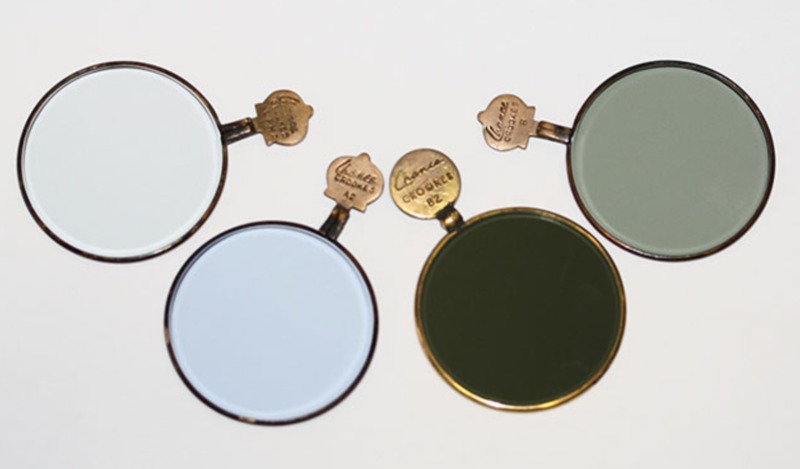
Although a different take on 'Fashion vs. Function', the invention of sunglasses fits quite interestingly in this debate. Today, most of us wear sunglasses; whether it’s for leisurely outdoor activities, driving in our cars, or playing sports, we all own a pair or two. Considering the practical and positive solution for the sun’s harsh glare, it may be a surprise to hear the origin story for these now common devices. In the early 1900’s William Crookes, a chemical physicist and president of The Royal Society in London, became interested with the causation and prevention of cataracts. During a largely industrial time in England, many industrial workers were suffering from poor vision due to cataracts. With this in mind, Crookes and several other scientists and doctors set out to increase the safety and health of these workers. Once thought to be caused solely by heat radiation from industrial jobs like glass making, cataracts was becoming common and costly to employers who had to pay extra money to injured workers. By tinting glass with various metal alloys to create a variety of different colored lenses, Crooke felt that he had found the answer to preventing cataracts. His lenses were “corrective” in the sense that they could potentially prevent cataracts or keep them from getting worse in some cases. What he didn’t realize at the time was that he had really created the first pair of modern sunglasses, used to combat glare from the sun. Crook's invention is priceless today in many different ways; one of them being the large contribution that he has made to the optical community. As modern technologies have increased and the invention of polarized lenses had been made, it’s easy to see how Crooke essentially paved the way for the modern movement towards transitions; where the world of corrective and prescription glasses collide with Crooke’s tinted lenses or sunglasses.
Luxury vs Necessity
Just as everyone has access to these technologies, the innovation of new items to continue that trend of social distinction evolved. The emergence of new technologies gave way to the debate about what is necessary for corrected vision and what is a luxury for corrective vision. This debate transcended into other aspects of culture, including literature, which demonstrates the significance of these changing glasses.
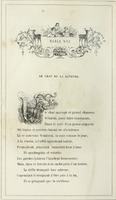
In 1838, the celebrated French poet Jean-Pierre Claris de Florian conveyed numerous lessons through a fable involving an unwary cat discovering a pair of opera glasses, the successor of the lorgnette. The cat, hunting in a guarded section of a lord’s house, uses the opera glasses to “enhance” his weakened vision in order to better spot his prey and avoid detection; however, he unwittingly reversed the ends of the tool to accomplish these tasks. Ultimately, the cat overestimated his prey’s proximity, thus alerting it to his presence, and failed to escape the guard because of underestimating his proximity. This passage emphasizes the abilities of the opera glasses through the cat’s folly, which were intended to magnify faraway objects such as in a theater (but could also create an illusion of extra distance if viewed through the opposite end). Florian presents his argument in concluding the fable, warning readers that they may suffer if they blind themselves to potential risk when focusing on desire.
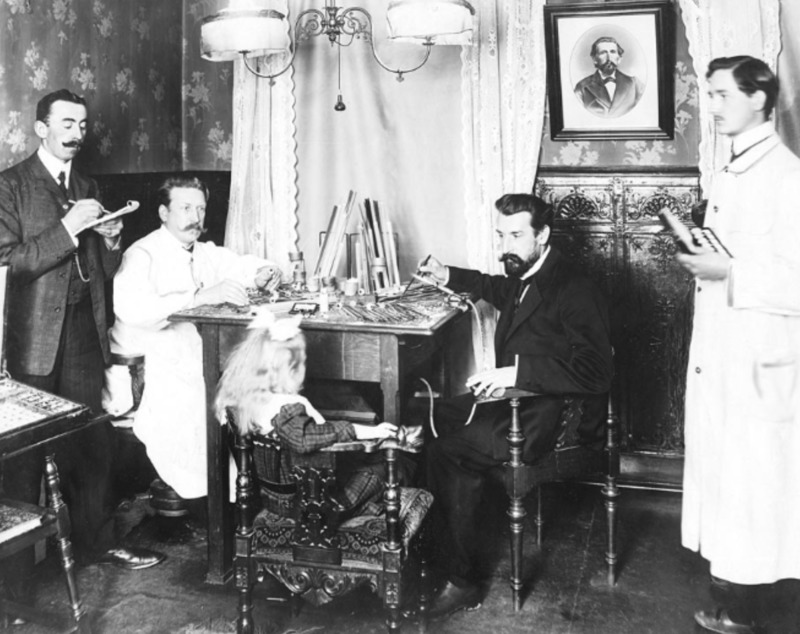
In 1887 glass contact shells were developed in Germany as a means of protection for the cornea of the eye. Dr. Theodor Samisch received a patient in 1887 whose right eye was exposed due to his lower eyelid had been destroyed from carcinoma. He suggested that a ‘transparent capsule’ should be used to protect the patient’s eye to prevent any further damage to the cornea. Instead of any entirely new fake eye, he decided to manufacture a shell with a clear cornea but covered the rest of the eyeball to prevent dehydration of the eye and irritation from the patient’s inward facing eyelashes. Dr. Samisch asked Muller-Wiesbaden to create this glass protective shell, and for the next 21 years the patient wore the shells every day and night with periodical replacement. These glass contact shells were derived from glass eyes, and they became the precursors to contact lenses that were visually corrective. Initially, contact lenses were meant to be protective of the eye and it was not until later did they develop to be something of more corrective vision that protection of vision.
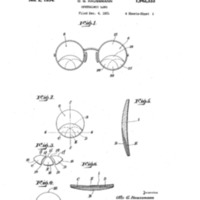
In 1931, Otto G Haussmann applied for a patent for a multifocal lens, one that would eliminate all of the frustrations caused by bifocals. His invention takes the idea of bifocals allowing for one power for distance and another for reading, but he improves it so there is no blurriness or any missing gaps of vision. His lenses increases the focal power more gradually and because of the shape of the close reading portion there is no doubling effect when the eye encounters the wide dividing line in the middle of the lense. He also included a middle portion of the lens that can have one or more focal powers on the sides of the reading field, and with that wearers would not have to move their head to see, just simply their eyes. With this invention, he branched off of the bifocals and by noticing their failures and frustrations, he was able to improve on this idea and make it better. This invention of the multifocal lens was approved in 1934 and it eventually lead to further inventions and improvements of lenses.
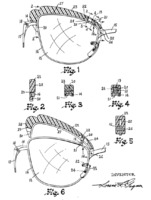
In addition, improvements in fashion took off during the 1900's which lead to a broader spectrum of frames and frame accessories to choose from. Created by Louis L. Gagnon and patented in 1956, ophthalmic mountings were initially a cutting edge design. Built as an attachable accessory to any traditional wire frame glasses, the mountings attached at the nose piece with a hinge that allowed them to swing upwards. This allowed for easy cleaning access, without the wearer comprising style. Furthermore, the mountings were not attached to the side pieces of the glasses so that the folding mechanism was not compromised either. This invention was not only smart, but very practical at the time. In addition, these frame mountings clearly suggest the demand for stylish glasses among the visually impaired. Specifically, the patents depicts ophthalmic mountings that are quite feminine. This patent really hints at the collision of gender, consumer marketing, and eyeglasses that was beginning to ripple through our society. Just think of cat eye glasses and Hollywood’s most famous women and you’ll know what I mean. Style was beginning to become important for women, and the invention of ophthalmic mountings shows just that.