Alcohol - Past
INTRODUCTION
Alcohol consumption and intoxication has been in existence for thousands of years- dating all the way back to the Stone Age period. Notably older than farming agriculture, the first intoxicating beverage was first discovered by groups of plainsmen residing in what is now known as modern-day Siberia (45). Kumiss, the name of the first alcoholic beverage, was made out of fermented mare’s milk, initiating the growing popularity of intoxicating, alcoholic beverages. With the birth of agricultural farming came the quick beginning of raising grains and wheats for the production of brewing beer and distilling liquors of all kinds. With this being said, there is no doubt that people enjoy sipping on refreshing yet intoxicating beers and liquors, however what exactly makes individuals so inclined to drink alcohol at all? Could this simply be to catch a “buzz?” Is it for the enjoyment of taste, or maybe for health benefits, or lack thereof? And most importantly, how did it begin during this era? In this past section, it proves critical to not only understand why people were originally ingesting alcohol, but to also analyze what the historical development of beer and liquor was and what affect that had on the overall production of alcohol. In other words, how did the production of small scale vs. mass scale production arise and for what reasons? Were specific social groups more inclined towards beers and liquors that came from smaller "craft" breweries and distilleries? Or, were there only a handful of beer companies that dominated American production and how were they able to gain popularity from society?
Lastly, this past page will also seek to answer how Prohibition, or the constitutional ban of the production, transportation, and sale of alcohol from the period of 1920-1933, majorly affected how not only social groups during this time perceived the importance of alcohol, but also how production changed and in what ways. Systematically alcohol and its production was intended to be eliminated, but as we know was not nearly the case. With this in mind, this section will analyze the American population's unquenchable desire for alcohol based on several advertisements and literature within the Prohibition era. This will seek to answer how despite its illegality, people were still drinking and how that affected the technology's development over time. Overall, the past of alcohol, dating as far back as the Stone Age up until the end of the Prohibition era in 1933 remained dynamic and complex in its history and evolution. Let us first begin by digesting these intricacies through understanding the historical process of the production and growing popularity of both beer and liquor alike.
Going Back To The Stone Age
As previously mentioned within the introduction, the first "intoxicant" became introduced by a group of individuals residing in regions throughout modern-day Serbia. With the first introduction of this intoxicant drink, periods of prohibition became quite common in conjunction with alcohol usage. Intoxicant drinks were first primarily utilized during religious ceremonies and rituals, as wine was known as "a gift from the Gods." Religious leaders soon discovered that people were too willing to drink these intoxicants even between religious ceremonies, which caused them to ban these drinks except for periods of religious celebration. This further emphasizes the fact that humans have ingested and utilized beer and other intoxicant drinks for thousands of years. Not only this, but the concept of prohibition has been in conjunction with alcohol consumption shortly after its existence. As Kranzberg’s first law states, “technology is neither good nor bad nor neutral” which greatly applies to the usage of alcohol as a whole. He continues to analyze that, “technical developments frequently have environmental, social, and human consequences that go far beyond the immediate purposes of the...practices themselves” (545). In this sense, Kranzberg is saying that the intoxicating effects of alcohol in this case had the social consequence of prohibition. What this then reveals is that humans were drinking alcohol, not necessarily to celebrate during religious ceremonies but because the enjoyed the intoxicating effect it had on the body, and excessively at that.
Overall, this proves of great importance to understand that humans have been enjoying the spirituous feeling of alcohol for thousands of years- which remains one of the reasons as to why people ingest it in the first place. Continuing, it remains critical to note that the production and distribution of beer and liquor alike has been a significant process and important process to humans since its basic origins in the Stone Age. The distribution and production of alcohol and its historical importance, particularly whiskey, will next be analyzed. What this will seek to answer is why alcohol even became popular, who was drinking it and for what reasons, and how that affected the size and demand of production as a whole.
While much of this page focuses on the history of beer specifically, it is not possible to consider the evolution of beer without also considering the evolution of other notable alcohols, such as whiskey. Similar to other forms of alcohol, whiskey has a distinctive (albeit murky) role in history. Its history is intertwined with that of beer, since beer is a made during the process of making whiskey, as described in Whiskey: A Global History (1). However, it seems to have always had a socially discerning quality about it, as the Book of Proverbs specifies between wine and a “strong drink,” which is spectated to be a grain-based alcohol similar to whiskey. (2) The variety of alcohol present in the earliest of civilization, as demonstrated by both Whiskey: A Global History and “The Stone Age had Booze,” indicates that people developed a myriad of preferences for alcoholic intake quite early on—thus supporting the argument that alcohol is consumed for more than just its ethanol content.
The complexity of the origins of whiskey demonstrate the oftentimes murky process of innovation, as seen with Bijker’s article on Bakelite (2). Perhaps more riveting is the social significance placed on the linguistic significance of whiskey, which continues to be seen today. For example, in the United States and Ireland, whiskey is spelled with an “e,” while Scotland and Canadian spell the drink “whisky.” While this seems a minute difference, it delves into a deeper meaning of national identity, as both Scotland and Ireland oftentimes contend to be the birthplace of modern whiskey. The importance of words to define a technology’s relevant social groups is not foreign; this concept is discussed in great detail regarding “jaywalkers” in Peter Norton’s “Street Rivals” (4). While there is no margin for error on the simple spelling of “beer,” the complex significance of whiskey as a technology demonstrates that studying the history of alcohol is an important cultural narrative intertwined with the history of humanity.
(1) Kevin Kosar, Whiskey: A Global History, (London: Reaktion Books, 2010), 12.
(2) Kosar, 35.
(3) Wiebe Bijker, “The Social Construction of Bakelite: Toward a Theory of Invention,” in The Social Construction of Technological Systems, 155-82.
(4) Peter Norton, “Street Rivals: Jaywalking and the Invention of the Motor Age Street,” Technology and Culture (48: 2), 2007, 331-59.
Historical Purpose of Alcohol
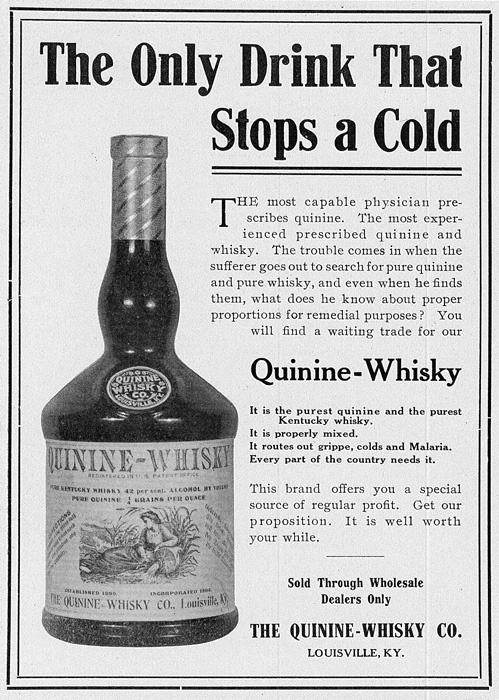
As we continue to unravel the development and history of alcoholic beverages, it remains critical to continue to question why various groups of individuals were initially ingesting and utilizing beers and liquors, particularly during the pre-prohibition period. This ad, produced in the early 1900s, depicts the early determination that ingesting alcohol, in this case quinine whiskey, which can help fight off colds, illnesses, and even diseases such as malaria. It states that it is “the purest quinine and purest Kentucky whiskey” in which “every part of the country needs it.” Although a great contrast as to what any doctor in the present age would suggest to drink when battling sickness or even malaria, it proves of great insight as to what the value was on hard liquors such as this whiskey brand. Individuals sought out and drank liquor, not necessarily for the refreshing taste it possesses or to intoxicate and heighten the overall blood alcohol content of an individual to catch a “buzz.”
This advertisement interestingly suggests the medical importance placed on alcohol during this time. Individuals clearly relied on the specific alcohol to cleanse the body of unwanted toxins and harmful diseases. Although ironic to now know that fighting off illness with another toxin, it nonetheless showcases its importance and reliance to those looking to release themselves of sickness. Maybe unwise to drink now with the medical progressions we have made, and even hysterical to look at from a 21st century perspective, it proves that alcohol had various meanings, values, and understandings to individuals. These values are then important to understand in order to analyze the value alcohol has on various social groups and how these values change or continue through the evolution of beer and liquor through the present and future.
Doctors have been concerned about the health effects of alcohol well before the Prohibition Era. This 1809 Magazine article discusses the dangers of drinking in excess based on the professional medical opinion of a Dr. Darwin. Dr. Darwin believes that most people have a tendency to overindulge in alcohol and many indulge for the sake of "fashion". He suggests lowering the consumption of beer, wine, and spirits in order to reduce health issues such as gout, dropsy, and diseased liver.
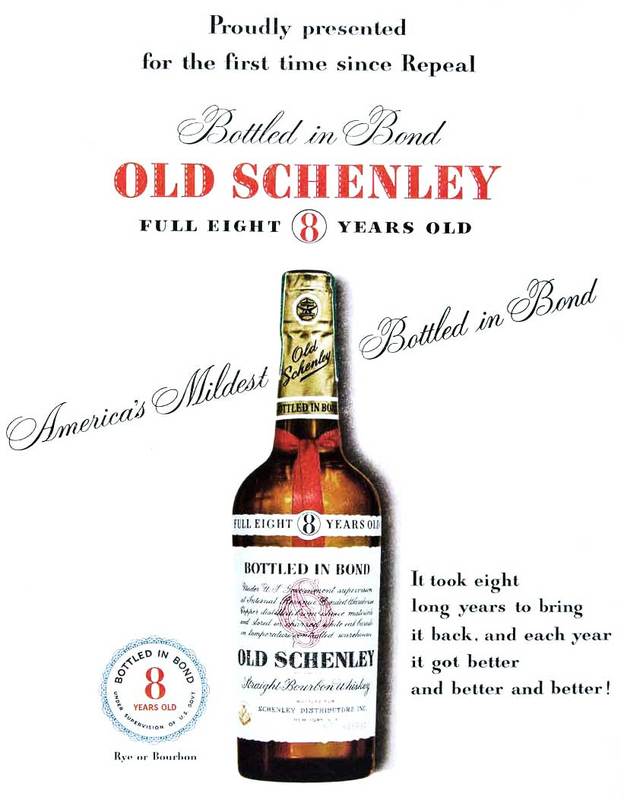
The prohibition era depicted alcohol as an evil and intoxicating liquid, but after the end of prohibition the social definition of alcohol began to evolve. This advertisement shows a bottle of whiskey that has been aged "since the repeal". After prohibition, distilleries struggled to age their whiskey because of the high demand and limited time to produce. This advertisement shows the whiskey as tasteful and luxurious, alluding to the fact that alcohol was more of a social and culinary phenomena than a way to become intoxicated.
This advertisement boasts about the long time inputed into producing a "good" bottle of whiskey, which is inconsistent with the rise of mass and efficient alcohol production.
Sixteenth and Seventeenth Century: Origins of Mass Alcohol Production
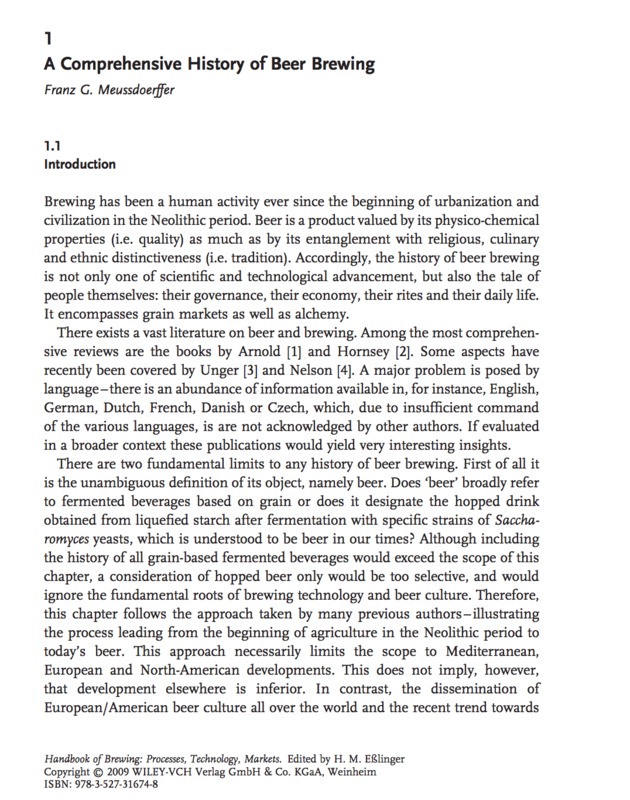
This source details the history of brewing from the dawn of beer's creation. Meussdoerffer explained that before the sixteenth century, most beer production in London was done by small-scale brewers. Commerical brewing started in the late sixteenths century and was prevalent by the early eighteenth century. Meussdoerffer claims this trend towards commercial brewing started with the increased government policies incentivizing large scale brewing and the rise of porter beer's popularity. Porter beer was easily mass produced and increased the overall demand for beer products in London. The rise of porter beer and commercialization of the industry led to increased innovation like the steam engine brewery that was established in 1784.
Meussdoerffer seemed to agree with our analysis that in the future, beer production will be more localized and focused on craft beers. Meussdoerffer stated "the dissemination of European/American beer culture all over the world and the recent trend towards globalization generates new variants of beer - like beverages that follow regional traditions and preferences".
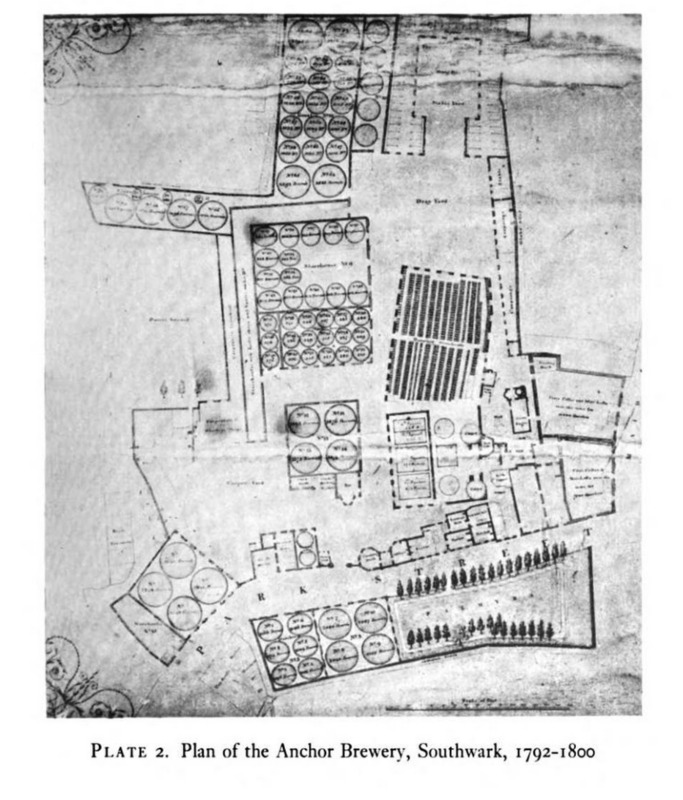
In "The Brewing Industry in England", Mathias agreed with Meussdoerffer that the rise in porter beer popularity contributed to the dawn of mass brewing. On page 12, Mathias stated "Only porter breweries rose to massive production in the eighteenth century, establishing the modern structure of the brewing industry in London, while the ale brewers stayed at a scale of production not greatly different from that the larger brewers were working at the end of the seventeenth century...undoubtedly the rise and hegemony of porter brewing and the subsequent expansion of ale brewing are both in response to swings in public taste".
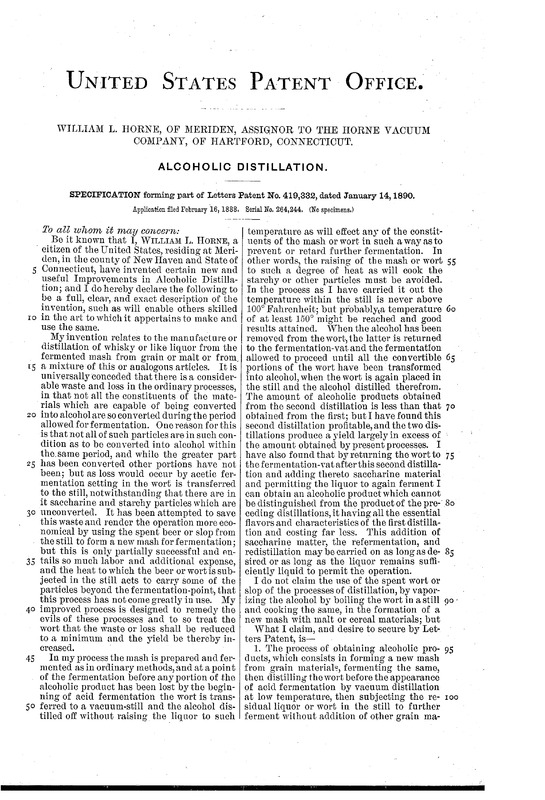
As the beer brewing industry began to commercialize in the eighteenth and nineteenth centuries, the distillling industry also began to increase production. This patent shows how whiskey distillers were also focusing on increasing production to a more commercial scale in the 1890s.
The patent owner is creating a way to maxmize efficiency while producing whiskey by minimizing waste. The patent owner stated ""My improved process is designed to remedy the evils of these processes and to so treat the wort that the waste or loss shall be reduced to a minimum and the yield be thereby increased".
Producers are constantly trying to find the most efficient way to create their products in order to stay competitive. This patent shows that the production of alcohol will continue to evolve and improve over time.
The Dry Land...America During the Prohibition Era
The Prohibition Era in the United States incarcerated alcohol and the liberties of its citizens for over thirteen years. Prohibition impacted the manufacturing of alcohol on a national level with a domino effect in many industries across the United States. The era began on January 16, 1920 with the ratification of the 18th amendment of the US constitution. The constitutional amendment came about as a result of temperance movements in the United States and progressive values which believed that problems within society could be resolved with safe environments. (1) Progressive ideologists believed that consumption of beer, malt, and liquor products infringed on the ability for society to have a safe environment and that it should be abolished. Government action with the passing of the 18 Amendment eventually led to the implementation of the Volstead Act which had the purpose of carrying out/enforcing the clauses of the amendment.
With the act in place the steps to get it there were not that easy. Much of this was due to vague terminology of what defined an alcoholic beverage. Was it the ingredients used in the production or fermentation, was it based on the amount of alcohol it contained by percentage, etc. In a 1912 article published in Chicago Tribune, a congressional representative from the state of Minnesota proposed that Dr. Harvey Wiley, a former government chemist, to answer the question, "What is Beer?". According to the tribune story, Dr. Wiley defines beer as a "fermented product from a mash composed of barley melt and hops, with or without a small quantity of unmalted cereals not exceeding 30 percent of the barley malt used". With Dr. Wiley's answer putting a rest to the brewing beer question, pressure was placed to similarly find out one that defined liquor. However, these definitions had a major impact on the production of beer in the years leading up to prohibition and through what took place during the thirteen years it lasted.
(1) Hamm, Richard F. Shaping the Eighteenth Amendment: Temperance Reform, Legal Culture, and the Polity, 1880-1920. Chapel Hill, NC: U of North Carolina, 1995. Print.
The Shift in Production
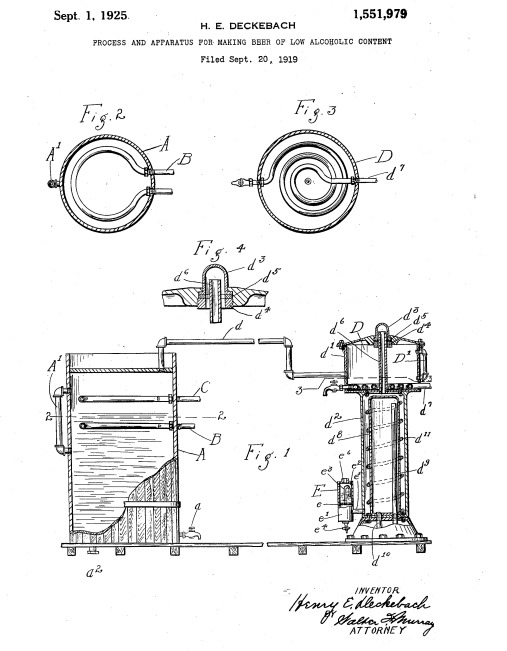
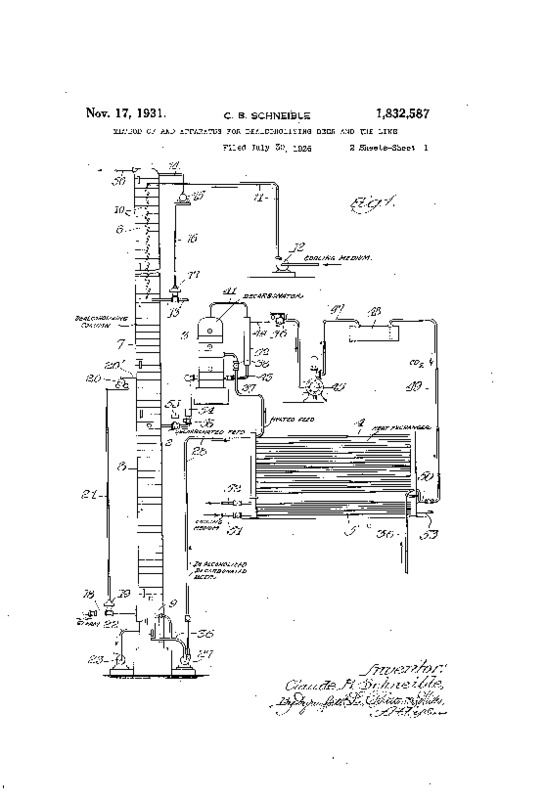
Both of the patents seen to the left were designed to eliminate large amounts of alcohol content from beverages such as beer, wine, and liquor. Fittingly, both of the patents were created and granted during the Prohibition Era. However, these patents add to the complexity of alcohol’s significance to society: rather than simply reverting to speakeasies and hoarding alcohol in one’s bathtub as oftentimes stereotyped, these inventions attempt to allow people a means of enjoying beverages without legal consequence—and without intoxication. This further points to the significant notion that alcoholic beverages are more than simply a package (oddly enough linking to Kranzberg’s Third Law of technology) by which to deliver ethanol to the bloodstream.* These patents from history oppose the continued assumption held by some that alcohol merely exists for people’s draw towards intoxication. This is further supported by the fact that non-alcoholic beer is still available, and even found in advertisements as a desirable product (as seen with the ad with a pregnant woman on the “Present” page). It also paints a rather different picture of the Prohibition Era: one that replaces illegality with innovation.
With the rise of enforcement of the 18th amendment through the Volstead Act, production of beer/malt and distilled liquor shifted in the United States. Many patents were filed within the 13 years that the prohibition era lasted with many seeking to find loop holes within the legal definition of what makes a beer a beer or what makes liquor, liquor. The patent on the left hand side includes three different diagrams which outline a new method to change the composition of the fermented solution during the production and preparation of beer. The process transcribed from the diagrams drawn show the removal of carbon dioxide from the beer which will assist to remove some of the alcohol content in an effort to de-alcoholize beer.
Production also shifted in terms of in home brewing, small batch breweries from larger industrial manufactures. With the shut down of saloons during prohibition and the clauses in the 18th amendment, any sort of consumption of alcohol was banned. As a result many began to produce larger quantities from the similar size batch in order to preserve it for a longer time, to get around this they would brew them within there home and keep them out of sight from inspection.
Following the end of prohibition, production will once again rapidly switch from small in home brewers and distillers to large size industrial production in which four major companies will dominate the market of consumed and produced alcohol in the United States. With this, we see a rapid spike in patents in the years following 1933 where many new technologies and processes for fermentation came about which is linked to the mass production. You can learn more about how mass production has impacted the reason why people drink today on our current page.
*Kranzberg’s Third Law of Technology: “Technology comes in packages, big and small.” Melvin Kranzberg, “Technology and History: ‘Kranzberg’s Laws,’” Technology and Culture (27: 3), July 1986, 549.
Impact on Social Groups
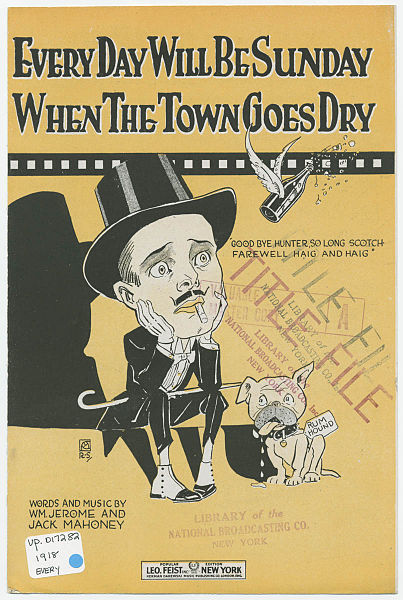
Looking into religious affiliations certain religions prohibit consumption of alcohol on Sundays while others prohibit it before 12pm. Noon being the time that morning mass or prayer service would be ended by. "Every Sunday Will Be Sunday When The Town Goes Dry" shows the impact of beliefs and ideologies on the way of life. It was a song composed by William Jerome and Jack Mahoney in 1918, two years prior to the start of prohibition. In this musical poster you see a man seated in a black suit with his hands on his face kind of thinking of what is going to happen now that alcohol is going to become banned if the 18th amendment passes. On the top right corner of the musical poster you see a bottle of alcohol spilling out with wings as if the bottle was flying away.
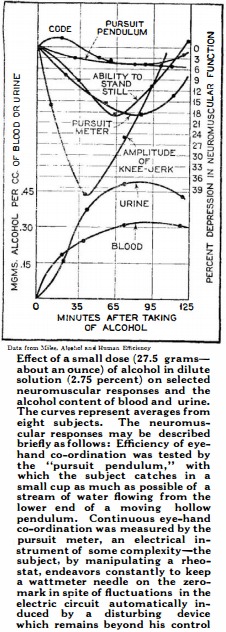
However, not all publications during the Prohibition Era spoke in support/aganist of the movement. It is easy to forget that while alcohol was illegalized during Prohibition, freedom of speech prevailed. Therefore, there was a wealth of articles released during the Era that weighed its benefits and drawbacks, such as one from the popular magazine The Scientific American. This article discussed the results of numerous studies conducted to test the physiological effects of alcohol. Unsurprisingly, there was a consistent demonstration of decreased motor skills, along with other qualities oftentimes attributed to intoxication today.
It was striking to notice the balanced argument made in the conclusion of the article: while it certainly acknowledged the physiological drawbacks to drinking alcohol, it also discussed the benefits of alcohol from a social and psychological standpoint—H. H. Mitchell could not deny that there was an allure of alcohol that could not be ignored, regardless of scientific findings. Its conclusion therefore advocated for a balanced approach to the legality for the consumption of alcohol. It is fascinating to see the comparisons easily made between this debate made during the Prohibition Era, and the one currently being considered by numerous policymakers on the potential legalization of marijuana for recreational use. This article not only serves to remind the historian of the importance of free speech in American culture (this article’s conclusion would probably be silenced in a censored media), but also allows one to consider the implications and future for the legalization for other mind-altering substances.
Transitioning from Prohibition in America into the 1940's and Beyond
The prohibition era kept America and Americans alike, dry, for over 13 years. In December of 1933 the 18th Amerndment which prohibited the manufacturing, consumption and trransportation of alcohol became repealed by the 21st Amendement. While Americans and large industries alike were given their rights back to consume and produce alcohol, the 13 years prior made a massive impact in many different aspects for the industry. Prior to 1920's, large manufactures dominated the industry in America following trends from the 1600's thru the 1800's, this similar cycle begins to emerge post-prohibition. To learn more about alcohol consumption, the reason behind it and the change over time for manufacturing please visit our present page.