Eyeglasses - Introduction
What are Glasses?
In the simplest form glasses consisted of frames and lenses, the power of each lens differed and the optometer is what allowed for the measurement of such power. Through each of these components, arguments and debates arose through the innovation of these technologies. As society progressed, each component became more complex and began to cater to individual needs.

Surviving documents lead us to believe spectacles had been invented around 1286. One specific document where a preacher giving sermon talks about how making eyeglasses was an art and how they were made to improve vision and continues to say how spectacles are perhaps the best and most necessary object. The idea that a segment of a clear glass-like sphere might be used to magnify an object had been fairly common knowledge around the time period. The idea of using lenses in spectacle to correct vision is believed to have been a discovery made purely by chance and by people who knew nothing about optics. Venice, Italy became an important spectacle-making place in early 1300s. The first reference to spectacles were made by a medical writer in 1363. It wasn’t until 19th century when it became common in Europe for readers to wear spectacles with hinged supports over their ears.
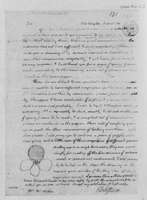
In 1784, Benjamin Franklin invented the bifocals, this allowed people to be able to see distance and read without carrying various pairs of glasses around with them; this was a common problem among early Americans, as described by Franklin giving advice to his sister. The bifocals were still considered spectacles, just improved and condensed, so they were not called anything different. But, in a letter Thomas Jefferson wrote to Mr. McAllister, a well known optician, in 1806 described these bifocals by interchangeably using the terms ‘glasses’ and ‘spectacles.’ Jefferson writes, “You have heretofore furnished me with spectacles so reduced in their size as to give facility to the looking over their top without moving them,” in the beginning of the letter. Then, later in the letter he writes, “Dr. Franklin tried this by semicircular glasses joined horizontally, the upper & lower semi- circles of different powers, which he told me answered perfectly.” He continues to jump between the words ‘spectacles’ and ‘glasses’ within the short letter, all referring to the same thing. In both the technical profession of optometry and the language of the educated during early America, ‘spectacle’ and ‘glasses’ were used interchangeably to convey the same item with no difference in the actual item even with the new introduction of the advancement of the bifocal lenses.
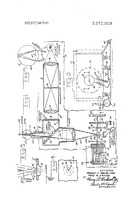
From Benjamin Franklin's invention of the bifocals, the development of measuring the power for lenses has grown. This patent is of an infrared optometer device that allows manual or automatic measurement of the refractive index where a collimated beam of light is directed through an infrared filter and by a beam splitter mirror at 90 degrees into the patient’s eye. The light is then reflected by the fundus of the eye and exits through the lens of the eye from the interior through the beam splitter is converged by a lens to a focal point which is located on an adjustable photo sensor which detects maximum intensity of the exit beam illumination. This invention was designed to improve the method for determining the refractive state human eye and eliminate employment of the usual trial method which has no value in measurement of the refractive stat of eye in the case of a nonresponsive patient.
Where we were, where we are, and where we're going
The depiction of eyeglasses have stablized for quite a few decades, however, the future of eyeglasses and their depiction are evolving. For awhile, eyeglasses have become part of the identity of the wearer, but as the technology of glasses develops, so does the depiciton of the identity of the wearers.
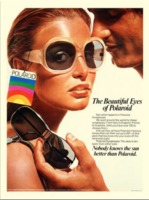
What’s particularly interesting about this ad is its nod at the stabilization of a product’s design. This begs the question, what counts as recent concerning the history of eyeglasses? Although from the 1970’s, these sunglasses look no different from what many people wear today. Even marketing tactics have been stabilized. Many high end brands today such as Prada, Gucci, Dior, and Channel use close up images of attractive women wearing their eyeglasses to market them. Polaroid utilizes bright and catchy colors, young and attractive people, and some language with dual meanings to promote their product. The two people are clearly attracted to one another, as we can see from their closeness. Polaroid chooses to emphasize this and immediately say “See what happens in Polaroid Sunglasses”. They also make subtle claims that your world is better with a pair of Polaroid Sunglasses; “The view is fantastic from either side”, meaning the world you see through their glasses is more attractive, and since you’re wearing the glasses, you’ll be more attractive too.
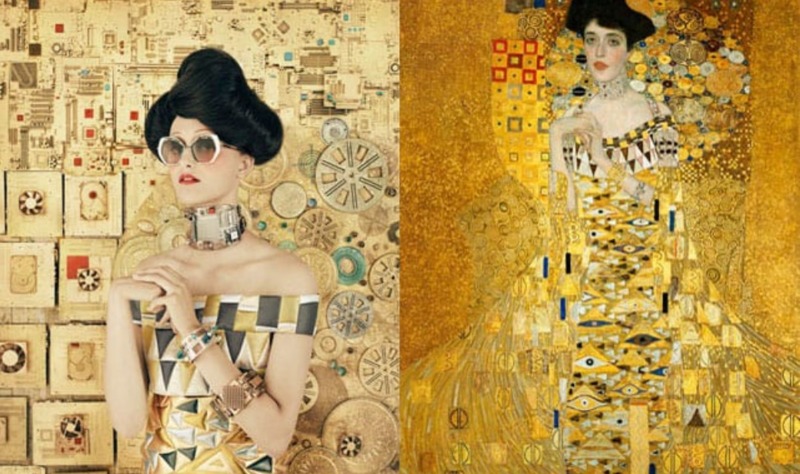
This advertisement is based off symbolist artist Gustav Klimt. One of Klimt’s most famous paintings has been recreated in photography using contemporary models – all featuring eyewear from the brand “Etnia Barcelona.” This ad featuring a famous Barcelonian artist might indicate that Etnia Barcelona is trying to appeal to Latinex culture – that wearing eyeglasses can become an integral part of existing culture. The choice to recreate this particular image can be indicative of “sex sells.” This adaptation features two traditionally “supermodel” attractive women and one naked muscular man. This image is as visually jarring. The photograph recreation is full of contrasts- a culturally familiar panting is paired with outrageous wigs and futuristic glasses.
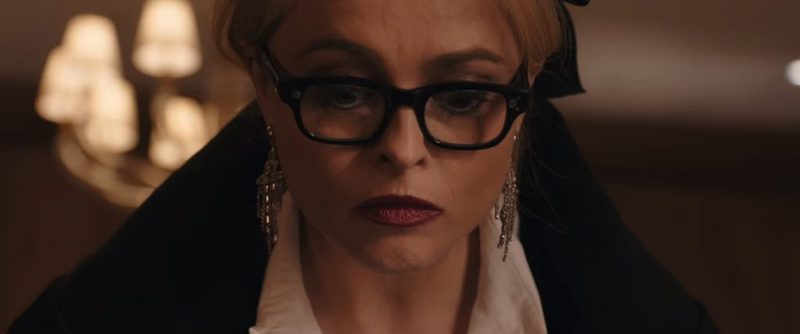
The camera glasses in Ocean’s 8, combined modern ‘smart technology’ with the conventionality of eyeglasses. This ‘high tech’ aspect shown in the movie to help pull off the heist is actually not far off from the future of eyeglasses; tying together electronic technology with corrective glasses is something that is very near in the future with the emergence of Google glasses and things of the like. This particular pair worn by Helena Bonham Carter’s character, Rose Weil, scanned and transmitted the geometric details of the necklace necessary for the execution of the heist. The details were transmitted to the printer’s computing unit to then reproduce an exact replica of the necklace. For cinematic drama, the online connection between the glasses and printer were scattered until a typical technologically driven slap to the device and a change of venue. The glasses and wireless connection, however, are quite realistic and not far fetched by any means. This connection between basic, non-electronic technology to that of tech that is electronically driven is becoming more and more prevalent as other forms of basic technology are getting this connection of ‘smart technology.’ While, the movie does not resemble anything currently on the market, the intent is current as well as the complications driven by this secret tech concealed in ordinary aspects of life. Where we have been and are in the evolution of eyeglasses have been relatively the same in terms of function and fashion, but, where we are going as a society is taking that aspect of function and running wild with it.